

Issues
A large Saudi manufacturing group operating multiple production plants across the Kingdom sought advanced energy efficiency advisory to support its transformation goals under Vision 2030. The client manages facilities in heavy industries, fast-moving consumer goods, and specialized component production, each with varying energy profiles and operational processes. Their leadership team was seeking a structured approach to reduce energy intensity, improve operational consistency, and align facility-level consumption with national sustainability objectives. Although the group had basic monitoring practices, they lacked a holistic, data-driven energy management framework capable of identifying savings opportunities across their diverse asset base.
Solution
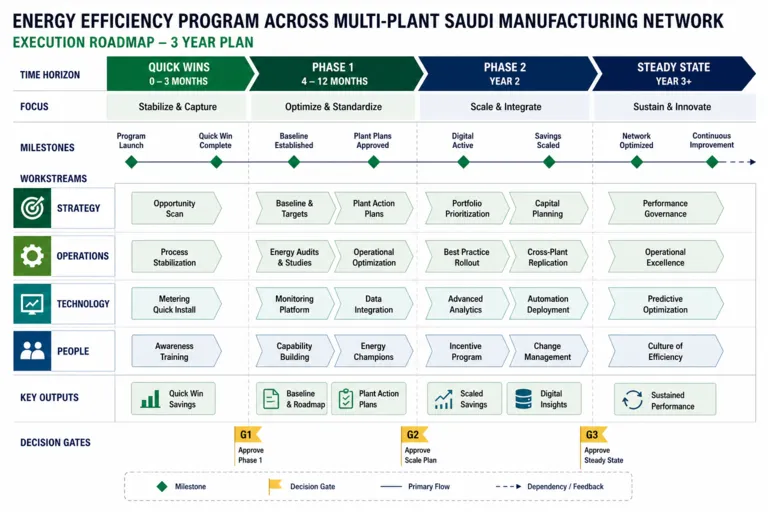
We delivered a comprehensive Energy Efficiency Consulting program focused on building a unified efficiency strategy for all facilities. The solution included installing standardized monitoring protocols, conducting detailed asset-level assessments, and benchmarking each site against optimal performance scenarios. We introduced a structured measurement framework that enabled facilities to track energy intensity per production line, evaluate equipment performance, and identify quick-win opportunities such as retrofitting outdated systems, optimizing thermal processes, and implementing smart controls. We also developed a multi-year investment roadmap covering modernization of motors, compressors, and HVAC systems, paired with a capability-building program for site engineers. This approach empowered the client to transition from reactive improvements to proactive efficiency optimization across all plants.
Approach
- Conducted deep-dive energy audits across all facilities, capturing data on equipment age, operational load, thermal losses, and baseline consumption.
- Benchmarked each plant against Saudi industry standards and global best practices for energy intensity and equipment performance.
- Mapped operational bottlenecks such as excessive idle time, inefficient production scheduling, and heat recovery gaps.
- Introduced digital energy dashboards enabling real-time visibility of consumption patterns and anomaly detection.
- Designed a multi-phase upgrade roadmap prioritizing cost-efficient retrofits, process optimization opportunities, and high-impact modernization investments.
- Delivered training workshops for facility managers on demand-side management, performance tracking, and continuous improvement cycles.
Recommendations
- Implement systematic replacement of legacy equipment with high-efficiency motors, compressors, and thermal systems to achieve long-term savings.
- Adopt standardized operating procedures to regulate production scheduling, reduce equipment idle time, and optimize load distribution.
- Establish a centralized energy management office responsible for monitoring KPIs, coordinating audits, and validating efficiency gains.
- Expand digitalization initiatives by integrating smart meters, predictive analytics, and automated control systems across all sites.
- Launch annual capability-building programs to strengthen workforce expertise in energy optimization techniques and performance tracking.
- Allocate dedicated budgets for phased modernization, ensuring investments align with projected cost savings and operational targets.
Engagement ROI
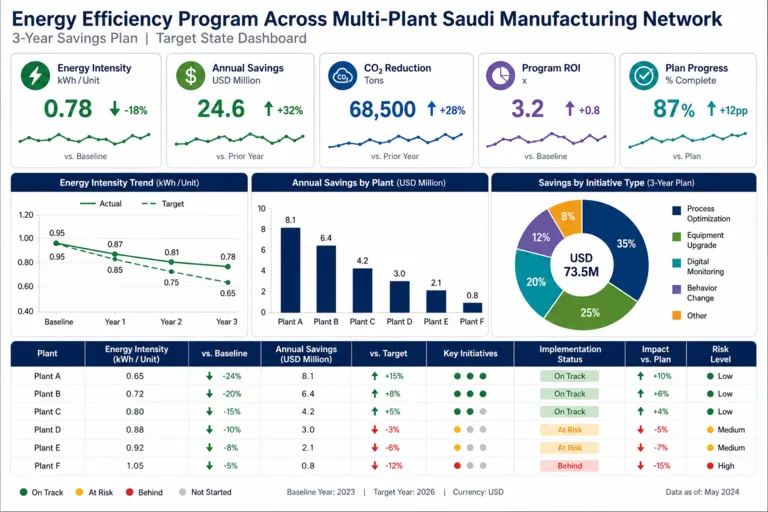
The engagement produced measurable improvements across the client’s facilities. The group achieved a 14–18% reduction in energy consumption within the first year, equivalent to operational savings exceeding SAR 11.2 million. Process optimization reduced equipment idle time by 22%, and modernization of HVAC and thermal systems generated an annual savings potential of SAR 4.8 million. The new monitoring framework enabled early detection of anomalies, preventing approximately SAR 1.3 million in unplanned equipment failures. Over a three-year horizon, projected benefits exceeded SAR 35 million, reflecting both direct reductions in consumption and improved operational reliability across the manufacturing network.
Talk to us for your needs in:
-
Energy Efficiency Strategy & Feasibility
-
Renewable Energy Strategy & Investment Advisory
-
Digital Energy & Smart Grid Strategy
-
Market Entry Strategy
-
Sustainability & Impact Strategy
-
Energy Project Governance & PMO Advisory
-
Energy Market Research
-
Energy Stakeholder & Customer Research
-
Energy Market Intelligence
-
Energy Feasibility & Investment Assessment
-
Energy Sector Benchmarking & Performance Strategy