

Issues
A Saudi industrial conglomerate planning a major expansion of its manufacturing zone sought expert support to design and assess new energy-infrastructure requirements. The expansion included new production lines, warehouse clusters, and utility buildings, requiring robust electrical, thermal, and mechanical systems. Leadership aimed to ensure that the infrastructure design would accommodate long-term growth, meet regulatory standards, and minimize operational risks. The client required a forward-looking energy-infrastructure development strategy aligned with future demand scenarios.
Solution
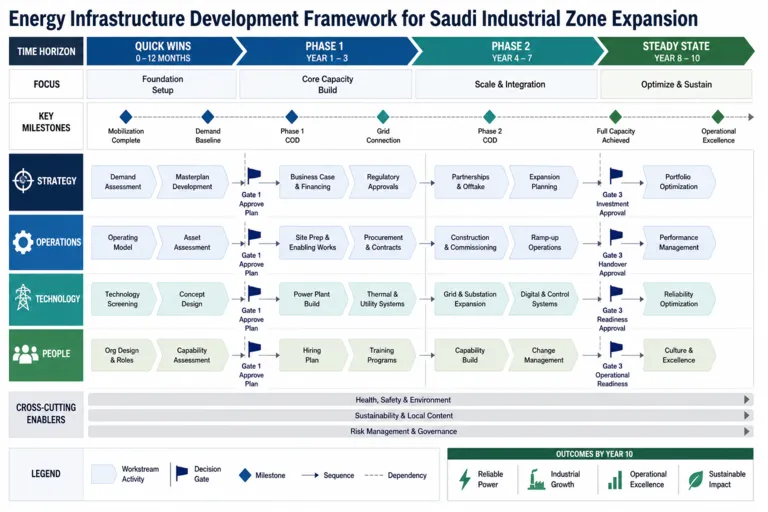
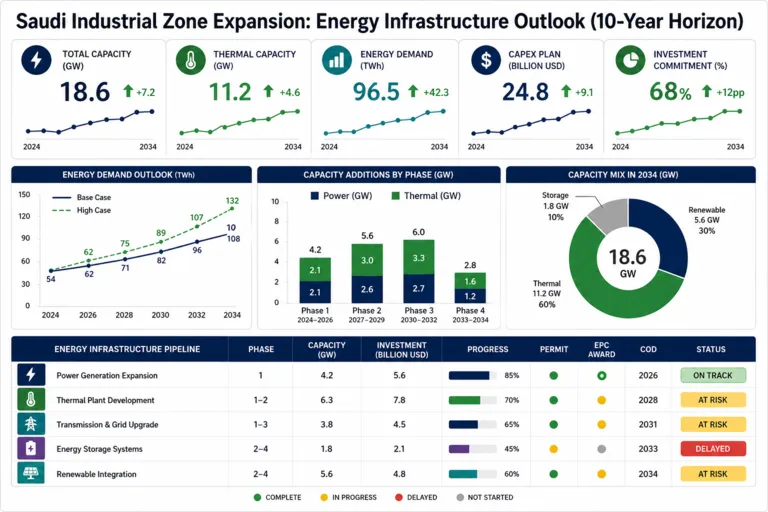
We delivered a comprehensive Energy Infrastructure Development Framework covering electrical, thermal, mechanical, and digital systems. Load-forecasting models were developed using updated production data, climatic factors, and future equipment expansion scenarios. We created detailed designs for substations, distribution networks, and thermal systems, ensuring resilience and regulatory compliance. Infrastructure phasing plans were produced to align with construction milestones, allowing gradual deployment without operational interruptions. The solution positioned the industrial zone for long-term growth supported by reliable, scalable energy infrastructure.
Approach
- Conducted full capacity assessments for electrical, thermal, and mechanical systems.
- Built load-forecasting models reflecting future production, occupancy, and environmental loads.
- Designed infrastructure specifications for substations, distribution networks, and thermal plants.
- Evaluated multiple redundancy strategies to strengthen system resilience.
- Coordinated with engineering teams to align infrastructure designs with construction phasing.
- Conducted regulatory compliance assessments covering safety codes and energy-efficiency requirements.
Recommendations
- Implement phased infrastructure upgrades to maintain operational continuity.
- Adopt modular substation and thermal-plant designs to accommodate future demand increases.
- Strengthen redundancy measures including dual-feed systems and backup generation capabilities.
- Deploy advanced monitoring systems to track equipment performance and prevent failures.
- Use high-efficiency transformers, chillers, and distribution technologies to minimize long-term costs.
- Continue periodic load reviews to ensure infrastructure remains aligned with production growth.
Engagement ROI
The infrastructure strategy prevented potential oversizing costs of SAR 32 million and avoided undersizing-related operational risks estimated at SAR 19 million. Optimized design ensured long-term efficiency, reducing projected operational costs by 12–18% over the next decade. Phased deployment minimized downtime risks, preserving an estimated SAR 11.6 million in production continuity value. Over 10 years, cumulative financial benefits exceeded SAR 150 million, supported by resilient infrastructure and reduced maintenance requirements.
Talk to us for your needs in:
-
Energy Efficiency Strategy & Feasibility
-
Renewable Energy Strategy & Investment Advisory
-
Digital Energy & Smart Grid Strategy
-
Market Entry Strategy
-
Sustainability & Impact Strategy
-
Energy Project Governance & PMO Advisory
-
Energy Market Research
-
Energy Stakeholder & Customer Research
-
Energy Market Intelligence
-
Energy Feasibility & Investment Assessment
-
Energy Sector Benchmarking & Performance Strategy