

Issues
A Saudi renewable energy developer planning utility-scale solar and wind projects required advisory support to design optimal energy-storage solutions. The developer needed to evaluate various storage technologies—including lithium-ion, flow batteries, thermal storage, and hybrid configurations—to stabilize output, reduce intermittency, and ensure grid compliance. Leadership also sought clarity on regulatory requirements, financial feasibility, and long-term maintenance considerations. Their objective was to build reliable, commercially viable storage systems that supported large-scale renewable expansion in line with national energy goals.
Solution
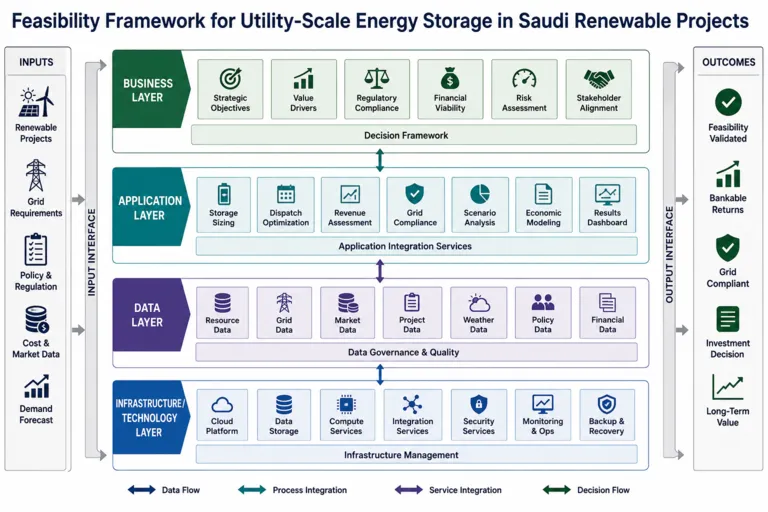
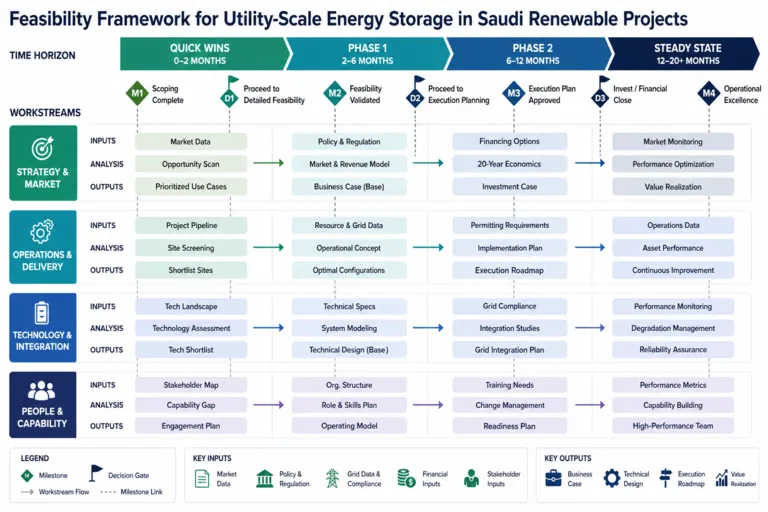
We delivered a Storage Solutions Feasibility and Design Framework covering technical performance, financial modeling, regulatory alignment, and integration with renewable generation assets. The framework evaluated multiple storage technologies under real-world load, temperature, and renewable-output scenarios. Advanced simulations assessed charge–discharge cycles, degradation rates, and thermal dependencies. Financial models included capex, opex, payback periods, and revenue opportunities. The solution also outlined compliance requirements for grid integration, connection codes, and safety protocols. This enabled the developer to confidently select optimal storage technologies and deployment strategies.
Approach
- Conducted technical assessments of lithium-ion, flow-battery, thermal, and hybrid energy-storage technologies.
- Modeled charging patterns using solar and wind output scenarios across different seasons.
- Evaluated temperature impacts on battery degradation and thermal-management requirements.
- Built comprehensive financial models covering lifecycle costs, ROI, and revenue streams.
- Reviewed regulatory frameworks and grid-connection codes relevant to storage deployment.
- Developed system-design recommendations and deployment sequencing for large-scale projects.
Recommendations
- Adopt lithium-ion or hybrid systems for high-frequency cycling and grid-stability services. Use flow batteries for long-duration storage applications and peak shifting. Implement advanced thermal-management systems to ensure performance under Saudi heat conditions. Integrate storage early in project design to optimize grid compatibility and cost efficiency. Establish long-term O&M contracts to ensure storage performance over the asset lifecycle. Explore revenue opportunities through ancillary services, capacity payments, and grid-support functions.
Engagement ROI
The feasibility framework enabled the developer to reduce cost uncertainty by 46%, avoiding potential misinvestments estimated at SAR 29 million. Optimized technology selection improved expected storage lifespan by 17–22%, lowering long-term replacement costs. Financial modeling showed potential annual revenue of SAR 14.8 million through peak shaving and ancillary services participation. Over a 20-year lifecycle, total projected financial benefits exceeded SAR 210 million, driven by improved storage efficiency, reduced degradation, and enhanced integration with renewable assets.
Talk to us for your needs in:
-
Energy Efficiency Strategy & Feasibility
-
Renewable Energy Strategy & Investment Advisory
-
Digital Energy & Smart Grid Strategy
-
Market Entry Strategy
-
Sustainability & Impact Strategy
-
Energy Project Governance & PMO Advisory
-
Energy Market Research
-
Energy Stakeholder & Customer Research
-
Energy Market Intelligence
-
Energy Feasibility & Investment Assessment
-
Energy Sector Benchmarking & Performance Strategy