

Issues
A major Saudi commercial real estate developer planning a new mixed-use district required a detailed feasibility study to assess the viability of integrating advanced energy systems into the development. The district included commercial buildings, retail clusters, hospitality facilities, and residential towers. Leadership aimed to evaluate the feasibility of solar integration, district cooling technology, smart energy systems, and energy-efficient building envelopes. The developer sought a comprehensive technical, financial, and regulatory assessment to ensure the project aligned with long-term sustainability goals and delivered strong commercial returns.
Solution
We conducted a comprehensive Feasibility Study and Assessment evaluating technical performance, financial viability, and regulatory feasibility of multiple energy systems. Load assessments were developed for cooling, lighting, mechanical systems, and peak demand scenarios. We modeled technical performance for district cooling systems, solar PV integration, smart energy dashboards, and advanced HVAC technologies. Financial modeling evaluated capital costs, lifecycle expenses, operational savings, and expected returns under multiple deployment scenarios. The final assessment provided a clear investment roadmap outlining the optimal technology mix for the district.
Approach
- Conducted load modeling for all building types within the mixed-use district.
- Evaluated multiple technology options including district cooling, PV systems, thermal storage, and high-efficiency building materials.
- Analyzed regulatory requirements for energy systems, grid interconnection, and environmental approvals.
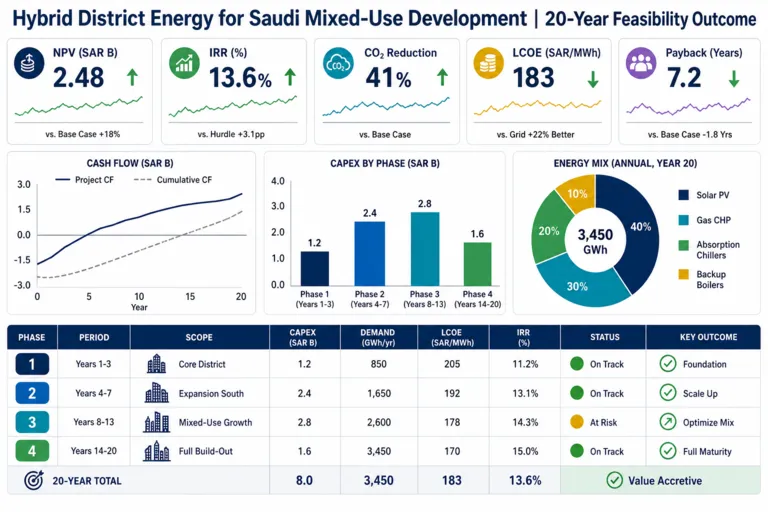
- Built financial models covering payback periods, NPV, and capital investment comparisons.
- Conducted supplier and technology benchmarking to evaluate system compatibility, performance, and reliability.
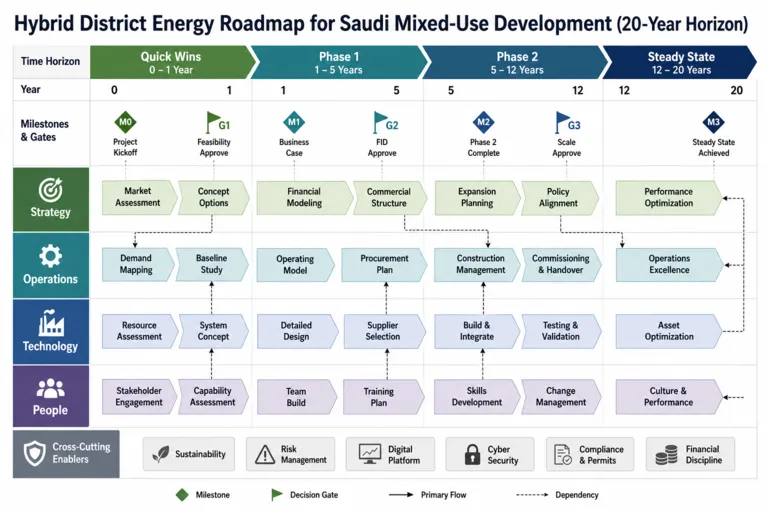
- Prepared a final feasibility report summarizing recommendations, risks, and implementation timelines.
Recommendations
- Adopt a hybrid energy model combining district cooling with rooftop solar systems to maximize operational savings.
- Integrate smart energy-management dashboards across buildings to track consumption in real time.
- Use high-efficiency insulation materials and glazing systems to reduce cooling loads for commercial and residential units.
- Phase implementation to align with construction timelines and reduce upfront investment. Develop strategic partnerships with certified technology providers to ensure quality and long-term performance reliability.
- Continuously monitor energy performance post-development through centralized performance tracking.
Engagement ROI
The feasibility study projected annual savings of SAR 19 million through district cooling and solar integration. Optimized building envelopes reduced cooling demand by 28%, while smart dashboards improved consumption management, enabling 12–15% ongoing operational reductions. Financial modeling indicated a payback period of 6.4 years, with long-term returns exceeding SAR 180 million over a 20-year lifecycle. The study’s insights enabled the developer to secure investor confidence and regulatory approval, accelerating project timelines and strengthening the district’s sustainability positioning.
Talk to us for your needs in:
-
Energy Efficiency Strategy & Feasibility
-
Renewable Energy Strategy & Investment Advisory
-
Digital Energy & Smart Grid Strategy
-
Market Entry Strategy
-
Sustainability & Impact Strategy
-
Energy Project Governance & PMO Advisory
-
Energy Market Research
-
Energy Stakeholder & Customer Research
-
Energy Market Intelligence
-
Energy Feasibility & Investment Assessment
-
Energy Sector Benchmarking & Performance Strategy