

Issues
A Saudi industrial conglomerate with operations in chemicals, manufacturing, logistics, and heavy industries required an in-depth market survey to evaluate energy consumption patterns across its diverse subsidiaries. The client wanted a comprehensive understanding of how energy demand varied by sector, asset type, and production intensity. Leadership sought clear benchmarks to help prioritize modernization investments, reduce energy costs, and strengthen long-term sustainability performance. The goal was to build data-driven insights capturing emerging trends and operational bottlenecks across multiple industrial clusters.
Solution
We conducted a multi-sector energy market survey covering actual consumption, equipment efficiency, operational patterns, and future demand forecasts. The survey combined on-site assessments, digital metering evaluations, workforce interviews, and equipment performance studies. We then created segment-level energy profiles with detailed benchmarks comparing each subsidiary to peer industries. These insights helped identify opportunities for cost savings through retrofits, load balancing, asset upgrades, and optimization of thermal and electrical systems. The consolidated survey results allowed the conglomerate to build a unified energy strategy aligned with both operational efficiency and sustainability goals.
Approach
- Conducted site visits across chemical plants, manufacturing facilities, logistics hubs, and industrial workshops.
- Installed temporary digital meters to track peak loads, idle consumption, and equipment-level performance.
- Analyzed thermal, mechanical, and electrical system efficiency across various asset classes.
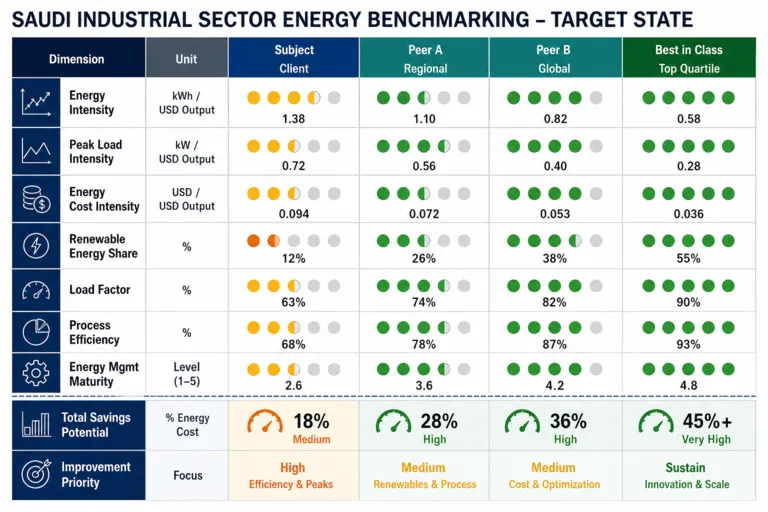
- Benchmarked subsidiaries against local and international industrial energy standards.
- Mapped high-intensity processes such as heating, cooling, material processing, and heavy machinery operations.
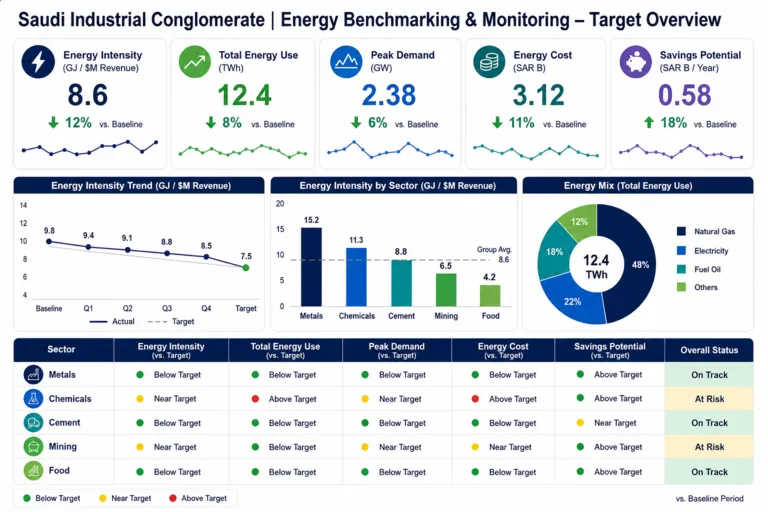
- Consolidated findings into a master dashboard comparing energy profiles, savings potential, and priority investment areas.
Recommendations
- Deploy standardized energy monitoring systems across all subsidiaries to improve data consistency and visibility.
- Prioritize modernization of outdated thermal systems and heavy machinery that showed the highest energy-intensity ratios.
- Implement cross-subsidiary training to harmonize operational best practices and improve resource efficiency.
- Introduce load-management frameworks to reduce peak-hour consumption and improve cost performance.
- Adopt targeted retrofits focusing on compressors, pumps, HVAC systems, and heat-recovery technologies.
- Establish an annual market survey program to maintain updated benchmarks and track improvements in real time.
Engagement ROI
The survey revealed efficiency improvement opportunities generating potential savings of SAR 53 million annually across the conglomerate. Facilities adopting recommended retrofits achieved 15–22% reductions in energy intensity, while peak-load optimization strategies lowered operational costs by SAR 8.7 million within the first year. Benchmarking insights reduced decision-making uncertainty by 41%, enabling the client to prioritize high-return modernization investments. Over a three-year period, cumulative savings projected from optimization exceeded SAR 160 million, strengthening the conglomerate’s competitive position and sustainability performance.
Talk to us for your needs in:
-
Energy Efficiency Strategy & Feasibility
-
Renewable Energy Strategy & Investment Advisory
-
Digital Energy & Smart Grid Strategy
-
Market Entry Strategy
-
Sustainability & Impact Strategy
-
Energy Project Governance & PMO Advisory
-
Energy Market Research
-
Energy Stakeholder & Customer Research
-
Energy Market Intelligence
-
Energy Feasibility & Investment Assessment
-
Energy Sector Benchmarking & Performance Strategy