

Issues
A major Saudi industrial construction operator with projects across the Kingdom sought assistance in integrating renewable energy solutions into its operations. The client manages heavy construction sites, prefabrication yards, and workforce facilities that rely heavily on diesel generators and grid electricity. With national sustainability targets becoming more stringent, the company aimed to adopt renewable energy to reduce operating costs, improve reliability in remote sites, and strengthen its compliance with evolving regulations governing emissions and energy efficiency. The organization wanted a comprehensive strategy that addressed technical feasibility, investment prioritization, and long-term operational models.
Solution
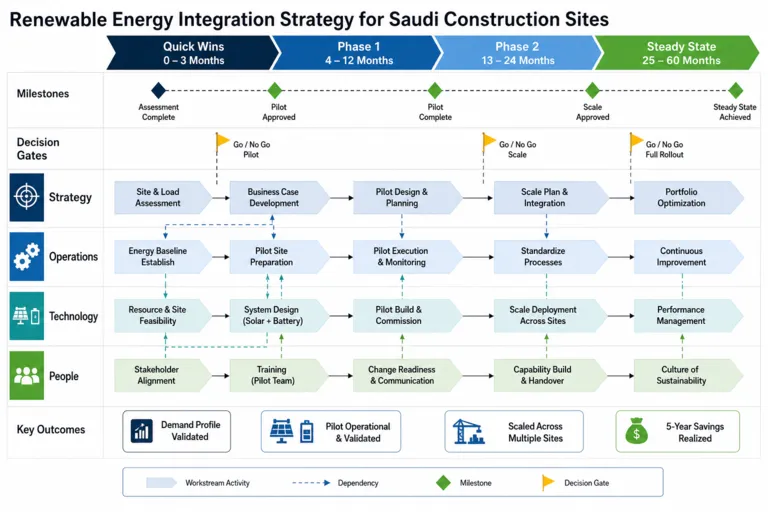
We developed a holistic Renewable Energy Integration Strategy tailored specifically to the client’s operational environment. This included detailed site-level assessments, load profiling, solar irradiation analysis, and modeling of hybrid system architectures combining photovoltaics, energy storage, and generator backup. Our team created an investment roadmap prioritizing conversion of high-demand sites, deployment of modular solar-battery systems, and integration of smart load management technologies. We also established technical standards for all future projects, ensuring consistent design, procurement, and performance monitoring. The solution enabled the client to shift toward cleaner, more reliable, and cost-efficient energy systems across its construction operations.
Approach
- Conducted comprehensive load analysis for each site, segmenting power requirements for machinery, lighting, accommodation units, and operational buildings.
- Modeled renewable energy configurations under multiple scenarios, including PV-only, hybrid PV-diesel, and PV-battery systems.
- Performed geospatial analysis of solar potential using Saudi meteorological data and site-specific conditions.
- Built a financial model assessing capital expenditure, payback periods, OPEX reductions, and long-term ROI for various deployment scenarios.
- Designed procurement and supplier-evaluation guidelines to ensure consistent quality standards for solar, inverter, and storage systems.
- Created operational manuals and performance dashboards to monitor generation, storage capacity, and overall system efficiency.
Recommendations
- Prioritize renewable deployment in remote and high-consumption sites to maximize immediate cost savings and reduce reliance on diesel.
- Implement modular and scalable solar-battery systems that can be redeployed as project locations shift.
- Establish a centralized renewable energy unit responsible for technical validation, supplier selection, and performance benchmarking.
- Adopt predictive maintenance tools to extend the lifespan of solar and battery assets.
- Integrate renewable energy into early project planning rather than late-stage deployment to optimize design efficiency.
- Build internal engineering capabilities through training programs focused on renewable system design, operation, and troubleshooting.
Engagement ROI
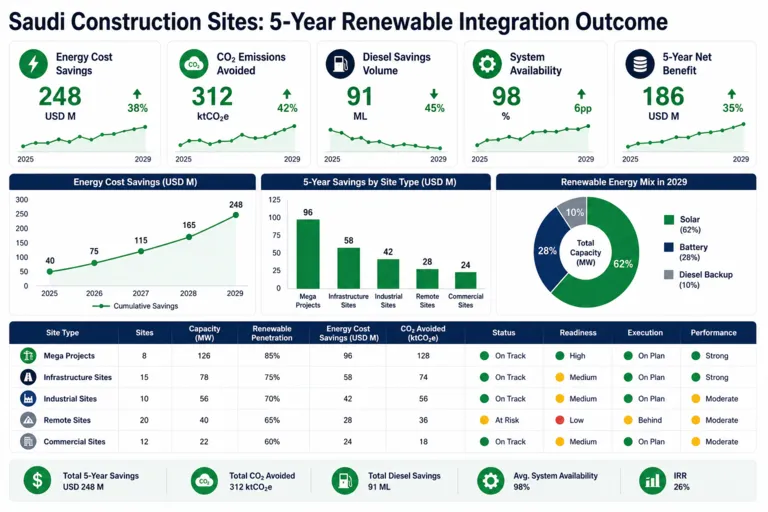
Within the first operational cycle, the client achieved reductions of 28% in diesel consumption, translating into annual savings of SAR 17.5 million. Solar-battery hybrid systems improved energy availability in remote sites by 35%, reducing downtime and accelerating project delivery timelines. The investment roadmap projected cumulative savings of SAR 62 million over five years, while carbon emissions were reduced by approximately 21,000 tons of CO₂ annually. These benefits strengthened the client’s regulatory alignment, improved bidding competitiveness, and positioned the company as a forward-leaning organization committed to sustainable construction practices.
Talk to us for your needs in:
-
Energy Efficiency Strategy & Feasibility
-
Renewable Energy Strategy & Investment Advisory
-
Digital Energy & Smart Grid Strategy
-
Market Entry Strategy
-
Sustainability & Impact Strategy
-
Energy Project Governance & PMO Advisory
-
Energy Market Research
-
Energy Stakeholder & Customer Research
-
Energy Market Intelligence
-
Energy Feasibility & Investment Assessment
-
Energy Sector Benchmarking & Performance Strategy