

Issues
A multi-site Saudi industrial operator specializing in chemicals, metals, and advanced manufacturing engaged our team to design a comprehensive energy benchmarking program. The client managed facilities across several regions, each with different production scales, equipment types, and operational complexities. Leadership recognized the need for a consistent and transparent framework to compare energy performance across sites, identify inefficiencies, and prioritize investment areas. The organization wanted a robust benchmarking system aligned with national energy-efficiency targets and global best practices to strengthen competitiveness and reduce long-term operational costs.
Solution
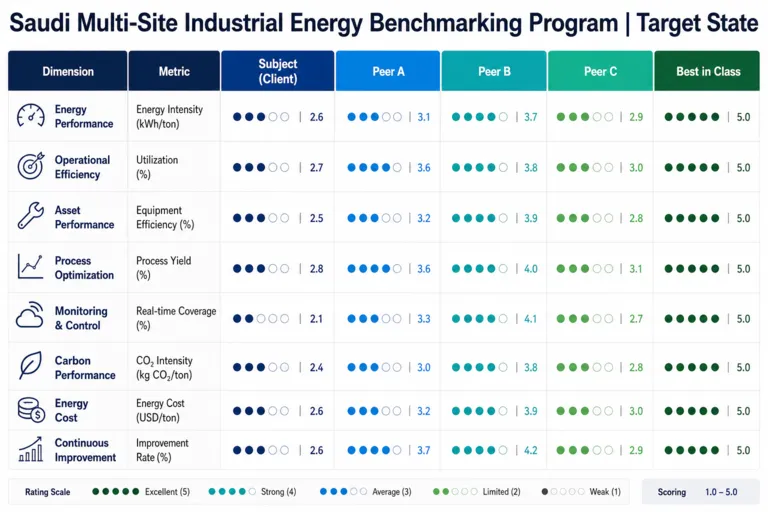
We implemented a Kingdom-wide Energy Benchmarking Program that unified all sites under a single measurement framework. The solution included standardized KPIs, new metering protocols, facility-level performance dashboards, and industry-aligned benchmarking criteria. We conducted asset-level assessments across all facilities, comparing energy intensity, thermal losses, and mechanical system efficiency. Advanced analytics tools were introduced to identify best-performing plants and high-impact improvement opportunities. The program provided leadership with a clear performance baseline and a structured path to accelerate energy-efficiency gains across the entire industrial network.
Approach
- Conducted deep technical assessments across all facilities, capturing baseline consumption and equipment performance.
- Designed unified KPIs reflecting Saudi and global industrial energy standards.
- Benchmark-tested all facilities against peer industries to evaluate relative energy intensity.
- Built a centralized digital dashboard providing real-time benchmarking insights and performance rankings.
- Introduced protocols for continuous monitoring, corrective actions, and improvement tracking.
- Conducted capability-building workshops to train site managers on benchmarking interpretation and optimization.
Recommendations
- Implement minimum performance thresholds for all facilities to drive consistent efficiency improvements.
- Prioritize modernization of low-performing sites based on benchmarking outputs and cost-benefit modeling.
- Deploy advanced metering infrastructure to ensure long-term data accuracy and comparability.
- Establish a governance committee dedicated to benchmarking oversight and cross-site collaboration.
- Conduct annual benchmarking cycles to maintain visibility on emerging inefficiencies.
- Integrate benchmarking results into investment planning, maintenance prioritization, and operational decision-making.
Engagement ROI
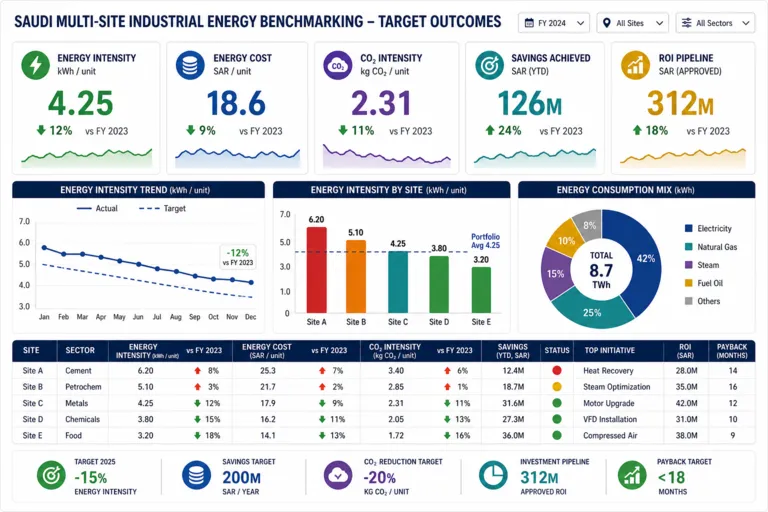
The benchmarking initiative delivered measurable improvements across all facilities. The operator achieved a 7–12% reduction in average energy intensity, generating annual savings of SAR 26.8 million. Modernization of low-performing plants yielded additional projected savings of SAR 14.2 million. Benchmarking transparency improved decision accuracy by 49%, enabling the client to prioritize upgrades with high financial returns. Over three years, cumulative financial benefits are projected to exceed SAR 95 million, supported by operational improvements, targeted retrofits, and stronger consumption governance.
Talk to us for your needs in:
-
Energy Efficiency Strategy & Feasibility
-
Renewable Energy Strategy & Investment Advisory
-
Digital Energy & Smart Grid Strategy
-
Market Entry Strategy
-
Sustainability & Impact Strategy
-
Energy Project Governance & PMO Advisory
-
Energy Market Research
-
Energy Stakeholder & Customer Research
-
Energy Market Intelligence
-
Energy Feasibility & Investment Assessment
-
Energy Sector Benchmarking & Performance Strategy