

Issues
A major Saudi public-sector entity overseeing environmental programs, urban development, and national sustainability initiatives sought expert support to design a comprehensive Green Economy Strategy. The organization aimed to accelerate adoption of low-carbon technologies, improve resource efficiency, and enable sustainable urban development across multiple sectors. Leadership required an integrated roadmap aligning policy, technology, infrastructure, and stakeholder engagement to strengthen national green-economy ambitions.
Solution
We developed a comprehensive Saudi Green Economy Strategy covering mobility, energy, waste, buildings, and circular-economy opportunities. The strategy introduced a unified governance framework, green KPIs, investment screening tools, and sector-specific decarbonization pathways. We conducted environmental and economic impact assessments for low-carbon technologies including electric mobility, renewable energy, water recycling, and waste-to-energy systems. Stakeholder-mapping exercises helped align public and private sectors, enabling joint-impact programs. The roadmap provided scalable initiatives supporting national sustainability transformation.
Approach
- Assessed existing sustainability initiatives, governance structures, and performance outcomes.
- Developed sector-specific decarbonization pathways covering energy, mobility, buildings, and waste.
- Designed green-economy KPIs aligned with national environmental targets.
- Built investment frameworks to assess commercial, environmental, and social impact.
- Conducted stakeholder mapping to identify partnership opportunities.
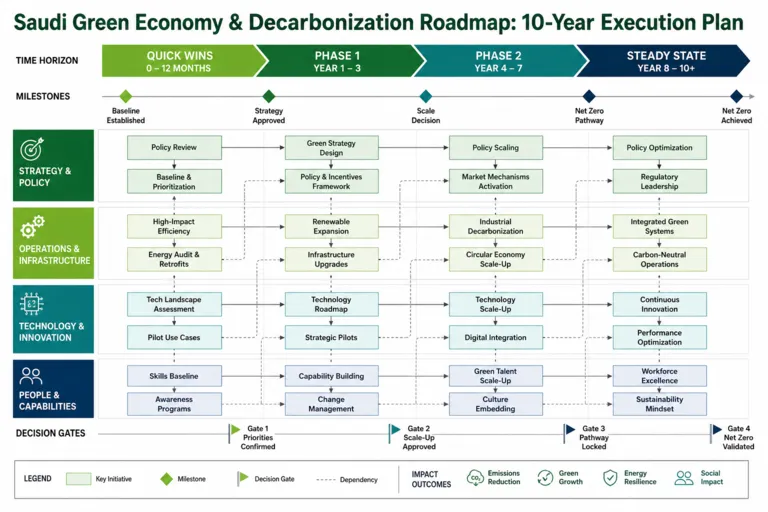
- Prepared a phased implementation roadmap covering policy updates, infrastructure investments, and capability building.
Recommendations
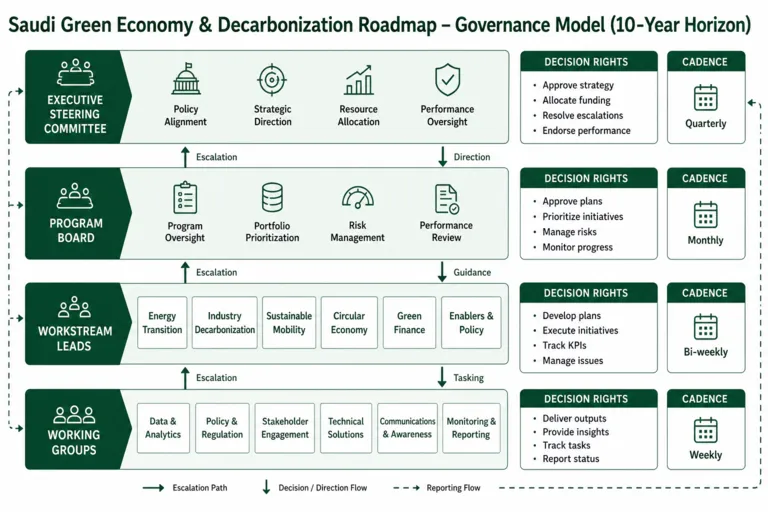
- Establish a centralized green-economy governance council to oversee strategy execution.
- Prioritize investments in electric mobility, energy efficiency, and renewable integration.
- Develop circular-economy hubs to support material reuse, recycling, and waste-to-energy projects.
- Integrate green-economy KPIs into national infrastructure planning and public-sector performance frameworks.
- Launch nationwide awareness programs to strengthen community participation in sustainability initiatives.
- Build long-term partnerships with private-sector innovators to accelerate technology deployment.
Engagement ROI
The Green Economy Strategy projected environmental savings equivalent to 4.3 million tons of CO₂ reductions over 10 years. Operational efficiencies across waste, mobility, and energy programs generated potential savings of SAR 72 million annually. Circular-economy initiatives created new economic value of SAR 180 million by enabling material recovery and lowering landfill dependence. Over a decade, cumulative financial and environmental benefits exceeded SAR 900 million, positioning the entity as a national leader in sustainable development and green innovation.
Talk to us for your needs in:
-
Energy Efficiency Strategy & Feasibility
-
Renewable Energy Strategy & Investment Advisory
-
Digital Energy & Smart Grid Strategy
-
Market Entry Strategy
-
Sustainability & Impact Strategy
-
Energy Project Governance & PMO Advisory
-
Energy Market Research
-
Energy Stakeholder & Customer Research
-
Energy Market Intelligence
-
Energy Feasibility & Investment Assessment
-
Energy Sector Benchmarking & Performance Strategy