

Issues
A large Saudi industrial player operating in metals, chemicals, and heavy manufacturing sought support to evaluate the potential adoption of renewable hydrogen within its operations. Leadership aimed to explore hydrogen as a fuel for high-heat processes, fleet operations, and internal power generation. The client also wanted to understand regulatory incentives, infrastructure requirements, cost outlooks, and technical feasibility. With Saudi Arabia investing heavily in hydrogen, the organization wanted a realistic roadmap aligned with its operational needs and national ambitions.
Solution
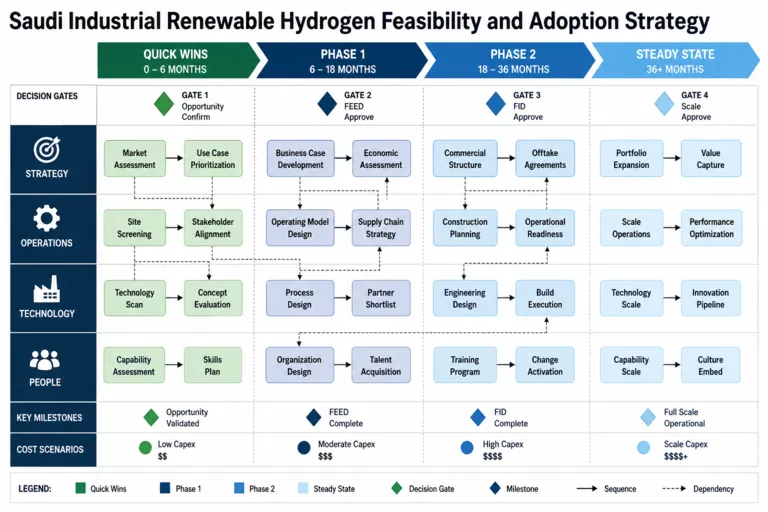
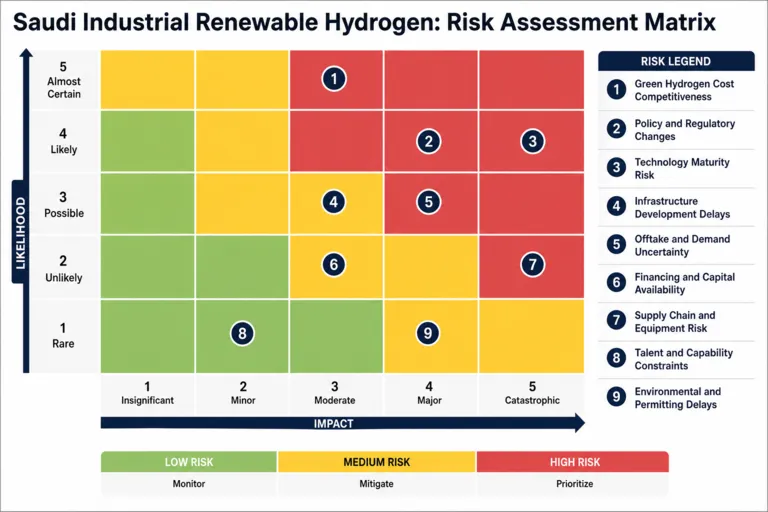
We delivered a Renewable Hydrogen Feasibility and Adoption Strategy evaluating technical, economic, regulatory, and operational dimensions. Hydrogen demand models were created for high-temperature processes, fleet operations, and power consumption. Technical assessments analyzed retrofitting needs, burner compatibility, storage systems, and safety requirements. Cost models projected hydrogen prices under multiple energy-supply scenarios. Infrastructure pathways were outlined for hydrogen supply, transport, and on-site production using electrolysis. The strategy positioned the client to plan hydrogen adoption systematically.
Approach
- Built hydrogen demand forecasts for industrial processes, fleet usage, and on-site generation.
- Conducted engineering compatibility assessments for burners, furnaces, and thermal equipment.
- Modeled hydrogen production costs using solar-powered electrolysis and hybrid supply models.
- Evaluated safety compliance requirements for storage tanks, piping, and handling procedures.
- Assessed regulatory developments and potential incentive frameworks.
- Designed phased adoption pathways with technical and financial milestones.
Recommendations
- Begin hydrogen adoption through pilot-scale blending in select thermal systems.
- Develop an on-site electrolysis pilot using renewable energy supply.
- Establish a hydrogen safety framework covering storage, handling, and emergency response.
- Evaluate long-term fleet conversion to hydrogen fuel cells for heavy transport.
- Collaborate with national hydrogen clusters to secure supply off-take agreements.
- Continuously monitor hydrogen price trends to adjust investment timing.
Engagement ROI
Projected long-term hydrogen integration reduced carbon emissions by 23–29%, strengthening compliance with emerging industrial sustainability regulations. Early hydrogen blending pilots could generate cost savings of SAR 4.2 million annually by improving thermal efficiency. Long-term adoption through on-site electrolysis yielded potential operational savings of SAR 19 million over 10 years, driven by lower energy prices during peak renewable generation. Industrial competitiveness increased significantly as hydrogen-enabled processes improved efficiency and supported high-temperature applications.
Talk to us for your needs in:
-
Energy Efficiency Strategy & Feasibility
-
Renewable Energy Strategy & Investment Advisory
-
Digital Energy & Smart Grid Strategy
-
Market Entry Strategy
-
Sustainability & Impact Strategy
-
Energy Project Governance & PMO Advisory
-
Energy Market Research
-
Energy Stakeholder & Customer Research
-
Energy Market Intelligence
-
Energy Feasibility & Investment Assessment
-
Energy Sector Benchmarking & Performance Strategy