

Issues
A Saudi-based utility operator responsible for electricity distribution across several urban and semi-urban regions sought expert support to modernize its grid operations. The utility handled rapidly expanding demand, driven by population growth, industrial expansion, and increased digital consumption patterns. The existing distribution network was built on legacy systems with limited automation and outdated fault-detection mechanisms. The organization aimed to improve grid resilience, reduce outage duration, and implement smart technologies that support Vision 2030 digitalization targets. They required a coordinated strategy to adopt smart grid technologies, integrate advanced metering systems, and enhance operational visibility.
Solution
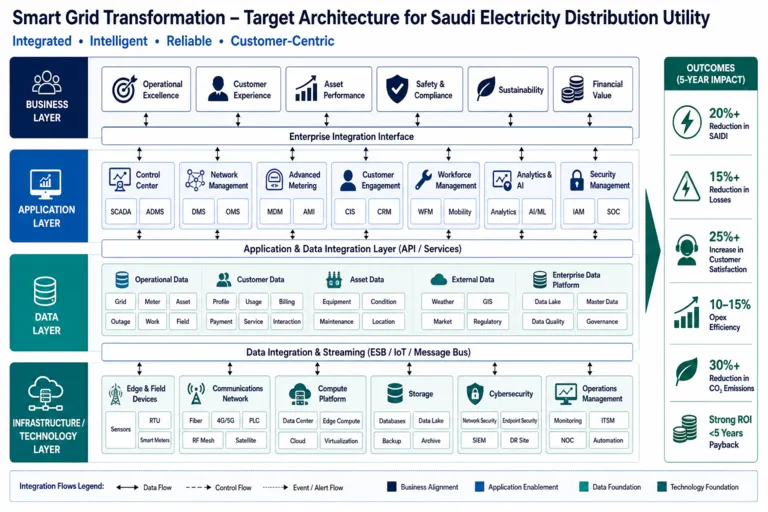
We implemented a Smart Grid Transformation Program centered on upgrading the utility’s distribution management systems. The solution introduced digital substations, advanced metering infrastructure (AMI), automated fault detection technologies, and real-time load management tools. We established a unified control center that integrated SCADA systems, smart meters, weather data, and outage management tools to improve decision-making and enable faster response times. Additionally, we designed a data governance framework to support predictive analytics and long-term capacity planning. This comprehensive modernization allowed the utility to transition toward a more resilient, efficient, and customer-centric grid.
Approach
- Conducted diagnostic assessments of grid assets, metering systems, outage history, and operational workflows.
- Designed a Smart Grid Architecture including AMI, digital substations, and automation layers for distribution management.
- Integrated data from smart meters, sensors, and SCADA systems into a unified platform for real-time analysis.
- Recommended load-balancing mechanisms to reduce pressure on high-demand feeders and improve overall grid stability.
- Introduced predictive maintenance models using asset-health data and environmental factors.
- Delivered extensive training covering grid automation, digital system operation, and emergency response optimization.
Recommendations
- Expand AMI deployment across all serviced regions to create a unified view of consumption, voltage quality, and network performance.
- Shift toward condition-based maintenance supported by analytics rather than time-based maintenance cycles.
- Develop a long-term digitalization roadmap that aligns smart grid advancements with investment cycles.
- Introduce customer-facing digital tools that support real-time consumption tracking and outage notifications.
- Enhance cybersecurity frameworks to protect connected grid assets and sensitive customer data.
- Establish ongoing partnerships with research institutes to pilot emerging smart-grid technologies.
Engagement ROI
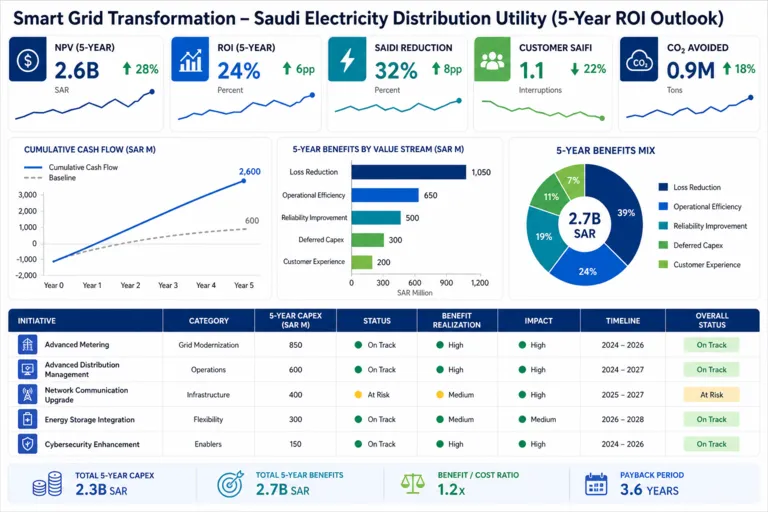
The smart grid initiatives enabled the utility to reduce outage duration by 31%, improve fault-location speed by 43%, and reduce operational costs by SAR 19 million annually. Deployment of AMI improved billing accuracy by 96%, minimizing revenue leakage and enhancing customer satisfaction. Predictive maintenance reduced equipment failure incidents by 22%, extending asset life and reducing emergency repair costs. Over a five-year horizon, overall financial benefits reached SAR 94 million, driven by reduced downtime, improved energy efficiency, and enhanced demand-side management.
Talk to us for your needs in:
-
Energy Efficiency Strategy & Feasibility
-
Renewable Energy Strategy & Investment Advisory
-
Digital Energy & Smart Grid Strategy
-
Market Entry Strategy
-
Sustainability & Impact Strategy
-
Energy Project Governance & PMO Advisory
-
Energy Market Research
-
Energy Stakeholder & Customer Research
-
Energy Market Intelligence
-
Energy Feasibility & Investment Assessment
-
Energy Sector Benchmarking & Performance Strategy