

Issues
A prominent Saudi industrial cluster consisting of multiple manufacturing and processing companies engaged our team to assess their overall sustainability performance and develop a unified improvement strategy. The cluster included energy-intensive industries such as metals, chemicals, and advanced materials, each with distinct environmental impacts and efficiency challenges. With Saudi Arabia’s increasing focus on sustainability, emissions reduction, and resource optimization, the cluster’s leadership sought a data-driven approach to evaluate their current performance and align future developments with national goals.
Solution
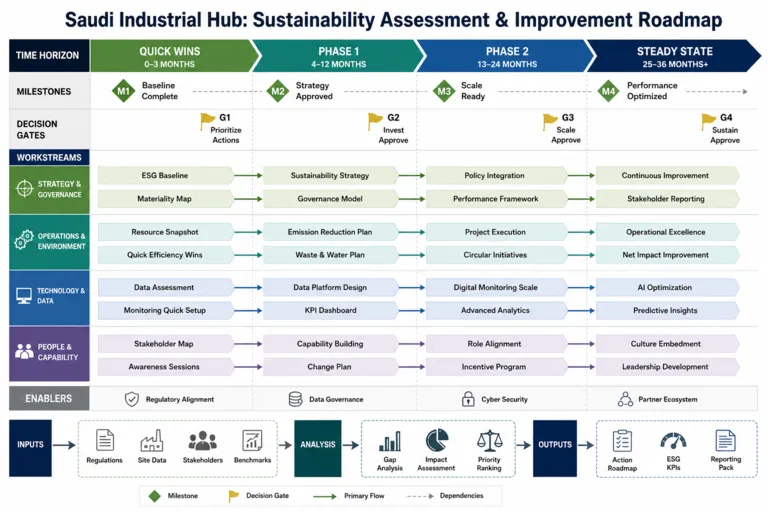
We delivered a comprehensive Sustainability Assessment Program evaluating environmental performance across all tenants within the cluster. This included designing a unified sustainability framework, developing KPIs aligned with national sustainability benchmarks, and conducting environmental audits covering energy use, emissions, water consumption, and waste management. We identified opportunities for cross-industry synergies such as shared utilities, circular-economy practices, and waste-heat recovery initiatives. Our team also created a roadmap for green infrastructure upgrades, digital monitoring systems, and governance improvements. This holistic approach enabled the cluster to adopt a coordinated sustainability strategy rather than fragmented tenant-level initiatives.
Approach
- Performed cluster-wide sustainability audits covering energy intensity, carbon emissions, water use, waste management, and compliance with Saudi environmental regulations.
- Developed a unified KPI framework reflecting Vision 2030 sustainability priorities.
- Benchmarked cluster performance against regional and global industrial sustainability standards. Identified opportunities for shared utilities, joint waste-management systems, and circular-economy strategies.
- Designed digital monitoring and reporting tools to unify environmental data across all tenants.
- Facilitated workshops with tenant companies to build alignment on shared governance practices and sustainability expectations.
Recommendations
- Establish a centralized sustainability office responsible for KPI tracking, reporting, and compliance coordination across all tenants.
- Implement shared services covering waste management, recycling, and water treatment to reduce resource use and operational costs.
- Deploy digital monitoring systems enabling real-time visibility of energy and water consumption trends.
- Adopt green infrastructure solutions such as solar rooftop systems, high-efficiency lighting, and waste-heat recovery. Introduce training programs to strengthen tenant capabilities in sustainability reporting and resource optimization. Encourage adoption of circular-economy practices including material reuse, industrial symbiosis, and shared by-product utilization.
Engagement ROI
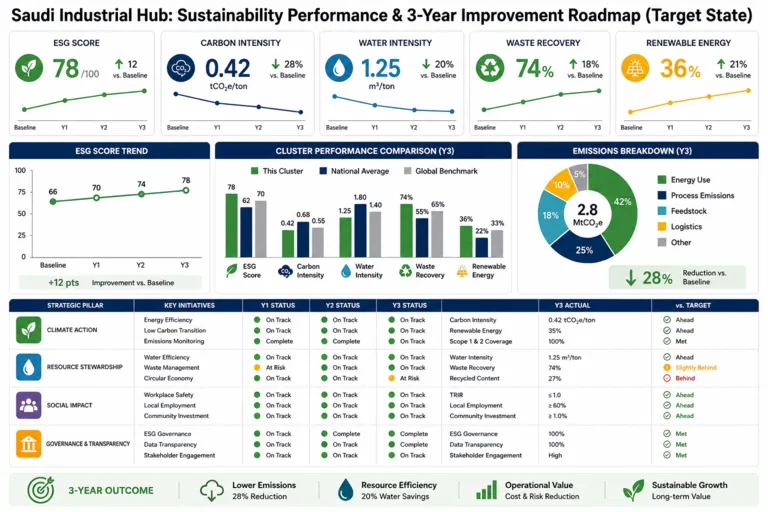
The sustainability program delivered a projected 18–24% reduction in cluster-wide emissions over three years, supported by operational savings of SAR 22.6 million from improved resource efficiency. Shared waste-management systems reduced disposal costs by 31%, while water-optimization initiatives achieved annual savings of SAR 7.4 million. Digital monitoring eliminated reporting discrepancies, improving compliance accuracy by 96%. The cluster’s enhanced sustainability performance strengthened its competitiveness and increased investor interest, with potential long-term economic benefits estimated at SAR 110 million from green-infrastructure investments and efficiency initiatives.
Talk to us for your needs in:
-
Energy Efficiency Strategy & Feasibility
-
Renewable Energy Strategy & Investment Advisory
-
Digital Energy & Smart Grid Strategy
-
Market Entry Strategy
-
Sustainability & Impact Strategy
-
Energy Project Governance & PMO Advisory
-
Energy Market Research
-
Energy Stakeholder & Customer Research
-
Energy Market Intelligence
-
Energy Feasibility & Investment Assessment
-
Energy Sector Benchmarking & Performance Strategy