Saudi Aramco’s 2026 capital allocation story is a balancing act between spending discipline and shareholder distributions. Reuters reported guidance for total dividends of $87.6 billion expected for 2026, and the company has repeatedly declared a base dividend level that anchors that commitment. At the same time, Aramco has emphasized execution of “priority projects” and operational improvements, including AI. This push-pull is central to investor debate about Aramco’s capex and dividend approach in 2026, because both sides of the equation are large and highly visible in quarterly disclosures.
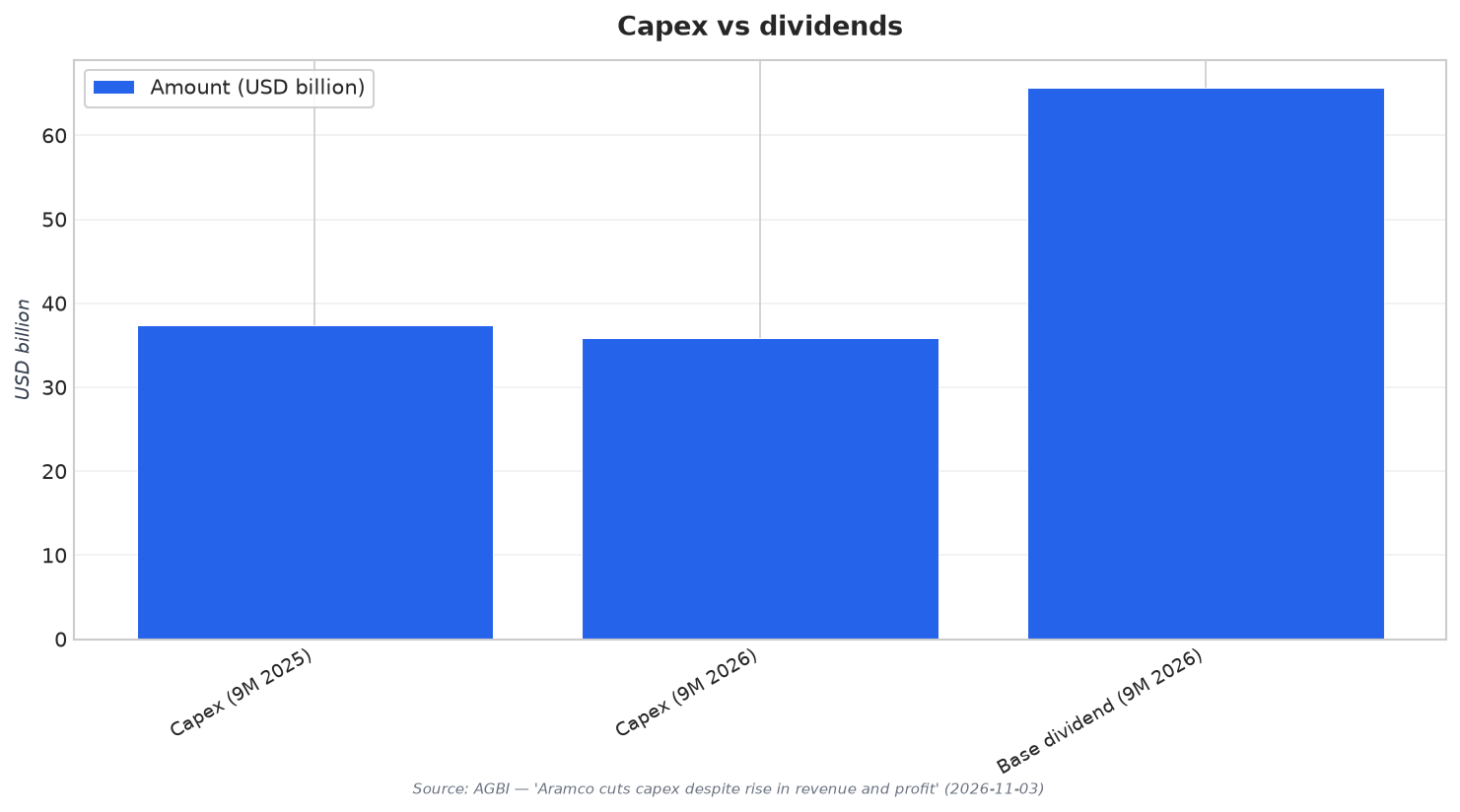
The dividend side is defined by scale and repetition. Aramco’s own release on its second quarter and half-year 2026 results said the board declared a Q2 2026 base dividend of $21.9 billion, to be paid in the third quarter. AGBI also reported a base dividend of $21.9 billion for the third quarter, up 3.5% year on year, and said total base dividend reached $65.7 billion in the first nine months. In the first quarter of 2026, Vision2030.ai cited Aramco’s own numbers showing $18.6 billion of free cash flow and a declared $21.9 billion base dividend, framing the gap investors watch most closely.
Capex Trends and Free Cash Flow: The Other Half of the Equation
On the spending side, AGBI reported that capex fell to $35.8 billion in the first nine months of 2026, from $37.4 billion a year earlier. The same report said Aramco’s free cash flow (net cash from operating activities less capex) stood at more than $28 billion by the end of September 2026, a 20% year-on-year increase. Earlier in the year, Aramco reported Q2 2026 free cash flow of $12.3 billion and first-half free cash flow of $30.9 billion, noting Q2 was impacted by a $13.6 billion working capital build. Together, these figures show how cash generation can move even when capex is being trimmed.
Where cash flow does not fully cover distributions, Aramco has more than one lever. Vision2030.ai described an asset-monetisation programme with $38.9 billion banked from three completed midstream transactions since 2021, and “up to $46.5 billion more in play” from at least five additional transactions reported to be in preparation as of July 2026. The same analysis explicitly set those totals against the $87.6 billion of dividends guided for 2026, arguing the arithmetic helps explain why asset sales and borrowing matter when free cash flow and shareholder payouts run close. It also noted that in full-year 2025 Aramco generated $85.4 billion of free cash flow against $85.5 billion of shareholder distributions.
Aramco also widened its definition of shareholder return in 2026. Truescho reported that the company announced its first share buyback in its history, up to $3.0 billion over 18 months, alongside full-year 2025 results on March 10, 2026. Reuters likewise reported the buyback program would run over the next 18 months. For investors, this sits next to yield math that changes with price: Truescho calculated a forward dividend yield of about 5.3% at a close of SAR 25.74 on October 8, 2026, based on SAR 1.36 in expected annual dividends per share. In short, the 2026 debate is not only about capex versus dividends, but about how multiple payout tools, asset sales, and cash flow timing fit together.
How is Aramco balancing capex and dividends in 2026?
What were Aramco’s reported base dividend amounts in 2026?
What does the data say about free cash flow coverage of dividends?
How do asset sales factor into funding shareholder returns?
What new shareholder return tool did Aramco add in 2026 alongside the dividend?
Talk to us for your needs in:
-
Energy Efficiency Strategy & Feasibility
-
Renewable Energy Strategy & Investment Advisory
-
Digital Energy & Smart Grid Strategy
-
Market Entry Strategy
-
Sustainability & Impact Strategy
-
Energy Project Governance & PMO Advisory
-
Energy Market Research
-
Energy Stakeholder & Customer Research
-
Energy Market Intelligence
-
Energy Feasibility & Investment Assessment
-
Energy Sector Benchmarking & Performance Strategy