The National Shipping Company of Saudi Arabia (Bahri) is positioned as a national shipping asset with direct relevance to crude export logistics. It was established in 1978 and listed on the Saudi stock exchange in 1993. Its shareholders include Saudi Arabia’s Public Investment Fund (PIF) with approximately 22.55% and Saudi Aramco with approximately 20%, with the remaining shares publicly traded. Bahri’s role is practical, not abstract: it carries crude oil and other cargoes to markets worldwide, combining end-to-end shipping, supply chain solutions, and integrated maritime services that support Saudi Arabia’s broader energy ecosystem.
Fleet scale is the foundation of how Bahri secures liftings when global tanker conditions tighten. Bahri Ship Management says it currently manages 95 vessels, including 42 VLCCs, 38 chemical and product tankers, six multi-purpose vessels, and nine dry bulk carriers. The same disclosures indicate an owned fleet of just over 100 vessels, suggesting recent additions. Other reporting points to further growth: by the end of June 2026, Bahri’s owned fleet was described as a record 107 vessels after it acquired five IMO II MR chemical tankers and sold an older VLCC. This breadth gives Bahri multiple tools for export logistics, but crude transportation remains central.
Why VLCC Control Matters When Routes and Rates Shift
Bahri’s VLCC footprint is repeatedly described as large enough to influence how Saudi crude moves under stress. By the first quarter of 2026, Bahri reportedly controlled around 50 VLCCs, six more than a year earlier, equivalent to approximately 5% of the global VLCC fleet. In the same period, it was described as carrying crude sold by Saudi Aramco on delivered terms and providing the shipping capacity required to move those cargoes to customers worldwide. Market disruptions can compress available tonnage quickly. Reporting on a Strait of Hormuz crisis described how fewer tankers were readily available in the Arabian Gulf, while longer voyages and complex positioning absorbed effective capacity and pushed VLCC freight rates higher.
When the market is tight, Bahri can supplement its own tonnage with spot and chartered-in capacity to keep volumes moving. In May 2026, it provisionally hired at least five VLCCs for Middle East-to-Asia movements, at costs approaching $200,000 per day for a VLCC capable of hauling up to two million barrels. The same coverage said benchmark freight rates on the Middle East-to-China route had more than tripled so far that year, reaching levels not seen since 2020. Separate reporting also stated Bahri increased its use of chartered-in tankers to meet growing customer demand and maintain the flow of Saudi crude exports, improving its ability to respond to shifts in Saudi export routes.
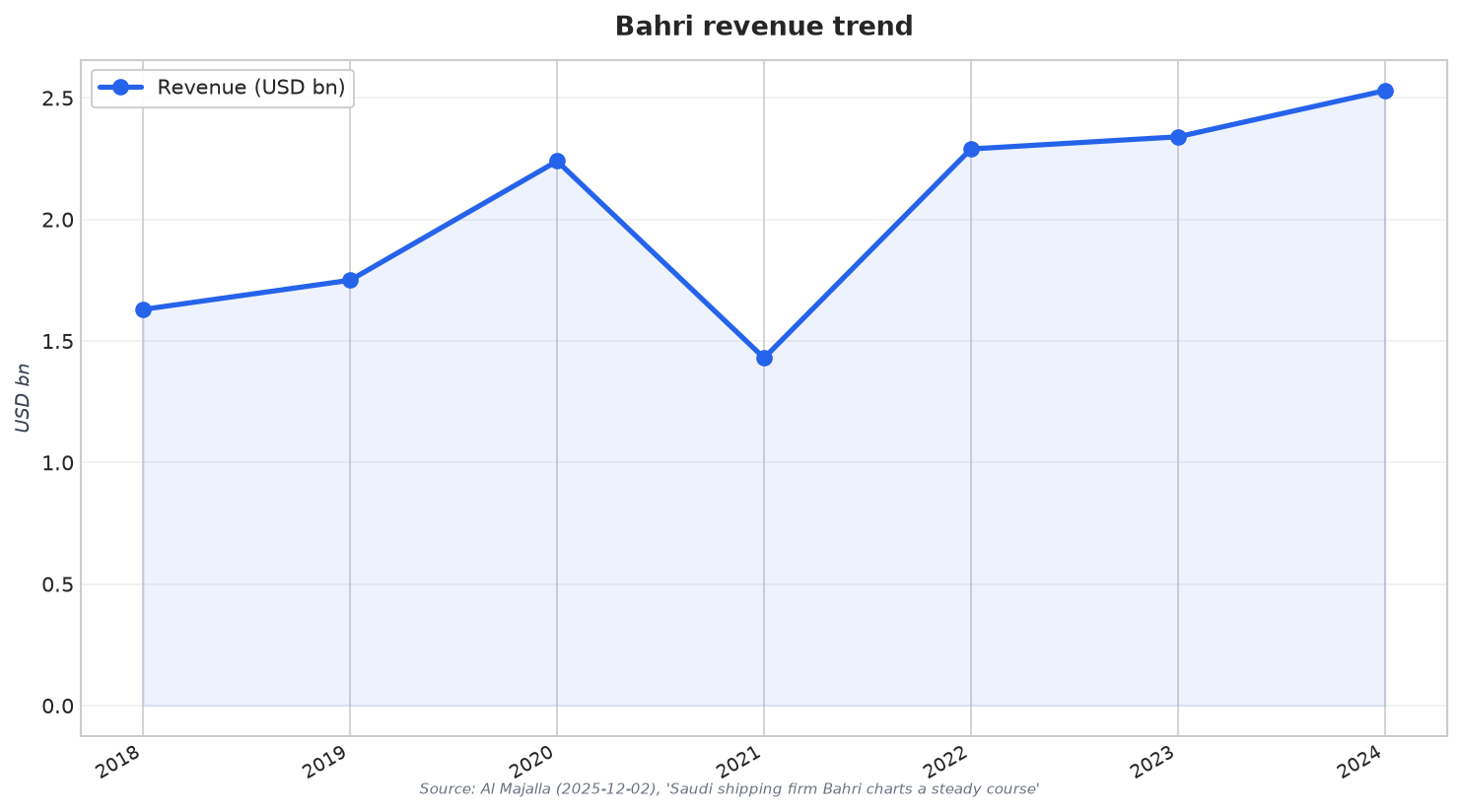
The bahri tanker fleet VLCC story is also about investing through cycles, not only reacting to them. Bahri’s revenues show volatility aligned with tanker-market swings: $1.63bn in 2018, $1.75bn in 2019, $2.24bn in 2020, $1.43bn in 2021, $2.29bn in 2022, $2.34bn in 2023, and $2.53bn last year, described as a historical high. Against a global backdrop where AGBI cited 928 VLCCs in the global fleet and about 200 under sanctions and unavailable to mainstream operators, Bahri ordered three new VLCCs from International Maritime Industries (IMI). The order was framed as strengthening capacity amid sanctions and geopolitical tension that constrain available tankers for mainstream trade.
How does Bahri’s VLCC fleet support Saudi crude export logistics?
How many vessels and VLCCs does Bahri manage?
What did reports say about Bahri’s VLCC control in 2026?
Why did Bahri charter in additional VLCCs during 2026?
What are the key ownership stakes linked to Bahri?
Talk to us for your needs in:
-
Energy Efficiency Strategy & Feasibility
-
Renewable Energy Strategy & Investment Advisory
-
Digital Energy & Smart Grid Strategy
-
Market Entry Strategy
-
Sustainability & Impact Strategy
-
Energy Project Governance & PMO Advisory
-
Energy Market Research
-
Energy Stakeholder & Customer Research
-
Energy Market Intelligence
-
Energy Feasibility & Investment Assessment
-
Energy Sector Benchmarking & Performance Strategy