Saudi Aramco’s In-Kingdom Total Value Add (IKTVA) program is built to maximize the economic impact of Aramco procurement inside Saudi Arabia. It launched in December 2015 and was operationalized through 2016, using a supplier scorecard that influences procurement decisions, contract awards, and commercial terms. Aramco confirmed in February 2026 that IKTVA crossed its founding 70% local content target, and it announced an intention to reach 75% local content in goods and services procurement by 2030. The size of the buying engine matters too: Aramco’s annual procurement budget exceeds USD 30 billion across materials, equipment, services, and logistics.
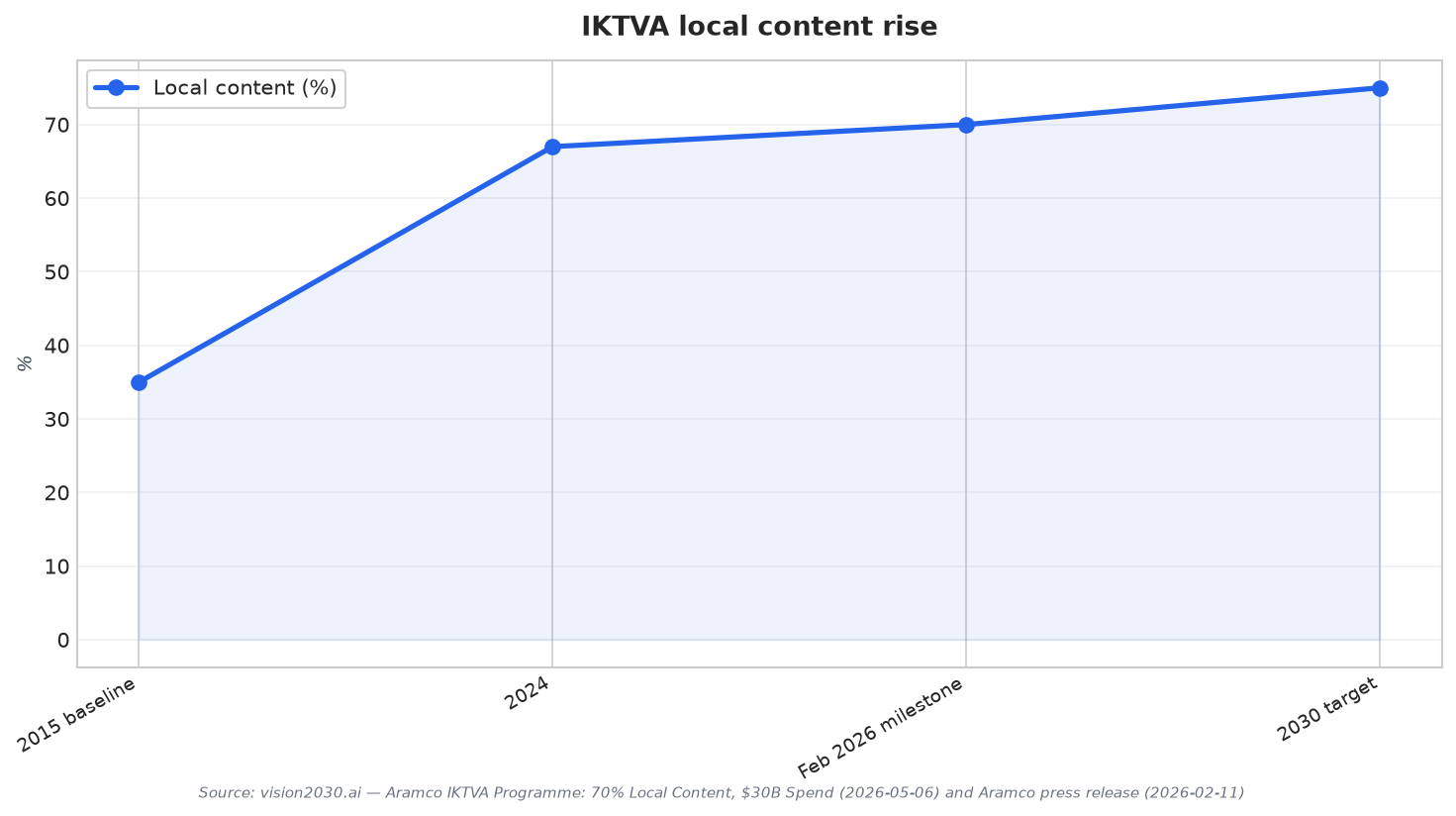
For teams working on an IKTVA strategy, the baseline and progress trend provide context for how quickly expectations can rise. One source describes a 2015 baseline of roughly 35% local content, climbing to 67% in 2024, before crossing 70% in early 2026. Over the period, IKTVA is linked to industrial expansion and labor outcomes inside the Kingdom, including approximately 350 new local manufacturing facilities and more than 200,000 direct and indirect jobs. Aramco also states that, since inception, IKTVA has added more than USD 280 billion to Saudi Arabia’s GDP and attracted USD 9 billion of inward investment.
How the IKTVA Scorecard Works—and What Suppliers Can Control
Energy suppliers aiming to raise their IKTVA standing should start with the mechanics of the score. One description says Aramco calculates an IKTVA percentage as the sum of five factors: localized goods and services, salaries paid to Saudis, training and development of Saudis, supplier development spending, and research and development. The same source stresses that the result is not a self-reported estimate: the data must be certified by one of Aramco’s approved audit firms before it counts. Operationally, suppliers complete an IKTVA survey to establish a baseline, obtain certification, and submit the certified documents so Aramco can calculate a starting score.
Execution is structured, not ad hoc. The supplier process described includes a five-year IKTVA plan for every registered supplier, mapping out specific and measurable moves toward a higher score. That planning discipline matters because IKTVA is a tender criterion: Aramco factors scores into vendor selection, so otherwise comparable bids can land differently once local content is weighed in. The program’s sector coverage also signals where investments may connect directly to demand, spanning chemicals, lubricants, steel, valves, pumps, drilling consumables, electrical components, engineering and project management, IT and digital services, logistics, transportation, and research-intensive items such as composite materials, specialty cables, and downhole electronics.
Suppliers can also use Aramco’s published opportunity framing to prioritize localization roadmaps. Aramco states it has identified more than 200 localization opportunities across 12 key sectors, representing an annual market size of USD 28 billion. In parallel, Aramco ran eight regional supplier forums worldwide in 2025, alongside its flagship biennial forum, to support engagement and momentum. For iktva program energy suppliers, the throughline is clear: build Saudi-based manufacturing and services capacity, expand Saudi employment and training, invest in supplier development and R&D, and document it through certified reporting that directly strengthens the IKTVA score used in procurement decisions.
What local content milestone did Aramco’s IKTVA program reach in 2026?
How is an IKTVA score calculated for suppliers?
What is required to become an IKTVA-registered supplier?
How big is the localization opportunity pipeline Aramco describes?
How can IKTVA-focused energy suppliers improve bid competitiveness?
Talk to us for your needs in:
-
Energy Efficiency Strategy & Feasibility
-
Renewable Energy Strategy & Investment Advisory
-
Digital Energy & Smart Grid Strategy
-
Market Entry Strategy
-
Sustainability & Impact Strategy
-
Energy Project Governance & PMO Advisory
-
Energy Market Research
-
Energy Stakeholder & Customer Research
-
Energy Market Intelligence
-
Energy Feasibility & Investment Assessment
-
Energy Sector Benchmarking & Performance Strategy