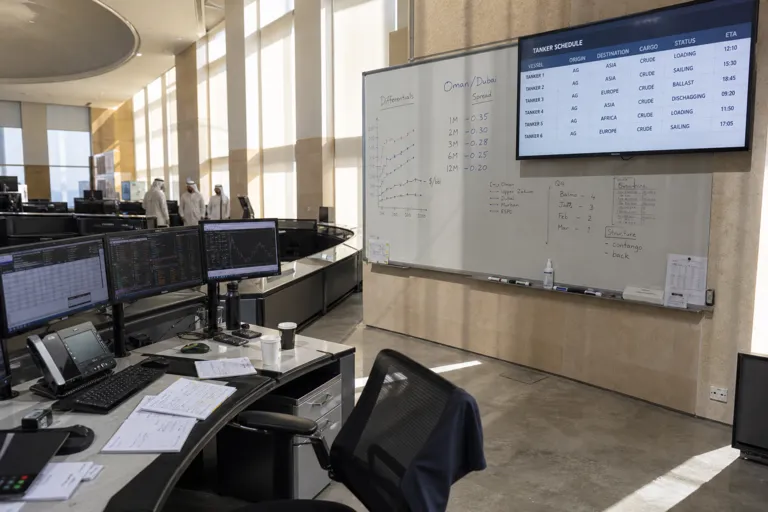
Saudi Aramco’s official selling price in Asia is not quoted as a flat price. It is published as a monthly differential to a reference benchmark, and for Asia that reference is the Oman/Dubai average. That structure is why OSP announcements can move market psychology quickly. A change in the differential rewires the relationship between Saudi barrels and the benchmark that keeps floating after the OSP is set. In early July 2026, Aramco set Arab Light for August loading at a $1.50 per barrel discount to the Oman/Dubai average, versus a $9.50 premium for July. That is an $11.00 swing in one pricing cycle, and Reuters records described it as the biggest single-month move going back to 2003. The same move also marked the lowest Arab Light differential to Asia since June 2020.
That headline swing matters because it is easy to misread. A move from +$9.50 to -$1.50 does not mean the absolute crude price fell by $1.50. It means the formula-based adjustment changed by $11.00 relative to the Oman/Dubai benchmark. The gap versus expectations amplified the signal. A Reuters survey of refiners and traders in late June pointed to a smaller adjustment: a cut of $6.50 to $8.00, implying an August premium of $1.50 to $3.00. The published outcome overshot the top of that range by three dollars. This is the core reason OSP decisions can jolt crude markets: they arrive as a definitive number into a world of probabilistic forecasts, and they reshape term-contract economics for the next month’s liftings.
Why a Single OSP Print Can Reprice Sentiment Across Crude
OSP prints also get interpreted as strategy, even when the evidence is mixed. In 2026, the sequence was dramatic. Arab Light to Asia hit +$19.50 per barrel over Oman/Dubai for May loading, described as the highest official selling price in Aramco’s history and more than double a previous wartime record of +$9.35. It then fell in three consecutive monthly cuts: June was cut $4.00, July $6.00, and August $11.00. The August cut was set on 6 July 2026, before later Red Sea security escalations cited in reporting, so it was not a reaction to those events. Aramco also cut every Arab grade in every region by identical amounts in that cycle—$11.00 in Asia, $15.00 in Northwest Europe, and $8.00 in North America—consistent with a broad regional repricing rather than a grade-by-grade demand call.
Because Asia is central to the flow, the differential carries extra weight. One report said Asia takes about 80% of Aramco’s oil, so a large Asia adjustment gets read as a market-share move. But OSP is not a guaranteed volume lever. Refiners still need to nominate and schedule liftings for the new differential to translate into barrels. The term-contract focus is why the decision can change procurement planning under time pressure: OSPs are typically released in the first week of each month for the following month’s liftings. In this context, May’s +$19.50 premium and August’s -$1.50 discount show how quickly the economics can flip, even though the benchmark itself continues to float afterward.
Later in 2026, the regional split itself became part of the market message. On 5 October 2026, Aramco set its November OSP for Arab Light to Asian buyers at minus $5 per barrel against the Dubai/Oman average, described as roughly ten dollars below what traders surveyed by Reuters had expected and the deepest Asia discount since June 2020. In the same announcement cycle, Europe was raised by $3, creating an eight-dollar divergence in a single month’s OSP movements that was described as having no precedent in available Aramco pricing records. Reporting tied that split to physical constraints and corridor risk, noting the East-West Petroline was running at less than half capacity following September drone strikes on three pumping stations. For crude markets, that is the lesson: OSP decisions can compress multiple signals—benchmark dynamics, expectations, logistics, and risk—into one number that traders must immediately price into their assumptions.
How does Aramco’s official selling price for Asia actually work?
What happened to Arab Light’s Asia differential in the August 2026 OSP decision?
Did the August 2026 OSP cut match market expectations?
How did November 2026 pricing show a new signal to crude markets?
Why do OSP announcements move crude markets even though they are only differentials?
Talk to us for your needs in:
-
Energy Efficiency Strategy & Feasibility
-
Renewable Energy Strategy & Investment Advisory
-
Digital Energy & Smart Grid Strategy
-
Market Entry Strategy
-
Sustainability & Impact Strategy
-
Energy Project Governance & PMO Advisory
-
Energy Market Research
-
Energy Stakeholder & Customer Research
-
Energy Market Intelligence
-
Energy Feasibility & Investment Assessment
-
Energy Sector Benchmarking & Performance Strategy