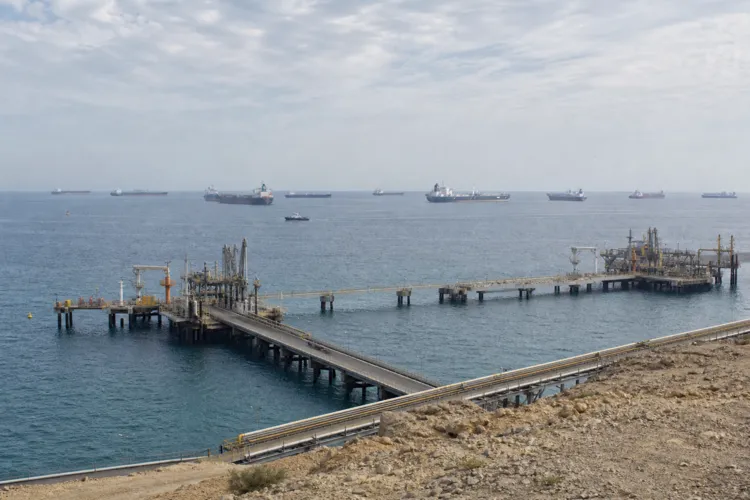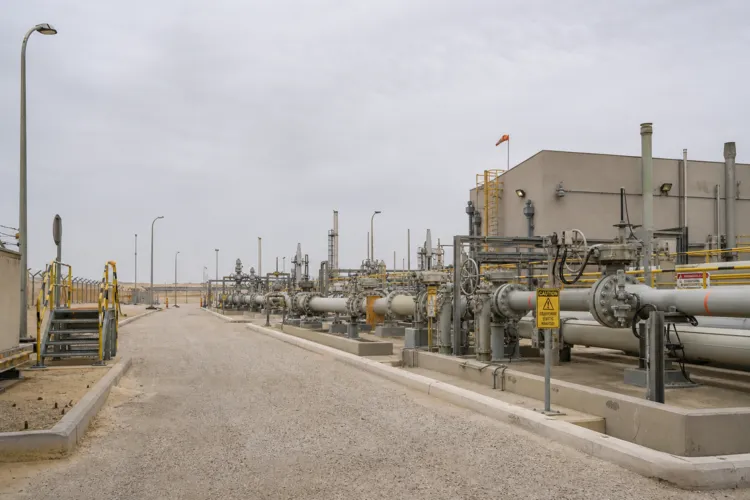
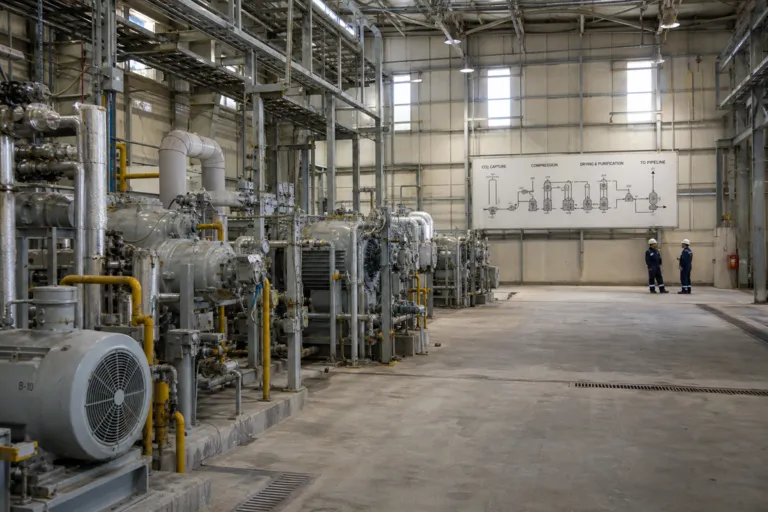
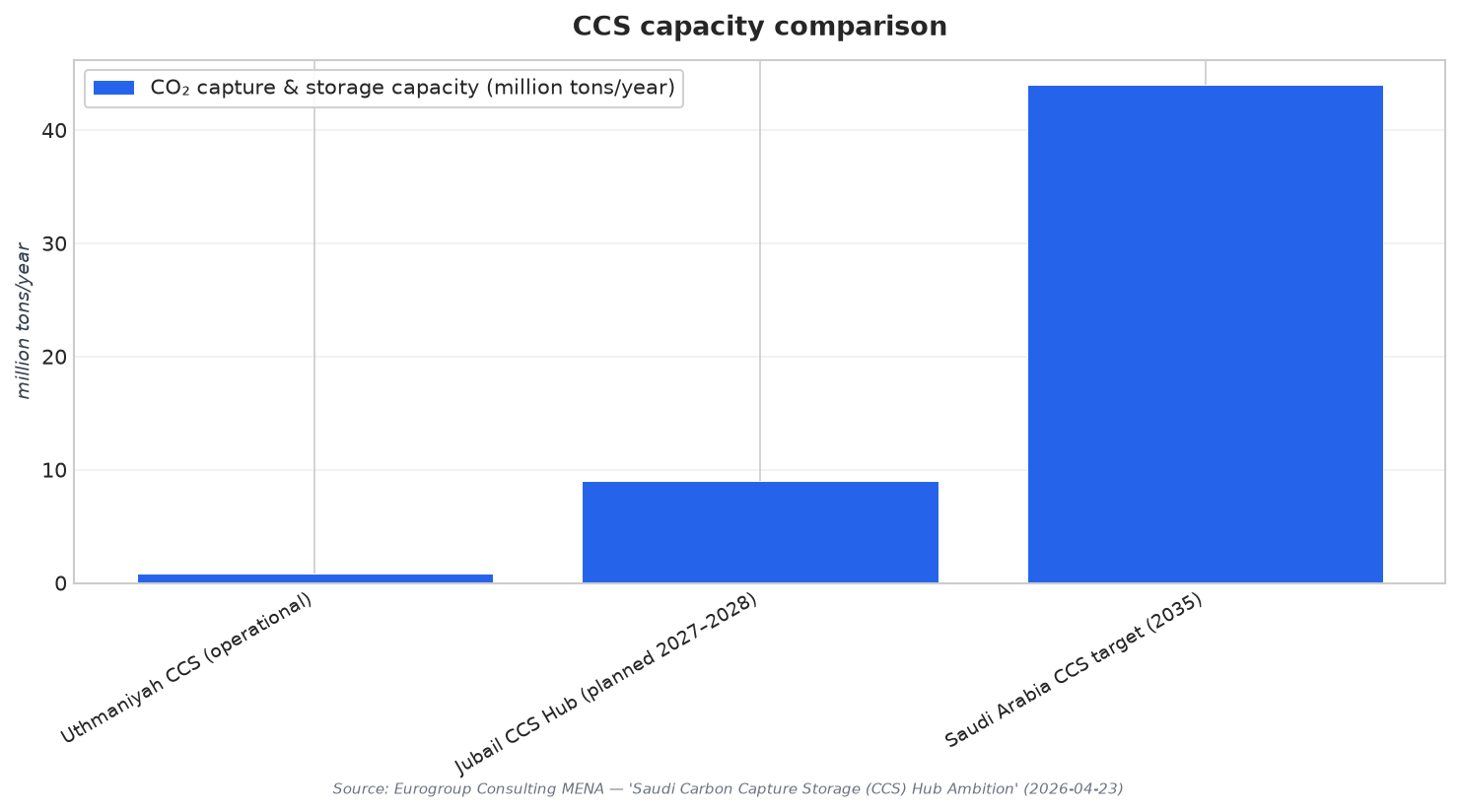
Saudi Arabia is building out carbon capture and storage at a scale framed by a national target: capturing and storing 44 million tons of CO₂ per year by 2035, according to sources describing Ministry of Energy plans. Within that push, the Jubail Carbon Capture and Storage hub is repeatedly cited as the flagship effort. It is described as shared infrastructure intended to let multiple industries connect to centralized CO₂ handling and permanent storage. In that context, the project is positioned as more than a single facility. It is presented as an anchor for broader industrial decarbonization and future networks that can expand beyond one emitter.
Multiple sources state the Jubail hub is expected to store up to 9 million tons of CO₂ annually, with completion or targeted operation described for 2027–2028. The same sources add a comparison: this annual amount is described as equivalent to removing nearly 2 million passenger cars from the road every year. Another description frames Aramco’s strategic shift in 2025 away from smaller CCUS projects linked to enhanced oil recovery and toward large-scale industrial decarbonization hubs, with Jubail at the center. This reframes the project as a scale-up play, as well as a change in the purpose and structure of deployment.
What Makes Jubail a Hub, Not Just a CCS Site
Sources describe a hub-and-spoke model that concentrates capture, conditioning, transport, and storage services so that several industrial players can plug in. One market-trends source says the Jubail CCS Hub is designed to capture 9 million tonnes of CO₂ annually starting in 2027 from Aramco gas plants at Wasit, Fadhili, and Khursaniyah, alongside emissions from neighboring petrochemical and steel facilities. Another source highlights established post-combustion capture technologies being used to support project bankability and near-term targets. Together, these details frame Jubail as infrastructure that can serve a dense industrial zone rather than a single isolated installation.
Contracting and investment signals are also explicit in the sources. A February 2025 award is described as a USD 1.5 billion EPC contract to Larsen & Toubro for gas compression and dehydration facilities tied to the Jubail hub, and another source describes over USD 1.7 billion in contracts deployed in 2025 for the flagship project. Separately, one source states Aramco awarded a USD 1.5 billion contract in 2022 to Larsen & Toubro for a large-scale CCS project, used as an indicator of momentum. These figures help explain why Jubail is often framed as a major inflection point for CCS delivery in the Kingdom.
The broader market narrative blends domestic deployment with a service-provider ambition. One source says Saudi Arabia already operates the Uthmaniyah CCS project, targeting 800,000 tons of CO₂ per year, and describes today’s operational CCUS capacity as 0.8 million tons per year. That same source adds that two additional projects, each targeting 2.8 million tons per year, are expected online by 2027–2028. It also outlines a scenario where CO₂ from Asia could be transported by sea and permanently stored in Saudi geological reservoirs. In parallel, market-sizing forecasts in the sources vary: one places the Saudi CCS market at USD 107.93 million in 2025 with a 15.2% CAGR to USD 334.79 million by 2033, while another cites USD 29.8 million in 2025 projected to USD 57.9 million by 2034.
What is the planned annual storage capacity of the Jubail CCS Hub?
What major contract is linked to the Jubail project in the sources?
How does the Jubail carbon capture hub fit into Saudi Arabia’s 2035 goal?
Which facilities are cited as CO₂ sources for capture in the Jubail hub design?
What operating CCS baseline is mentioned for Saudi Arabia?
Talk to us for your needs in:
-
Energy Efficiency Strategy & Feasibility
-
Renewable Energy Strategy & Investment Advisory
-
Digital Energy & Smart Grid Strategy
-
Market Entry Strategy
-
Sustainability & Impact Strategy
-
Energy Project Governance & PMO Advisory
-
Energy Market Research
-
Energy Stakeholder & Customer Research
-
Energy Market Intelligence
-
Energy Feasibility & Investment Assessment
-
Energy Sector Benchmarking & Performance Strategy