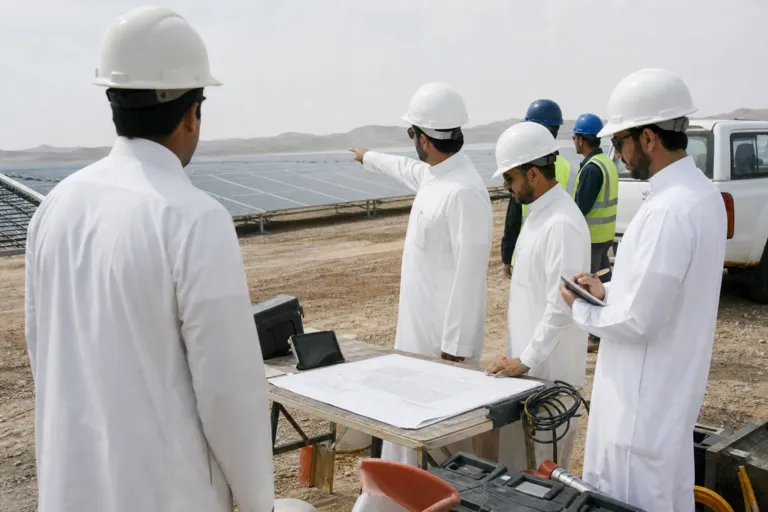
The Bisha 3000 MW Solar PV Plant is positioned as Asir Province’s largest renewable project. The keyword bisha solar pv project saudi arabia matters because it sits inside a wider national wave of gigawatt-scale solar procurement and buildout. The provided sources focus on Saudi Arabia’s broader solar market, the national renewable energy program rounds, and new power purchase agreements (PPAs). Those sources do not provide Bisha-specific construction details, but they do show the context in which a 3,000 MW project is being discussed: fast capacity additions, large PPAs, and a policy push for renewables in the electricity mix.
Two PV Magazine reports state that Saudi Arabia added around 7.8 GW of solar in 2025. They also note that growth is being led by gigawatt-sized utility-scale projects. In the same reporting, three projects belonging to Riyadh-based developer ACWA Power totaled 2.79 GW of new operational capacity that came online last year. This helps explain why a 3,000 MW plant is credible in the market narrative. The projects being planned and delivered are already being discussed at multi-gigawatt scale.
How Saudi Procurement Rounds Frame Mega Solar
The sources describe the sixth phase of Saudi Arabia’s national renewable energy program as having concluded last year, awarding 3 GW of solar. Oilandgas360 adds that Saudi Arabia awarded one wind and four solar projects with a total capacity of 4.5 GW, and estimates a total investment of $2.4 billion (also stated as 9 billion Saudi riyals). One of the solar projects mentioned is the 1.4-GW Najran Solar Energy Project, developed in partnership with Masdar, with an LCOE of 1.09682 U.S cents per kWh, described as the second-lowest in the world for solar electricity cost.
Saudi procurement is also shown through signed PPAs. PV Magazine reports that the Saudi Power Procurement Company signed five solar PPAs totaling 12 GW and two wind PPAs totaling 3 GW, billed as the largest renewable energy capacity signed for in a single phase globally to date. These projects are scheduled to be operational across 2027 and 2028. For readers tracking bisha solar pv project saudi arabia, this PPA pipeline indicates that large projects are being bundled into multi-year delivery windows, with grid readiness and interconnection becoming increasingly central to execution.
The same PV Magazine coverage highlights what comes next as solar scales up: grid integration and flexibility, faster interconnection, and a growing focus on large-scale solar-plus-storage. It also flags the need for new transmission to resource areas, better forecasting and grid codes for inverter-based resources, and procurement that helps cover evening peaks and limit curtailment. In addition, it suggests expanding distributed solar via net billing or wheeling for businesses, mobilizing low-cost finance such as green bonds or sukuk guarantees, and building local supply chains and workforce. These themes help explain why mega plants are discussed not only as generation assets, but as drivers of system-wide upgrades.
Finally, the Oilandgas360 source connects the renewables push to the national electricity mix. It quotes the Energy Ministry saying renewables are going to make up around 50% of the energy mix used to produce electricity by 2030, alongside replacing liquid fuel with natural gas. It also says Saudi Arabia expects total tendered renewable energy generation capacity to reach 64 GW by the end of 2025. Against that backdrop, a project described as Asir’s largest—like the Bisha 3000 MW Solar PV Plant—fits the market shift toward very large, utility-scale projects supported by national tenders and PPAs.
What is the bisha solar pv project saudi arabia in simple terms?
How much solar did Saudi Arabia add in 2025, according to the sources?
What do the sources say about Saudi Arabia’s biggest signed renewable PPAs?
What is one cited solar LCOE in Saudi Arabia’s procurement rounds?
What challenges does PV Magazine highlight as Saudi solar scales up?
Talk to us for your needs in:
-
Energy Efficiency Strategy & Feasibility
-
Renewable Energy Strategy & Investment Advisory
-
Digital Energy & Smart Grid Strategy
-
Market Entry Strategy
-
Sustainability & Impact Strategy
-
Energy Project Governance & PMO Advisory
-
Energy Market Research
-
Energy Stakeholder & Customer Research
-
Energy Market Intelligence
-
Energy Feasibility & Investment Assessment
-
Energy Sector Benchmarking & Performance Strategy