Saudi Arabia consumes all its natural gas output domestically and has no LNG facilities. Yet Aramco is pursuing international LNG volumes to build a tradable portfolio rather than relying on exports from the kingdom. CEO Amin Nasser said Aramco is aiming to build a long-term LNG portfolio of 20 million tons per year (Mt/y). The company has not ruled out exporting LNG one day, but its growing natural gas production is mainly for domestic use. This is why Aramco is focusing on acquiring LNG exposure abroad, then trading cargoes across regions as demand shifts.
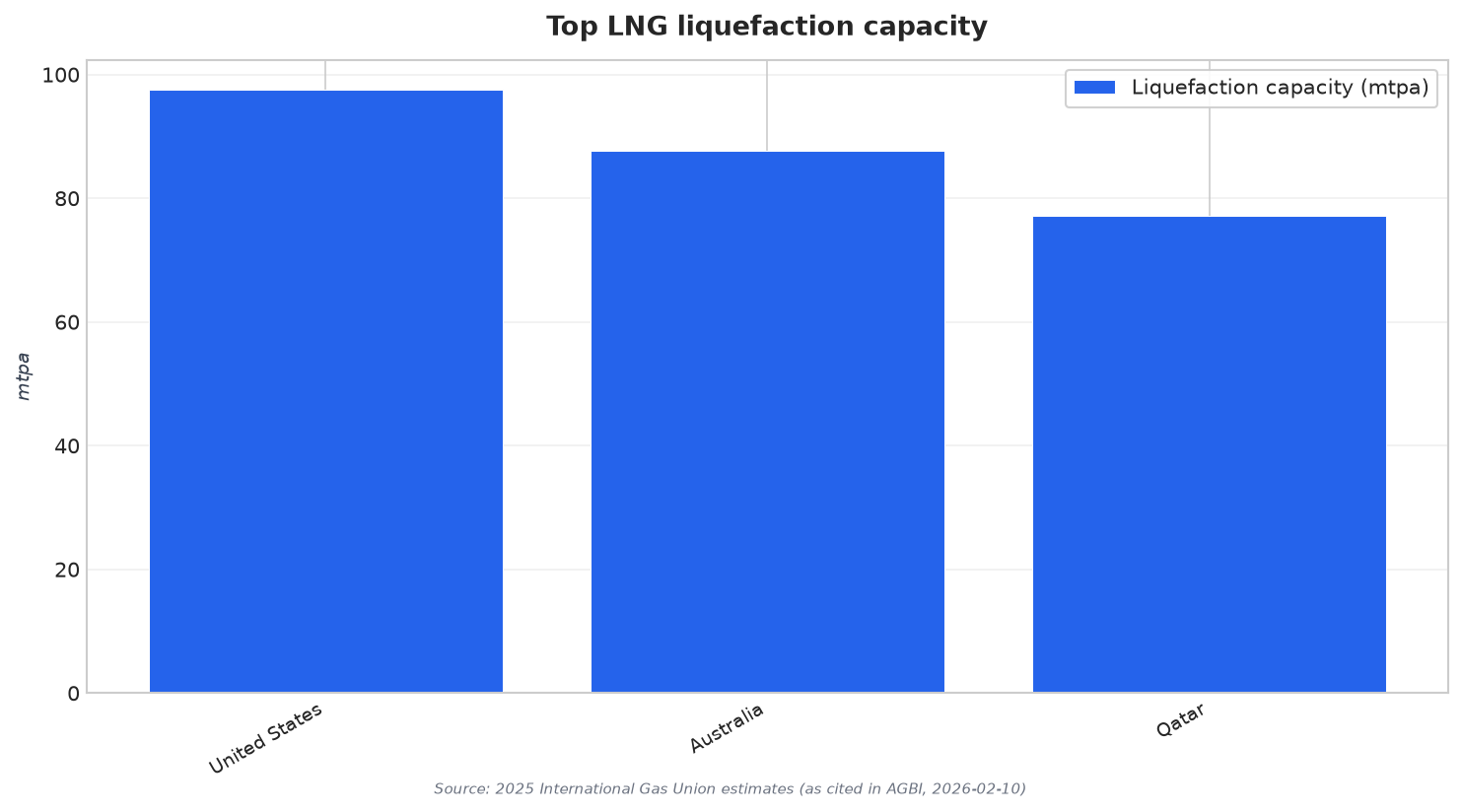
The strategy depends on flexibility. AGBI reported that Aramco’s contracts have no restrictions on where it can re-sell the gas, aside from provisions such as sanctions. That optionality matters because the same cargo can be directed to Europe or Asia depending on where demand is greatest. Aramco is also increasingly involved in spot trading, with cargoes sent to Bangladesh, Egypt, and China in recent months. This trading approach is being built in a global market where scale is concentrated: the 2025 International Gas Union estimates global liquefaction capacity totals nearly 500 million tonnes per annum, with the United States at 97.5 mtpa, Australia at 87.6 mtpa, and Qatar at 77.1 mtpa.
How MidOcean Builds a Tradable LNG Platform for Aramco
The Aramco MidOcean LNG investment began shaping Aramco’s international footprint in 2023. Natural Gas Intelligence reported that Aramco took a stake in MidOcean Energy LLC, which holds positions in export facilities in Australia and Peru. AGBI described the initial move as a $500 million minority stake. By 2024, Aramco completed a 49% acquisition of MidOcean Energy, giving it a material platform in LNG outside Saudi Arabia. CompressorTECH² also described a 2024 partnership with MidOcean aimed at acquiring stakes in LNG projects worldwide, reinforcing that MidOcean is intended as a scalable vehicle for global LNG participation.
Alongside equity exposure through MidOcean, Aramco is also securing long-term LNG supply from the United States. Natural Gas Intelligence said Aramco is working to finalize or has signed contracts for 7.5 Mt/y of LNG supplies, mainly through offtake and equity deals. It also reported a nonbinding agreement with Sempra Infrastructure to take a 25% stake in Phase 2 of Port Arthur LNG in Texas and purchase up to 5 Mt/y. CompressorTECH² said Aramco activated a 20-year sales and purchase agreement in September 2025 with NextDecade for 1.2 million tons per year from Train 4 of the Rio Grande LNG project in Texas. Reuters also reported 20-year supply agreements for Commonwealth LNG’s proposed Louisiana project and NextDecade’s Rio Grande terminal in Texas.
This overseas LNG build-out sits beside a major domestic gas push. Insights Global said Aramco secured contracts exceeding $25 billion for expansion of the Jafurah gas field and the third phase of its main gas network upgrade. Reuters described Jafurah as a $100 billion bet and said it is estimated to contain 229 trillion standard cubic feet of raw gas and 75 billion barrels of condensate. The aim is to support rising domestic demand driven by industrial growth, while also developing an international LNG portfolio that can be traded flexibly. As AGBI noted, the approach is two-pronged: acquire stakes via MidOcean and secure supply deals, with Nasser saying Aramco continues to evaluate opportunities in its pipeline.
What is Aramco trying to achieve with its MidOcean LNG investment strategy?
How large is Aramco’s stake in MidOcean Energy?
Which LNG volumes and deals from the US are cited for Aramco?
How concentrated is global LNG liquefaction capacity, based on the sources?
How does Aramco’s domestic gas push relate to its LNG ambitions?
Talk to us for your needs in:
-
Energy Efficiency Strategy & Feasibility
-
Renewable Energy Strategy & Investment Advisory
-
Digital Energy & Smart Grid Strategy
-
Market Entry Strategy
-
Sustainability & Impact Strategy
-
Energy Project Governance & PMO Advisory
-
Energy Market Research
-
Energy Stakeholder & Customer Research
-
Energy Market Intelligence
-
Energy Feasibility & Investment Assessment
-
Energy Sector Benchmarking & Performance Strategy