Saudi Arabia has plans to establish a civil nuclear power industry, but the starting point is still overwhelmingly fossil-based. Total electricity generation was 441 TWh in 2023, with natural gas at 257 TWh (58%) and oil at 182 TWh (41%), while wind contributed 1.6 TWh and solar 1.2 TWh. Imports and exports were small at 0.3 TWh and 0.4 TWh, respectively, which keeps the focus on domestic supply decisions. Per capita consumption was about 9400 kWh in 2023, and total consumption was 318 TWh. In that context, discussion about an AP1000 nuclear reactor for Saudi Arabia lands in a system that is looking for new non-fossil options but is still early in execution.
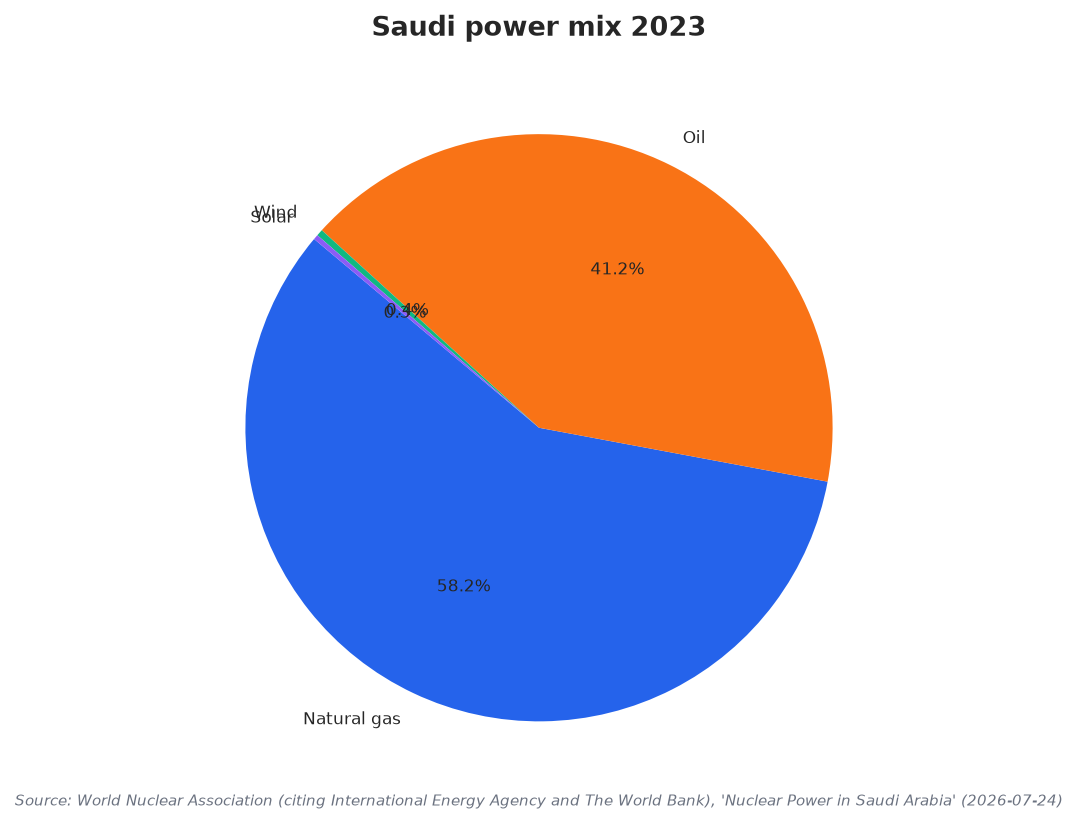
The long arc of Saudi planning helps explain why the vendor race matters. In 2013, the country projected 17 GWe of nuclear capacity by 2032, but that target was abandoned two years later. Meanwhile, generating capacity rose to 83.0 GWe in 2021 from 25.8 GWe in 2000, and population growth is also stark, from 4 million in 1960 to almost 37 million in 2025. World Nuclear Association notes that Saudi Arabia is unique in the region in having a 60 Hz grid frequency, which “severely limits the potential for grid interconnections.” That combination can push decision-makers to favor standardized, replicable designs that fit local grid realities and reduce execution risk.
AP1000 vs KEPCO: What the Sources Show About Vendor Positioning
The sources frame the competition as part of a broader push around pressurized water reactors (PWRs), where standardized replication is highlighted as a lever to improve efficiency, with examples including AP1000 alongside other designs. IndexBox lists both Westinghouse and KEPCO among representative PWR system participants and notes interest in nuclear-powered desalination in water-scarce, energy-rich regions such as the Middle East. For KEPCO specifically, Nuclear Engineering International reports that the US Department of Energy held talks with South Korean diplomats representing the state-owned Korea Electric Power Corp (Kepco) about potential financing tied to competing to build new large reactors, and it also states that KEPCO’s APR-1400 was certified by the US Nuclear Regulatory Commission in 2019. Wikipedia adds that the APR-1400 received US NRC Standard Design Approval in September 2018 and a design certificate in September 2019 valid for 15 years.
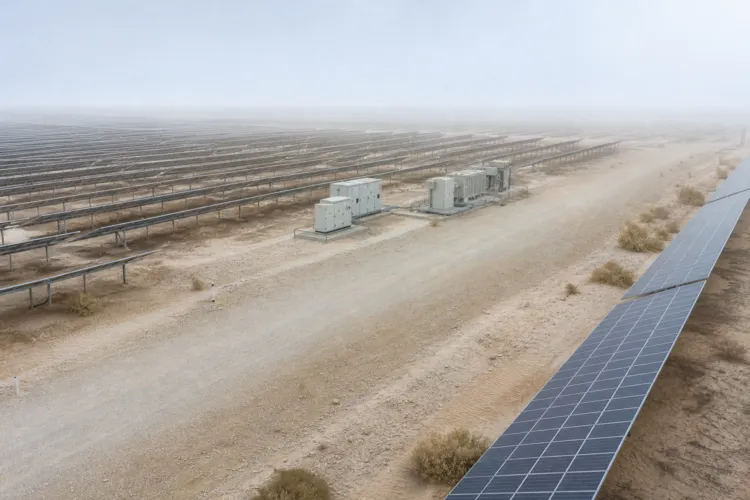
Saudi Arabia’s parallel renewables story underscores why nuclear choices get compared with other pathways, even when targets shift. A 2012 KA-CARE proposal aimed to add 23.9 GWe of renewable capacity by 2020 and 54 GWe by 2032, and it was later pushed back to 2040. Vision 2030 targets were later increased to 27.3 GWe in 2023 and 58.7 GWe in 2030, comprising 40 GWe solar PV, 16 GWe wind, and 2.7 GWe other renewable sources, but installed capacity lagged, with about 6.2 GWe of solar and 0.4 GWe of wind in place at the end of 2024. This gap helps explain why large, grid-connected options remain central, since Mordor Intelligence attributes 86.4% of demand in 2025 to grid-connected power as an end-use category, even as industrial process-heat use is projected to expand at a 14.7% CAGR through 2031.
Globally, the competitive landscape is shaped by market growth narratives and by where nuclear capacity sits today, but those figures should be read as context, not as Saudi-specific forecasts. Dataintelo values the global nuclear power plant market at $498.3 billion in 2025 and projects $860.1 billion by 2034, a 6.2% CAGR, and also states that pressurized water reactors command 38.2% of global capacity in its framing. Mordor Intelligence projects the nuclear power market expanding from 400.56 gigawatt in 2025 to 409.90 gigawatt in 2026 and 425 gigawatt by 2031, with pressurized light-water technology leading at 72.8% of installed capacity in 2025. For Saudi Arabia, the practical takeaway is simpler: the country is planning first-of-a-kind large nuclear steps while its grid is still dominated by gas and oil, so vendor selection tends to hinge on bankable designs, regulatory track records cited in the sources, and the ability to deliver standardized builds that match local constraints.
What is Saudi Arabia’s electricity mix today, and why does it matter for nuclear plans?
Did Saudi Arabia have a specific nuclear capacity target?
What do the sources say about KEPCO’s APR-1400 regulatory status in the US?
How does Saudi Arabia’s grid context affect the AP1000 nuclear reactor discussion for Saudi Arabia?
How far has Saudi Arabia progressed on renewables targets mentioned alongside nuclear planning?
Talk to us for your needs in:
-
Energy Efficiency Strategy & Feasibility
-
Renewable Energy Strategy & Investment Advisory
-
Digital Energy & Smart Grid Strategy
-
Market Entry Strategy
-
Sustainability & Impact Strategy
-
Energy Project Governance & PMO Advisory
-
Energy Market Research
-
Energy Stakeholder & Customer Research
-
Energy Market Intelligence
-
Energy Feasibility & Investment Assessment
-
Energy Sector Benchmarking & Performance Strategy