“Critical minerals saudi arabia” is no longer a niche topic. It sits at the centre of how the Kingdom wants to diversify its economy and shape future supply chains. Saudi Arabia’s Vision 2030 highlights a push to capitalise on a substantial mineral base, alongside its long-standing oil and gas strength. The goal is not only to dig more minerals out of the ground. It is also to build industrial clout through processing and downstream manufacturing, where global bottlenecks often appear even in mineral-rich countries.
Saudi ambitions are tied to the energy transition at home, too. One stated target is 130GW by 2030, with 50 percent coming from renewable energy sources. Meeting that agenda requires large-scale deployment of clean energy projects inside the country. Critical minerals matter across that chain, from magnets to nuclear energy and green hydrogen, and also in Electric Vehicles (EVs). This is why Saudi Arabia is linking its mineral strategy to both domestic energy goals and export-focused supply chain roles.
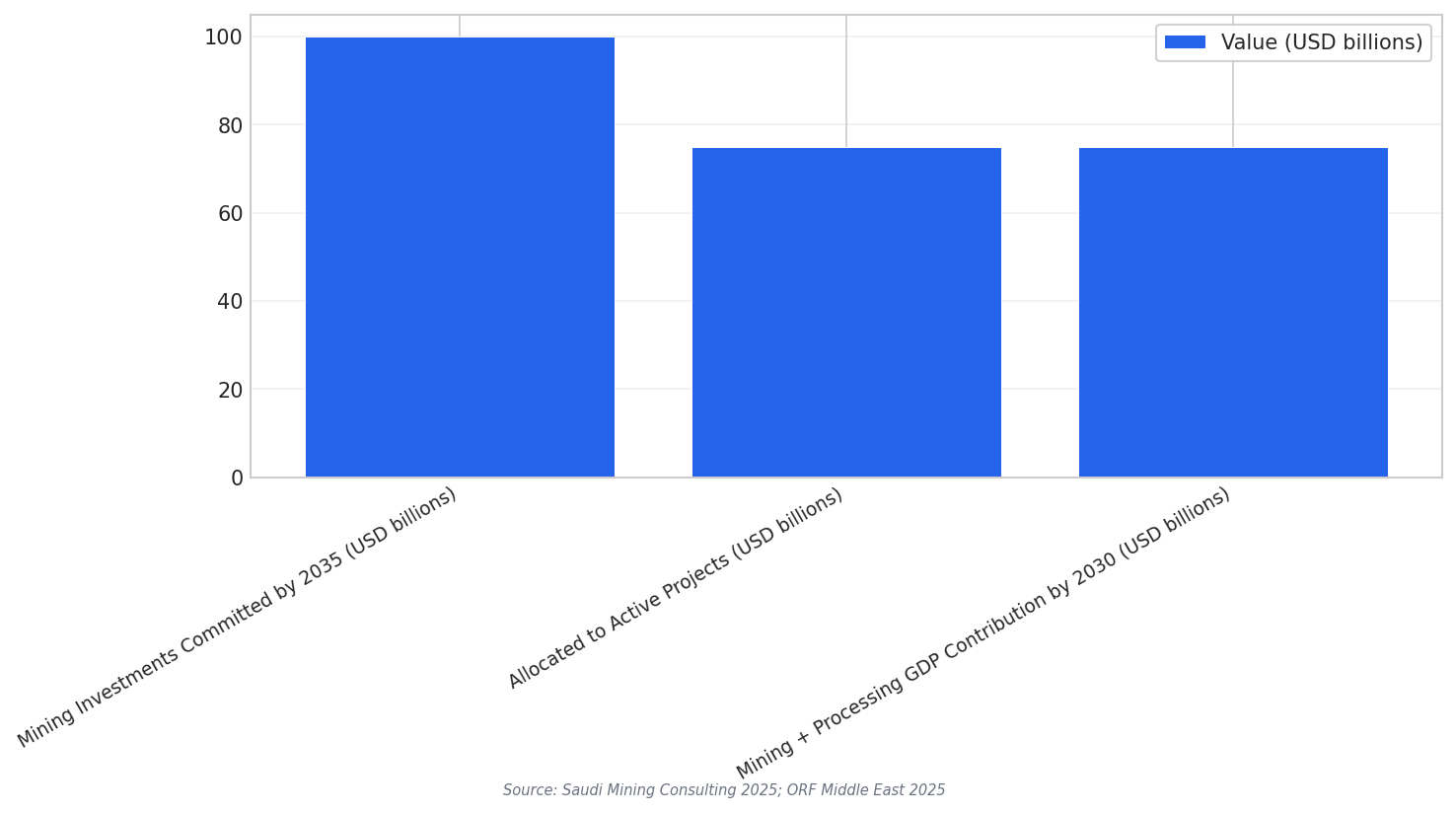
The Kingdom is also placing big financial bets. Under its Critical Minerals Strategy, Saudi Arabia has committed $100 billion in mining investments by 2035, with $75 billion already allocated to active projects. Another projection shows the scale of the economic upside: a systemic expansion of the mining sector and critical minerals processing capacity could contribute close to US$75 billion to GDP by 2030, which would be an increase of more than US$50 billion from 2024 figures.
Partnerships, Processing, and Geopolitical Leverage
Saudi Arabia is pitching itself as an alternative supplier as the US and Europe try to reduce reliance on China, which dominates global mineral supply chains. Analysts quoted by Climate Home News say the Kingdom is viewed as a politically neutral player in the growing US-China race over critical minerals. In May, the US and Saudi Arabia signed a cooperation agreement on critical minerals mining and processing. The EU has also stepped up engagement with the Gulf Cooperation Council. At the EU-GCC summit in October 2024, the two blocs agreed to “secure resilient energy supply chains including on clean technologies, raw materials and critical minerals”.
A separate US-focused agreement goes deeper into specific supply chain steps. CSIS reports a Strategic Framework for Cooperation on securing uranium, metals, permanent magnets, and critical mineral supply chains. It is designed to facilitate two-way investment. CSIS also reports that the U.S. Department of Defense, renamed the Department of War, will finance a 49 percent equity stake in a new rare earths refinery in Saudi Arabia. The stated aim is to reduce dependence on China after a year of volatility in access to heavy rare earths.
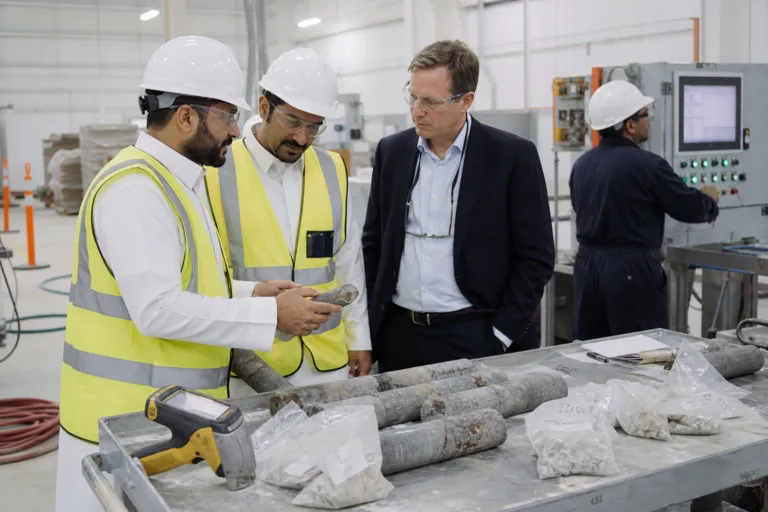
Saudi resource potential is presented as a key reason for outside interest. CSIS cites Saudi estimates that the Jabal Sayid deposit, about 350 kilometers northeast of Jeddah, is believed to hold the fourth most valuable reserves of rare earth elements globally. It is estimated at 552,000 tons of heavy rare earths and an additional 355,000 tons of light rare earths. This matters in a market where one paper notes that China dominates rare earth element manufacturing with over 80% of worldwide processing capacity, and over 70% of cobalt is produced in the Democratic Republic of Congo.
Saudi Arabia is also exploring how to expand beyond mining into processing and other value-added steps. House of Saud notes opportunities in rare earth refining, lithium extraction, and battery materials processing. It also reports an exploration pipeline that includes 691 gold sites and 242 base metal sites identified. In January 2025, Aramco and Ma’aden signed non-binding Heads of Terms to form a minerals exploration and mining joint venture focused on energy transition minerals, with lithium extraction as the headline objective. For Saudi Arabia, the strategy is about control of supply chains, not only exporting raw materials.
What is Saudi Arabia trying to achieve with critical minerals?
How much investment is planned under the Critical Minerals Strategy?
Why is processing so important for critical minerals saudi arabia plans?
What is in the U.S.-Saudi minerals cooperation discussed by CSIS?
What rare earth figures are cited for Saudi Arabia’s Jabal Sayid deposit?
Talk to us for your needs in:
-
Energy Efficiency Strategy & Feasibility
-
Renewable Energy Strategy & Investment Advisory
-
Digital Energy & Smart Grid Strategy
-
Market Entry Strategy
-
Sustainability & Impact Strategy
-
Energy Project Governance & PMO Advisory
-
Energy Market Research
-
Energy Stakeholder & Customer Research
-
Energy Market Intelligence
-
Energy Feasibility & Investment Assessment
-
Energy Sector Benchmarking & Performance Strategy