Saudi Arabia is turning into a major data center hub in the Middle East. This change is tied to Saudi Vision 2030, large infrastructure spending, and fast growth in local cloud and AI services. Hyperscale data centers are a key part of this story. They need large, steady electricity supply, and they raise new questions about cooling, water use, and long-term power planning.
Several programs are pushing this expansion. Alpin Limited links growth to government digitalization through the National Strategy for Data & AI (SDAIA) and the Hexagon government data center initiative. Global cloud firms are also building local capacity. S&P Global notes that increases in operations by hyperscale providers like AWS, Microsoft, and Oracle are driving cloud computing in the Kingdom. Capacity also reports AWS and Microsoft cloud regions in Saudi Arabia are set to launch by 2026.
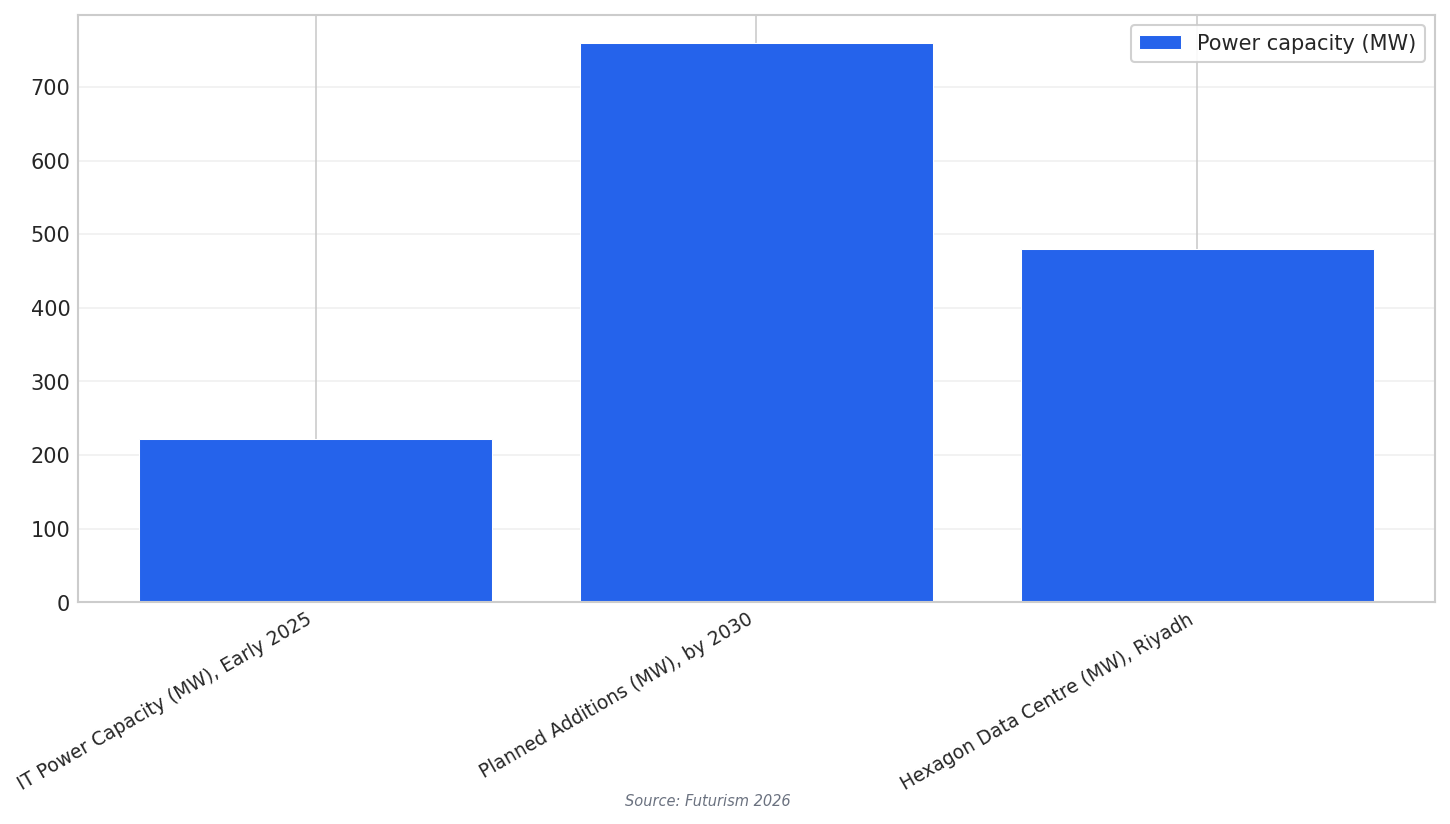
What matters for the grid is how fast load is rising. S&P Global projects the data center sector’s megawatt load will expand at a 29% growth rate from 2024 through 2030. Middle East Council on Global Affairs also says data center power demand is expected to grow at a 29% compound annual growth rate in Saudi Arabia. At the same time, Alpin Limited says the current IT load capacity is expected to cross 1.5 gigawatts (GW) by 2030. Futurism adds that IT power capacity was 222 megawatts (MW) in early 2025, with plans to add 760 MW by 2030.
Why Hyperscale AI Loads Change the Power Conversation
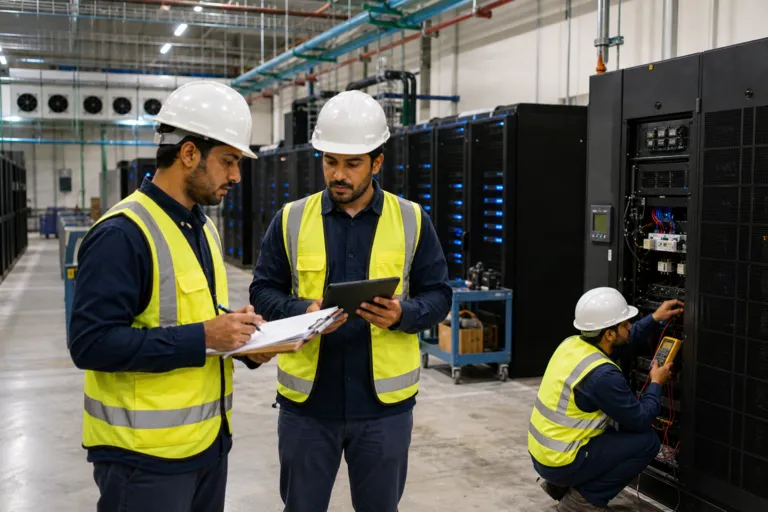
Hyperscale sites are not just bigger. They are also denser, because AI uses GPU clusters and specialized hardware. Futurism describes facilities designed for large AI training and inference workloads, and notes a national push tied to new builds and planning. This type of computing can drive higher and more constant electricity use. It also increases the stress on cooling systems, especially in hot and arid conditions.
Cooling is a major part of the energy profile. Alpin Limited says cooling typically accounts for nearly 40% of a data center’s energy profile. To respond, operators are moving beyond traditional air cooling. Alpin Limited highlights liquid immersion cooling, and AI-driven optimization that adjusts cooling output in real time based on server demand and external temperatures. It also points to designs aiming for lower Power Usage Effectiveness (PUE), targeting global benchmarks of 1.2 to 1.4 even in arid climates.
More power demand can also mean more pressure on water systems. Middle East Council on Global Affairs warns the Gulf’s AI infrastructure boom is unfolding in an extremely hot, arid region. It adds that Saudi Arabia’s 29% compound annual growth in data center power demand will drive substantially higher water demand as well. This makes efficiency choices important, including cooling approaches and integrated planning in large developments.
Investment signals show how quickly the market is moving. Capacity reports Equinix is investing $1 billion in a 100MW data centre, and DataVolt is developing a 1.5GW fully sustainable data centre campus in NEOM as part of a $5 billion expansion. Futurism also says investment commitments reached $21 billion in February 2025 alone, and that the government allocated $40 billion specifically for AI technology investments covering data centers, semiconductors, and AI companies. For data center power demand saudi arabia, these figures point to one core reality: growth is rapid, and power planning needs to keep pace.
Why is data center power demand saudi arabia rising so fast?
How much capacity is Saudi Arabia targeting by 2030?
How important is cooling in Saudi data center energy use?
What major projects are mentioned in the sources?
Talk to us for your needs in:
-
Energy Efficiency Strategy & Feasibility
-
Renewable Energy Strategy & Investment Advisory
-
Digital Energy & Smart Grid Strategy
-
Market Entry Strategy
-
Sustainability & Impact Strategy
-
Energy Project Governance & PMO Advisory
-
Energy Market Research
-
Energy Stakeholder & Customer Research
-
Energy Market Intelligence
-
Energy Feasibility & Investment Assessment
-
Energy Sector Benchmarking & Performance Strategy