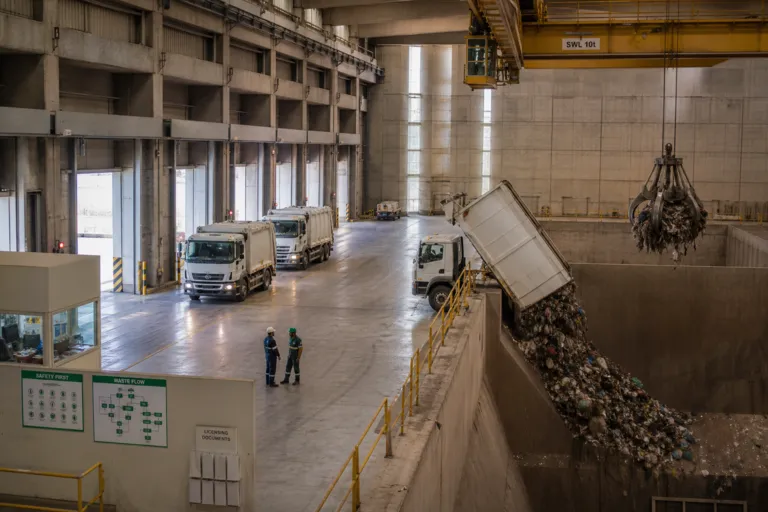
Saudi Arabia’s waste-to-energy story starts with volume and urgency. A 2026 review of municipal solid waste (MSW) reports that the Kingdom generates approximately 16 million tons of MSW annually. The same study describes the waste mix as heavily organic, with organic matter at 37–57%, paper at 11–28%, and plastics at 5–36%. These characteristics matter for technology selection because organic fractions favor biochemical routes, while higher-calorific fractions support thermal conversion. The direction of travel is clear in the same Vision 2030-linked projections, which expect MSW generation to increase to approximately 30 million tons per year by 2033, driven by population growth, urbanization, and increased tourism activities.
Investment signals are also strengthening around waste to energy Saudi Arabia, especially where waste policy and power offtake can meet. IMARC values the Saudi Arabia waste-to-energy market at USD 437.4 million in 2025 and expects it to reach USD 665.4 million with a 4.77% CAGR during 2026–2034. The same source frames WTE as a way to convert municipal solid waste into electricity and heat, while noting greater government support for projects through incentives, subsidies, and regulatory frameworks intended to attract private participation. In parallel, a Vision 2030 investment guide states that Saudi Arabia generates approximately 55 to 60 million tonnes of waste annually across municipal, construction and demolition, industrial, and hazardous categories, reinforcing that residual streams exist well beyond MSW alone.
What Technologies and Revenue Models Fit the Saudi Context?
Technology choice in Saudi Arabia is often a balancing act between cost, feedstock, and energy yield. The 2026 Saudi-focused review finds biochemical methods are the most cost-effective for managing organic waste, while thermochemical methods have higher capital costs but achieve significant energy recovery. For thermal incineration specifically, it notes that energy recovery efficiency generally ranges from 20% to 30%, depending on operational factors, and that pre-treatment can improve efficiency by optimizing calorific value. At the regional level, Grand View Research reports the thermal segment led Middle East waste-to-energy with a 94.92% revenue share in 2024, and it explicitly lists Saudi Arabia among countries investing in large-scale thermal facilities alongside the UAE and Qatar.
Revenue tends to be clearer when projects can secure long-dated electricity contracts and predictable gate fees. A 2026 market report notes that, in Saudi Arabia, waste-to-energy development sits under the National Center for Waste Management, which sets the licensing framework for waste treatment and disposal facilities including thermal recovery plants. The same report highlights electricity as the leading output because grid-connected power purchase agreements offer operators the most liquid and long-dated revenue stream from waste combustion. It also states that Saudi Arabia generated USD 1.3 billion of Middle East and Africa’s 2025 waste-to-energy revenue and is projected to reach USD 2.83 billion by 2034, positioning the Kingdom as the region’s largest market in that dataset.
Waste-to-energy projects also sit inside a wider shift in how waste services are procured and enforced. Mordor Intelligence values Saudi Arabia’s waste management market at USD 25.84 billion in 2025 and estimates growth from USD 27.39 billion in 2026 to USD 37.53 billion by 2031, at a 6.5% CAGR. It links momentum to Vision 2030 policy pressure and stricter penalties under Royal Decree M/3, including fines up to USD 8 million and prison terms for non-compliance. The same report also references a “90% diversion goal for 2040,” embedding recycling, composting, and waste-to-energy thresholds into permitting and obligations. In this environment, integrating WTE with recycling, as the 2026 Saudi review recommends, becomes central to turning waste diversion into dependable power and revenue.
How much municipal solid waste does Saudi Arabia generate today, and what is projected by 2033?
What is the forecast for the Saudi waste-to-energy market through 2034?
What efficiency range is cited for incineration energy recovery?
Which technology segment dominates Middle East waste-to-energy revenue, and how is Saudi Arabia positioned?
How is waste-to-energy in Saudi Arabia governed and monetized in practice?
Talk to us for your needs in:
-
Energy Efficiency Strategy & Feasibility
-
Renewable Energy Strategy & Investment Advisory
-
Digital Energy & Smart Grid Strategy
-
Market Entry Strategy
-
Sustainability & Impact Strategy
-
Energy Project Governance & PMO Advisory
-
Energy Market Research
-
Energy Stakeholder & Customer Research
-
Energy Market Intelligence
-
Energy Feasibility & Investment Assessment
-
Energy Sector Benchmarking & Performance Strategy