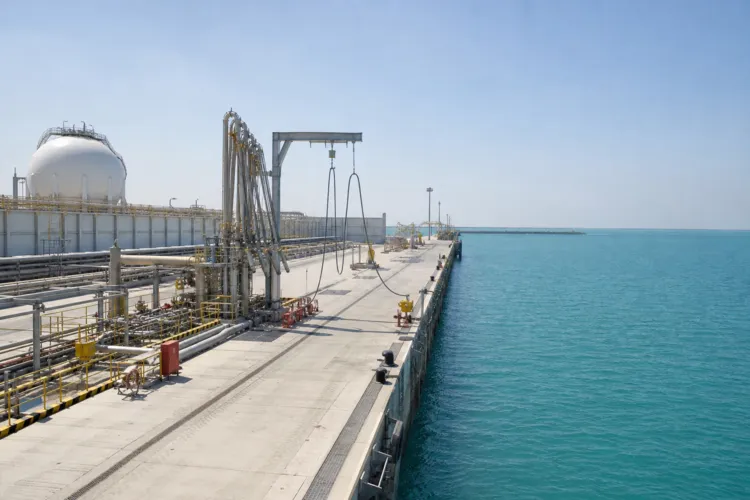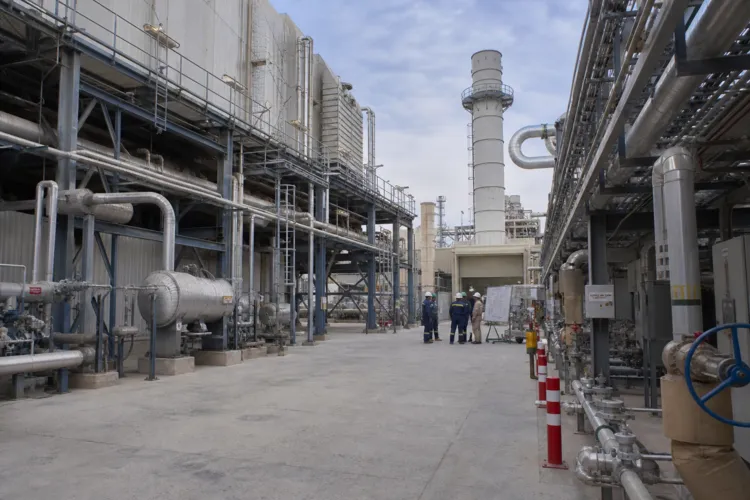
Aramco’s “aramco gas capacity growth 2030” push is built around a simple headline commitment. The company aims to increase sales gas production capacity by about 80% by 2030 compared with 2021 levels. Reuters linked that 2021 baseline to 9.2 bcfd, and calculated that the revision implies nearly 2 bcfd extra by the end of the decade. Aramco confirmed first shale gas production from Jafurah began in December 2025, and it positioned Jafurah and the Tanajib Gas Plant as two milestones that strengthen its integrated gas portfolio and expand processing capacity.
The central asset is Jafurah. It spans about 17,000 sq km and is described as the largest liquids-rich unconventional gas development in the Middle East. Aramco estimated Jafurah contains 229 Tscf of raw gas and 75 Bbbl of condensate and liquids. Phase-one facilities were described as producing 450 MMcfd, with output expected to ramp to roughly 2 Bcfd by 2030 as additional phases come online. By 2030, Aramco also targets 420 MMscfd of ethane and about 630,000 bpd of high-value liquids from Jafurah.
Those same figures create a clean way to visualize the 2030 product mix targets from Jafurah. The sources state two gas volumes (in standard cubic feet per day terms) and one liquids volume (in bpd). To keep units consistent, the chart below uses only the two gas volumes. It compares Aramco’s stated 2030 targets for Jafurah sales gas at 2 Bscfd and ethane at 420 MMscfd. Together, they show how the project is designed to deliver both fuel gas and petrochemical feedstock, not just one stream.
Strategy: Processing Capacity, Domestic Displacement, and Cash Flow
Aramco is pairing upstream growth with processing infrastructure. The Tanajib Gas Plant commenced operations in December 2025 and is expected to reach raw gas processing capacity of 2.6 Bscfd in 2026. It processes associated gas from the offshore Marjan and Zuluf fields and coincided with the start-up of the Marjan crude oil increment project. Aramco also framed the strategy as supporting Saudi objectives to diversify the energy mix, displace liquid fuels in domestic power generation, and enhance energy security.
Key customers start at home, because domestic power needs are repeatedly cited as the primary sink for new gas. One Reuters-based account states Saudi Arabia uses more than 1 million bpd of crude and fuel oil for domestic power generation, and Aramco aims to replace 500,000 bpd of that by 2030 with gas, freeing crude for export. That same report noted that at prices around $70 a barrel, 500,000 bpd of crude would generate nearly $12.8 billion in revenue a year. Separately, Aramco said incremental gas volumes could generate $12 billion to $15 billion in additional operating cash flow by 2030, subject to market conditions.
The biggest risks in the 2030 story are pace, market dynamics, and monetization choices. Analysts flagged uncertainty around the pace of ramp-up, and Aramco had previously said Jafurah was expected to come online in early 2024. There is also uncertainty about how much condensate will be exported versus used as feedstock. Competition and price risk sit in the background too. Reuters cited expectations by the International Energy Agency and some market participants of a surge of new Qatari and U.S. LNG this decade that could create a global supply glut and depress prices. Aramco’s plan therefore depends not only on delivering volumes, but on placing them into stable domestic demand while navigating global price cycles.
What does “aramco gas capacity growth 2030” mean in practical terms?
What are Aramco’s 2030 targets for the Jafurah project?
Who are the key customers for the expanded gas volumes?
What role does the Tanajib Gas Plant play in the strategy?
What are the main risks highlighted in the sources?
Talk to us for your needs in:
-
Energy Efficiency Strategy & Feasibility
-
Renewable Energy Strategy & Investment Advisory
-
Digital Energy & Smart Grid Strategy
-
Market Entry Strategy
-
Sustainability & Impact Strategy
-
Energy Project Governance & PMO Advisory
-
Energy Market Research
-
Energy Stakeholder & Customer Research
-
Energy Market Intelligence
-
Energy Feasibility & Investment Assessment
-
Energy Sector Benchmarking & Performance Strategy