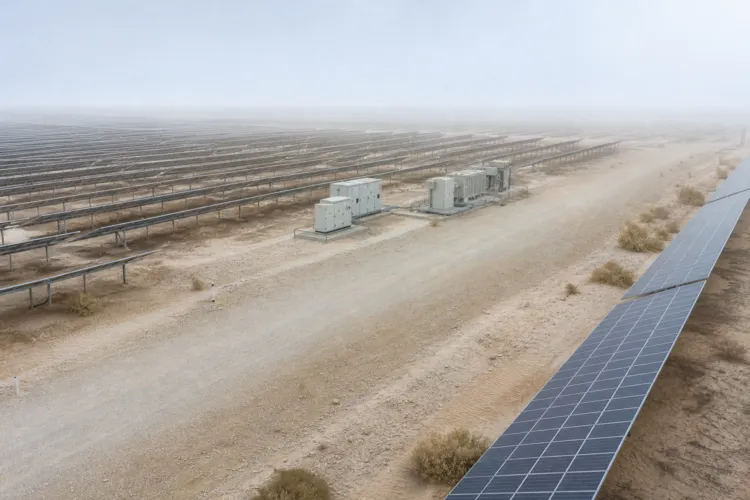
Interest in blockchain energy trading saudi arabia is growing alongside rapid renewable procurement and grid integration needs. In 2025, Saudi Power Procurement Company signed five solar PPAs totaling 12 GW and two wind PPAs totaling 3 GW, with projects scheduled to be operational across 2027 and 2028, according to pv magazine. The same reporting notes that growth in Saudi Arabia’s solar market is led by gigawatt-sized utility-scale projects, and that three ACWA Power projects totaled 2.79 GW of new operational capacity. As the system scales, market participants need tools that can coordinate metering inputs, trading, and settlement in ways that stay transparent and auditable.
Peer-to-peer (P2P) trading is one use case often linked to blockchain-style ledgers because it depends on many parties agreeing on energy and certificate transactions. A Scientific Reports paper describes how, in blockchain networks, each node verifies transactions individually. It also distinguishes consensus types, noting that puzzle complexity exists only in proof-of-work (PoW) chains where obtaining a target hash is the puzzle to be solved. The paper further highlights designs where bids and offers can be handled in real time, with transactions confirmed without any noticeable delay. For Saudi market pilots, this points to a practical design question: choose an approach that supports quick confirmation while matching governance and compliance requirements.
REC Tracking and Credibility: Design Matters
Renewable energy certificate (REC) tracking is a second key use case, especially when buyers want traceability across complex value chains. A Nature paper on blockchain and sustainability states that blockchain technology’s contribution to the Sustainable Development Goals (SDGs) is highly dependent on application design, and that design must balance energy efficiency and transparency. In REC-style tracking, this balance is central. A system that is transparent but operationally heavy may struggle to scale, while a lightweight system still needs enough disclosure and verification to be trusted. The same source also discusses coordination under cap-and-trade mechanisms, showing how ledger-based coordination can connect compliance concepts to operational workflows.
Settlement is where blockchain can translate recordkeeping into operational value. Mining Weekly describes platforms that help automate bidding, trading, and settlement, while also ensuring that everything stays compliant and transparent. It also notes the need for talent that combines advanced IT skills with deep energy market knowledge, warning that technology alone is insufficient. For Saudi Arabia, where pv magazine highlights a shift in drivers toward grid integration and flexibility, settlement automation can support faster interconnection processes and clearer transaction finality. In practice, settlement design must align with metering, forecasting, and analytics so transactions can be validated and closed with fewer disputes.
Finally, blockchain-led energy workflows should be framed as part of a broader market stack rather than a standalone tool. Mining Weekly points to end-to-end capability areas such as metering, forecasting, settlement, and analytics, and describes how trading platforms enable producers, traders, and utilities to operate in a connected, scalable way. In Saudi Arabia, pv magazine reports the sixth phase of the national renewable energy program awarded 3 GW of solar, and the seventh round covers 3.1 GW across four solar projects. As these rounds progress and projects reach operation, P2P trading pilots, REC tracking, and settlement automation can be tested with careful design choices that prioritize both transparency and efficiency.
What does “blockchain energy trading saudi arabia” mean in practice?
How can blockchain support peer-to-peer energy trading?
Why is application design critical for REC tracking?
Can blockchain help with settlement and compliance?
Talk to us for your needs in:
-
Energy Efficiency Strategy & Feasibility
-
Renewable Energy Strategy & Investment Advisory
-
Digital Energy & Smart Grid Strategy
-
Market Entry Strategy
-
Sustainability & Impact Strategy
-
Energy Project Governance & PMO Advisory
-
Energy Market Research
-
Energy Stakeholder & Customer Research
-
Energy Market Intelligence
-
Energy Feasibility & Investment Assessment
-
Energy Sector Benchmarking & Performance Strategy