Saudi Arabia’s National Renewable Energy Programme (NREP) has moved into its seventh procurement phase with a new request for qualifications (RFQ) led by the Saudi Power Procurement Company (SPPC). The Round 7 tender totals 5.3 GW of new renewable capacity, combining 3.1 GW of solar PV and 2.2 GW of wind. In practical terms, the scope is defined as four solar PV projects and two wind projects. SPPC is the Kingdom’s principal offtaker for power projects, and the RFQ format sets the first gate for developers seeking to compete later in the process. For readers tracking “nrep round 7 saudi arabia,” the key takeaway is that Round 7 is a single, packaged step covering both technologies at scale.
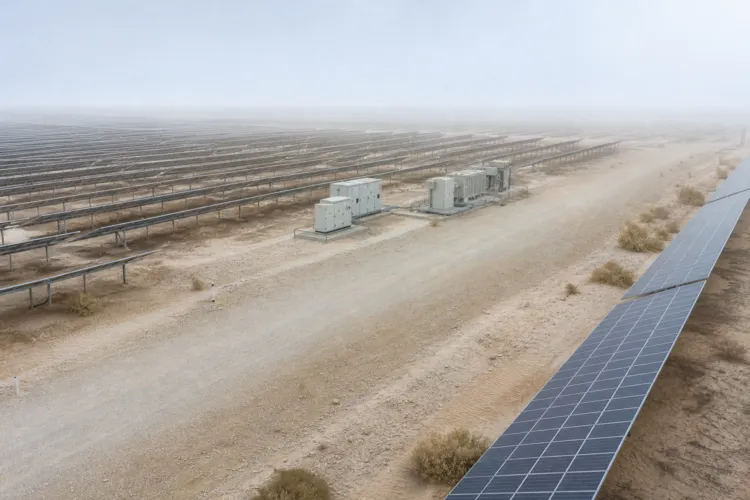
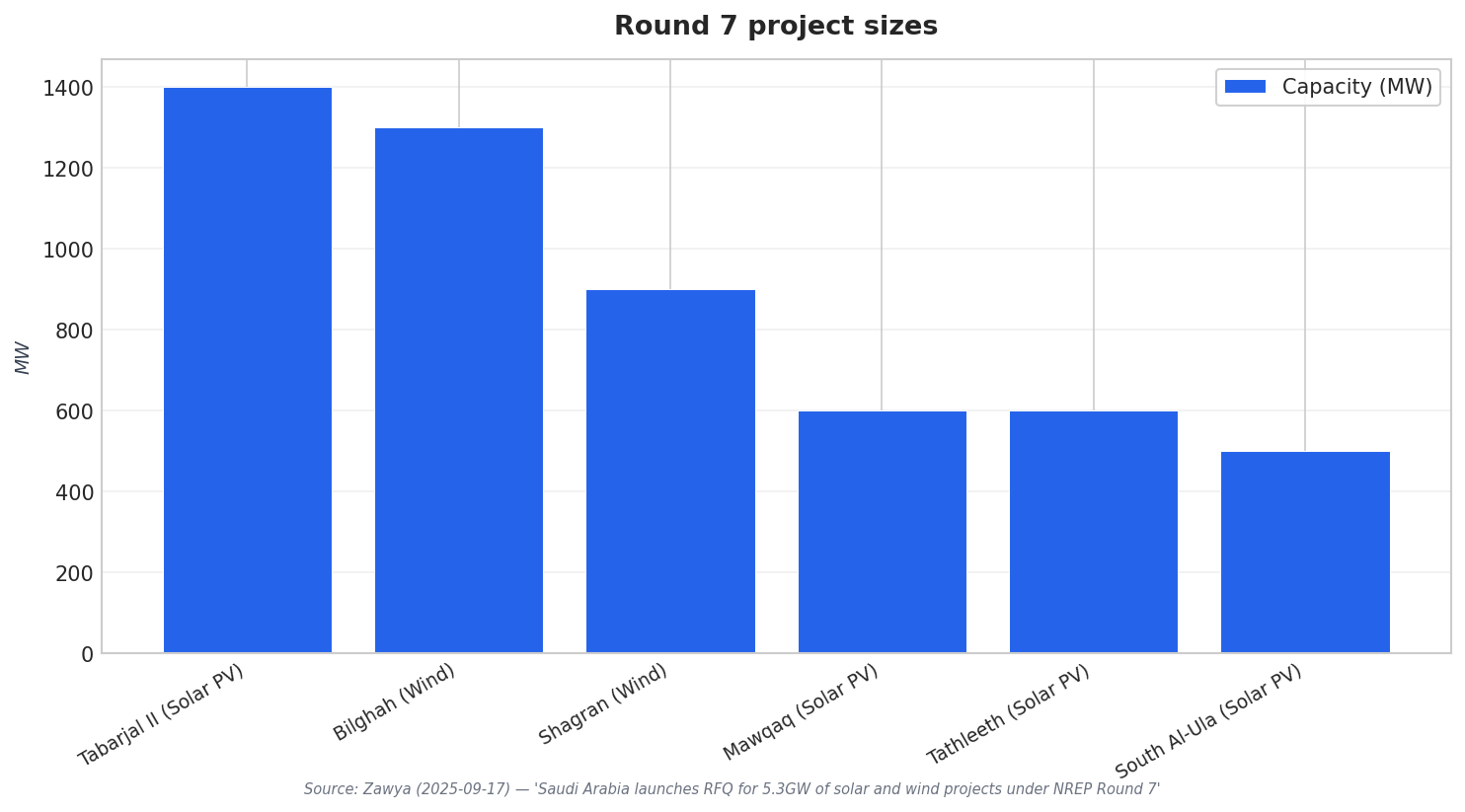
On the solar side, the Round 7 portfolio spreads capacity across several regions and concentrates on utility-scale sites. The projects listed are Tabarjal II in Al Jouf at 1,400 MW; Mawqaq in Hail at 600 MW; Tathleeth in Aseer at 600 MW; and South Al Ula in the Madinah region at 500 MW. Taken together, these four PV sites account for the 3.1 GW solar allocation under this round. Sources also describe approved solar projects under this phase, including two projects within a Tabarjal portfolio totalling 1.4 GW in Al-Jawf, along with Mawqaq, Tathleeth, and South Al Ula at the same capacities listed above. The regional spread underscores how procurement is being used to place new generation across the Kingdom rather than in a single hub.
What’s in the Wind Portfolio and Why It Matters
Wind is the second pillar of Round 7, with two projects located in the Madinah region: the 1,300 MW Bilghah wind project and the 900 MW Shagran (also spelled Shaqran in some reporting) wind project. Together, they total 2.2 GW, matching the wind allocation described for this round. SPPC has framed these additions as a way to diversify Saudi Arabia’s renewable portfolio and reduce reliance on liquid fuels in the power generation sector. While reporting notes that SPPC did not disclose submission deadlines or power purchase agreement (PPA) details in the RFQ announcement, another source stated that successful participants were expected to be announced by September 29, 2025. Either way, the wind scope is clear: two large sites, one region, and a material share of the 5.3 GW package.
Round 7 also sits inside a broader pipeline that SPPC has reported in multiple updates. SPPC noted it has launched tenders for more than 43 GW of renewable capacity to date, with PPAs signed for over 38 GW; another update specifies 38.7 GW signed out of 43.2 GW launched since the program’s inception. Grid progress is also quantified: 10.2 GW has already been connected to the national grid, and this figure is projected to rise to 12.7 GW by the end of 2025. Saudi Arabia’s targets are described in two ways across sources: one states an aim to raise renewables from 0.5% in 2022 to over 30% by 2030, while another notes a commitment for 50% of power generation to come from renewable sources by 2030. These figures explain why Round 7 is positioned as both a capacity-build step and a system-planning lever.
By early 2026, Saudi Arabia had also published qualified bidder lists for the Round 7 projects, showing the competitive depth behind the RFQ. For the solar PV projects, SPPC’s qualified bidders included 22 companies, among them Masdar, EDF, Engie, Sembcorp Utilities, Jinko Power (HK), TotalEnergies Renewables, KEPCO, and SPIC Shanghai Electric Power Company, alongside local developers. The wind qualified developers similarly included a mix of international and local players such as Masdar, Alfanar Company, EDF, Engie, Marubeni Corporation, PowerChina, Sembcorp Utilities, and TotalEnergies Renewables. Separately, sources point to upstream activity tied to renewable buildout: in 2025, GameChange Solar doubled capacity at its Saudi plant to 6 GW, and TrinaTracker opened a 3 GW facility in the country. Together, these details show how Round 7 is not just a tender list, but part of a wider ecosystem forming around Saudi procurement volumes.
How much capacity is included in Saudi Arabia’s NREP Round 7 tender?
Which solar PV projects are in NREP Round 7, and where are they located?
What wind projects are included in NREP Round 7?
How many companies qualified for the solar PV projects in Round 7?
How does Round 7 fit into SPPC’s wider NREP pipeline?
Talk to us for your needs in:
-
Energy Efficiency Strategy & Feasibility
-
Renewable Energy Strategy & Investment Advisory
-
Digital Energy & Smart Grid Strategy
-
Market Entry Strategy
-
Sustainability & Impact Strategy
-
Energy Project Governance & PMO Advisory
-
Energy Market Research
-
Energy Stakeholder & Customer Research
-
Energy Market Intelligence
-
Energy Feasibility & Investment Assessment
-
Energy Sector Benchmarking & Performance Strategy