
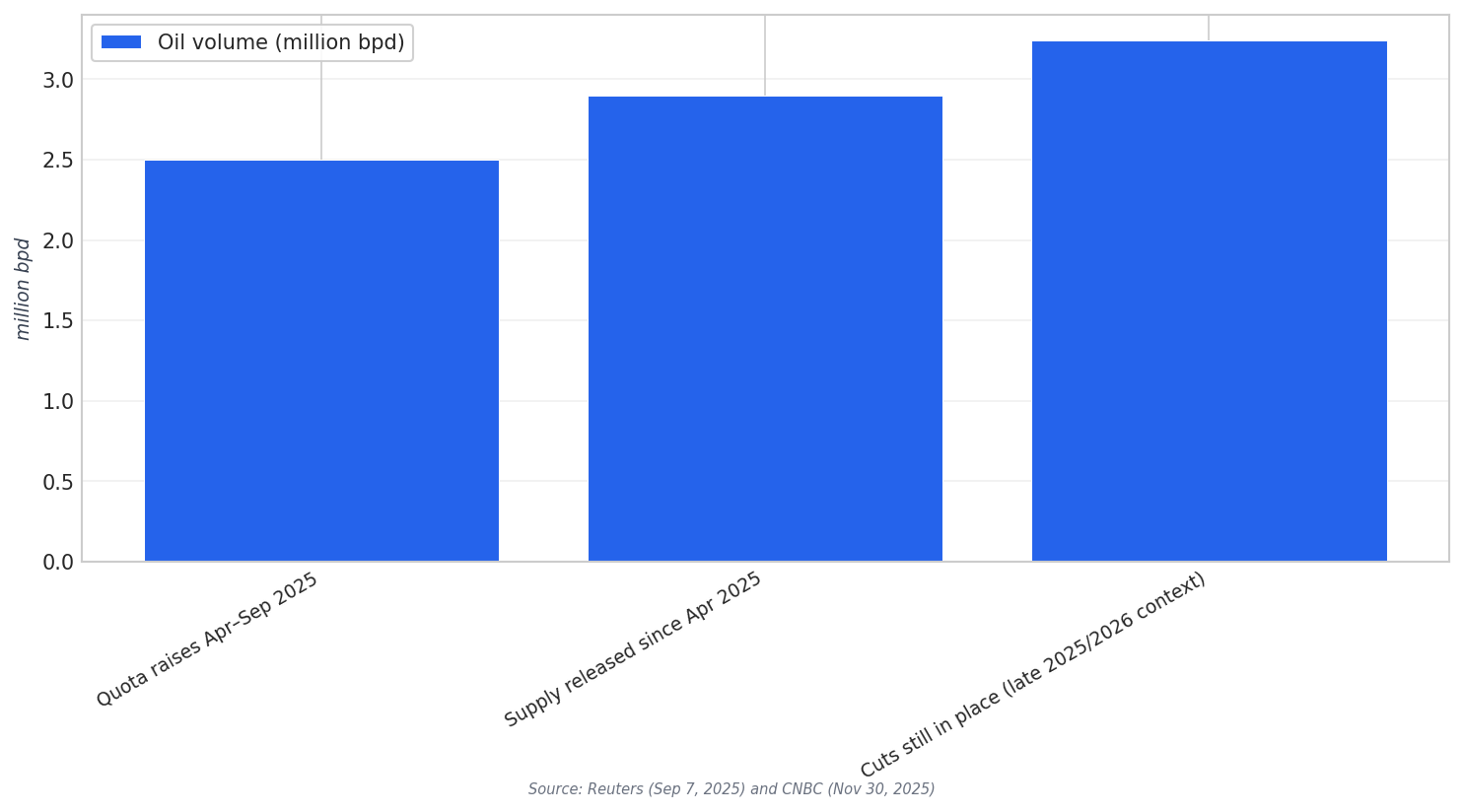
In 2026, OPEC+ is managing oil prices and barrels with a strategy that keeps options open. OPEC+ countries agreed to maintain group-wide oil output quotas for 2026, according to an OPEC statement cited by CNBC. Separately, eight OPEC+ countries also had an agreement in principle to maintain a pause in output hikes for the first quarter of 2026, according to an OPEC+ source and a person familiar with the talks. This approach matters because the group still had about 3.24 million barrels per day (bpd) of output cuts in place, representing about 3% of global demand, and the Sunday meeting did not alter those cuts.
The background to 2026 is the pace of quota changes and the pressure it put on prices in 2025. Reuters reported that OPEC+ had already raised production quotas by about 2.5 million bpd between April and September, around 2.4% of global demand. Over the same period, oil prices declined by about 18% from their 2025 high in mid-January to $67 a barrel. CNBC also said OPEC+ released some 2.9 million bpd into the market since April 2025, then paused hikes for the first quarter of 2026. Saudi Arabia’s balancing act sits inside this tension between adding supply and avoiding another sharp price slide.
The quotas also interact with compliance realities, which shape how much oil actually reaches the market. Reuters cited IEA figures showing that in March 2025, just before OPEC+ began unwinding its first layer of cuts, joint production reached 31.83 million bpd, only 1 million bpd below its 32.88 million bpd production target for September. Reuters added that Kazakhstan, the United Arab Emirates and Iraq had far exceeded their OPEC+ production quotas, and in July that trio jointly outpaced their September quotas by some 500,000 bpd. Reuters argued new guidelines may “not actually” add many additional barrels because quotas can be catching up with production already occurring.
Saudi Arabia’s 2026 Tradeoff: Market Share vs Price Support
Saudi Arabia’s role is to navigate competing goals inside OPEC+. World Oil reported that Saudi Arabia, which drove an accelerated restart of supply, wanted to further boost production as it seeks to offset lower prices with higher volumes, while acknowledging that some members could oppose moves that weaken prices. The same report said a range of options remained possible, including pausing hikes for a period. Reuters also noted OPEC+ retained options to accelerate, pause, or reverse hikes at future meetings. In practice, Saudi Arabia is trying to lead a policy that can respond quickly if market conditions change.
Oversupply risk is the main constraint on any aggressive quota expansion in 2026. Reuters said the IEA previously forecast supply would outstrip demand by an average of 3 million bpd between October 2025 and the end of 2026, even before one OPEC+ announcement. Separately, World Oil cited IEA expectations for a hefty surplus of 2 million bpd in the fourth quarter. That context explains why OPEC+ could hold 2026 group-wide quotas steady while keeping substantial cuts in place. It also explains why actual production additions may be “muted,” as Reuters wrote, because many members are already producing at or near full capacity.
What does “opec plus saudi arabia production quota 2026” mean in practice?
Did OPEC+ change its group-wide quotas for 2026?
How large were OPEC+ cuts still in place heading into 2026?
Why might quota hikes not translate into the same size production increase?
What oversupply signals were shaping OPEC+ decisions through end-2026?
Talk to us for your needs in:
-
Energy Efficiency Strategy & Feasibility
-
Renewable Energy Strategy & Investment Advisory
-
Digital Energy & Smart Grid Strategy
-
Market Entry Strategy
-
Sustainability & Impact Strategy
-
Energy Project Governance & PMO Advisory
-
Energy Market Research
-
Energy Stakeholder & Customer Research
-
Energy Market Intelligence
-
Energy Feasibility & Investment Assessment
-
Energy Sector Benchmarking & Performance Strategy