
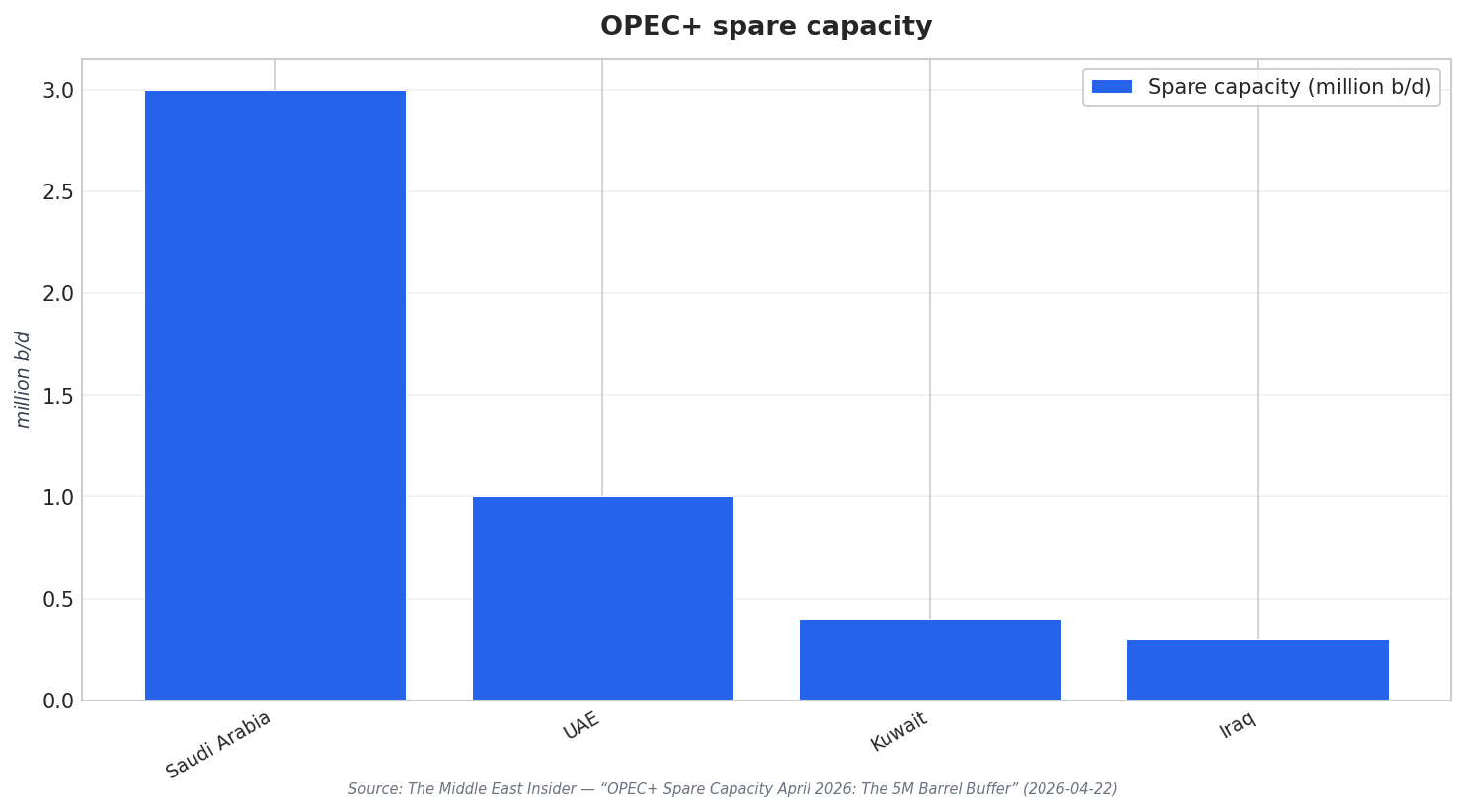
Saudi Arabia enters 2026 with an unusually large cushion of spare production capacity, and that buffer is policy-driven. One April 2026 market assessment put OPEC+ spare capacity at more than 5 million barrels per day, with Saudi Arabia holding 3 million, the UAE 1 million, Kuwait 0.4 million, and Iraq operationally constrained at 0.3 million. In that same snapshot, Saudi production sat near 9.1 million barrels per day, leaving a gap of about 3 million barrels per day to spare. The same analysis described this as the highest Saudi spare reading since 2009, arguing the driver is Riyadh carrying voluntary OPEC+ cuts plus additional unilateral cuts.
Other 2026 commentary framed the Kingdom’s buffer as an estimated 2–3 million barrels per day of spare capacity and called it the largest of any producer. That range matters because OPEC+ policy is not static. The OPEC+ alliance began a phased unwinding of voluntary production cuts in late 2025, but the pace was described as slower than originally planned, and output increments were paused for January through March 2026 due to seasonal demand weakness. The result is a constant trade-off: defending price stability by keeping barrels off the market, while keeping enough flexibility to respond if market share comes under pressure or if disruptions tighten supplies.
Why 2026 Spare Capacity Is a Moving Target
In 2026, spare capacity is also shaped by how analysts define what is “usable.” The U.S. Energy Information Administration updated its production-capacity framework and distinguished between maximum sustainable capacity (a level that could be reached within a year) and effective capacity (what could be reached within 90 days and sustained, net of disruptions). In its December STEO update, the EIA said its revised estimates increased OPEC capacity by 0.31 million barrels per day on average in 2026, with similar increases to OPEC surplus capacity because estimates of actual OPEC production changed little. In practical terms, market participants focus on what can be delivered fast and sustained without damaging fields.
That delivery question became acute during the 2026 disruption described by the IEA. The IEA reported that global oil supply declined by a further 1.8 million barrels per day in April to 95.1 million barrels per day, bringing total losses since February to 12.8 million barrels per day. It also said output from Gulf countries affected by the closure of the Strait of Hormuz was 14.4 million barrels per day below pre-war levels. In April, North Sea Dated traded in a range of almost $50/bbl and averaged $120.36/bbl after a surge of about $16.50/bbl month over month. These conditions raise the value of readily available OPEC+ spare, especially Saudi Arabia’s portion, because it can stabilize balances faster than slower-moving supply sources.
Looking beyond the immediate crisis, the planned policy path can mechanically reduce the spare buffer. One April 2026 assessment said the current OPEC+ plan implied roughly 2.0 million barrels of cuts returning over the eighteen months through Q3 2027, which would take about 2 million barrels per day off spare capacity by definition. The same source stated Saudi capacity is holding at 12.2 million barrels per day, while UAE capacity is rising through 2027 toward a 5 million target. Against that, U.S. shale was described as a secondary buffer, adding roughly 700,000 barrels over twelve months in a sustained high-price environment. For investors tracking Saudi Arabia OPEC spare capacity in 2026, the key is how quickly voluntary barrels come back versus how much flexibility Riyadh retains for stability and market share.
How much spare capacity is Saudi Arabia estimated to have in 2026?
What is total OPEC+ spare capacity in April 2026, and who holds it?
Why does spare capacity change when OPEC+ returns barrels to the market?
How does the EIA define capacity that can actually be used in the near term?
What conditions in 2026 made spare capacity more important for oil-market stability?
Talk to us for your needs in:
-
Energy Efficiency Strategy & Feasibility
-
Renewable Energy Strategy & Investment Advisory
-
Digital Energy & Smart Grid Strategy
-
Market Entry Strategy
-
Sustainability & Impact Strategy
-
Energy Project Governance & PMO Advisory
-
Energy Market Research
-
Energy Stakeholder & Customer Research
-
Energy Market Intelligence
-
Energy Feasibility & Investment Assessment
-
Energy Sector Benchmarking & Performance Strategy