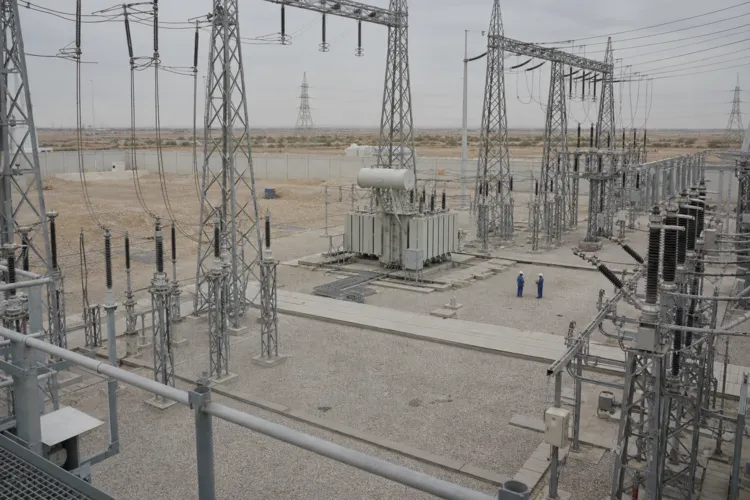
SEC’s 9-line HVDC plan is best read as a transmission “power highway” concept, similar to how U.S. analysts describe a HVDC macrogrid that can be built piece by piece. In that U.S. context, interregional transfer capacity is cited at 84 GW, a figure used to illustrate why long-distance transfer matters when demand and supply are uneven across regions. HVDC is repeatedly positioned in the sources as a tool for moving bulk power efficiently over long distances, and for linking systems that cannot be directly connected through AC. This framing helps explain why a multi-line corridor approach fits the logic of a Saudi Electricity Company grid expansion, even when project-specific Saudi figures are not provided in the sources.
The market backdrop reinforces why large corridor programs keep appearing worldwide. One report values the global HVDC Transmission Market at USD 12.39 billion in 2025 and projects USD 22.93 billion by 2035, with a 6.34% CAGR from 2026–2035. A separate analysis of HVDC transmission systems expects growth from USD 13.38 billion in 2025 to USD 14.62 billion in 2026, reaching USD 22.47 billion by 2031 at an 8.98% CAGR over 2026–2031. These are global figures, not Saudi-specific, but they show sustained investment momentum. They also underline that interregional build-outs are increasingly treated as long-term infrastructure programs rather than one-off upgrades.
Why “Interregional Power Highways” Keep Pointing to HVDC
Across the sources, HVDC is repeatedly linked to long-distance transfer and renewable integration constraints. One market analysis states that HVDC enables bulk electricity transfer with losses far below equivalent AC over distances exceeding several hundred kilometres. Another report highlights how developers favor voltage-source converter (VSC) schemes because they can inject or absorb reactive power without synchronous condensers, reducing footprint and lifetime operating cost. The same source describes modular multilevel converter (MMC) stations using 6.5 kV IGBTs and notes harmonic distortion reduced to below 1%, supporting stricter grid codes. In practice, that technology stack is what makes a multi-line interregional vision feasible as a system, not just as individual point-to-point links.
Component and topology choices also shape how a corridor plan would be executed. In 2025, converter stations captured 53.5% revenue within the HVDC transmission systems market, while overhead systems held 55.1% market share by transmission type. By voltage rating, the 400 to 800 kV class accounted for 45.9% of installations in 2025, and the above-800 kV tier is expected to post an 11.6% CAGR by 2031. Another converter-focused source notes that about 17% of installations support cross-border and interregional power exchange, and that bi-polar configurations represented roughly 31% of the market (USD 289.64 million in 2026), reflecting the value of continuous power flow even if one line is interrupted.
Cable supply trends further explain the corridor narrative, even when individual Saudi routing details are not in the sources. The HVDC Cables Market is valued at USD 11.86 billion in 2025 and is projected to reach nearly USD 17.04 billion by 2032, growing at a 5.31% CAGR from 2026 to 2032. The same source notes that HVDC cable voltages mostly range from 100 to 800 kV and that HVDC can transfer power across grid systems operating at different frequencies, such as 50 Hz and 60 Hz. Another market analysis ties offshore wind to HVDC cable demand and states that each new gigawatt of offshore wind typically consumes up to 120 km of ±525 kV XLPE cable. Together, these figures show why long corridors are increasingly planned as repeatable “lines plus converter nodes” programs.
What is the core idea behind SEC’s 9-line HVDC plan?
What do the sources say about global HVDC market growth?
Which HVDC components and configurations matter most for interregional corridors?
How do cables and voltage levels show up in HVDC planning trends?
How does this connect to Saudi Electricity Company grid expansion as a topic?
Talk to us for your needs in:
-
Energy Efficiency Strategy & Feasibility
-
Renewable Energy Strategy & Investment Advisory
-
Digital Energy & Smart Grid Strategy
-
Market Entry Strategy
-
Sustainability & Impact Strategy
-
Energy Project Governance & PMO Advisory
-
Energy Market Research
-
Energy Stakeholder & Customer Research
-
Energy Market Intelligence
-
Energy Feasibility & Investment Assessment
-
Energy Sector Benchmarking & Performance Strategy