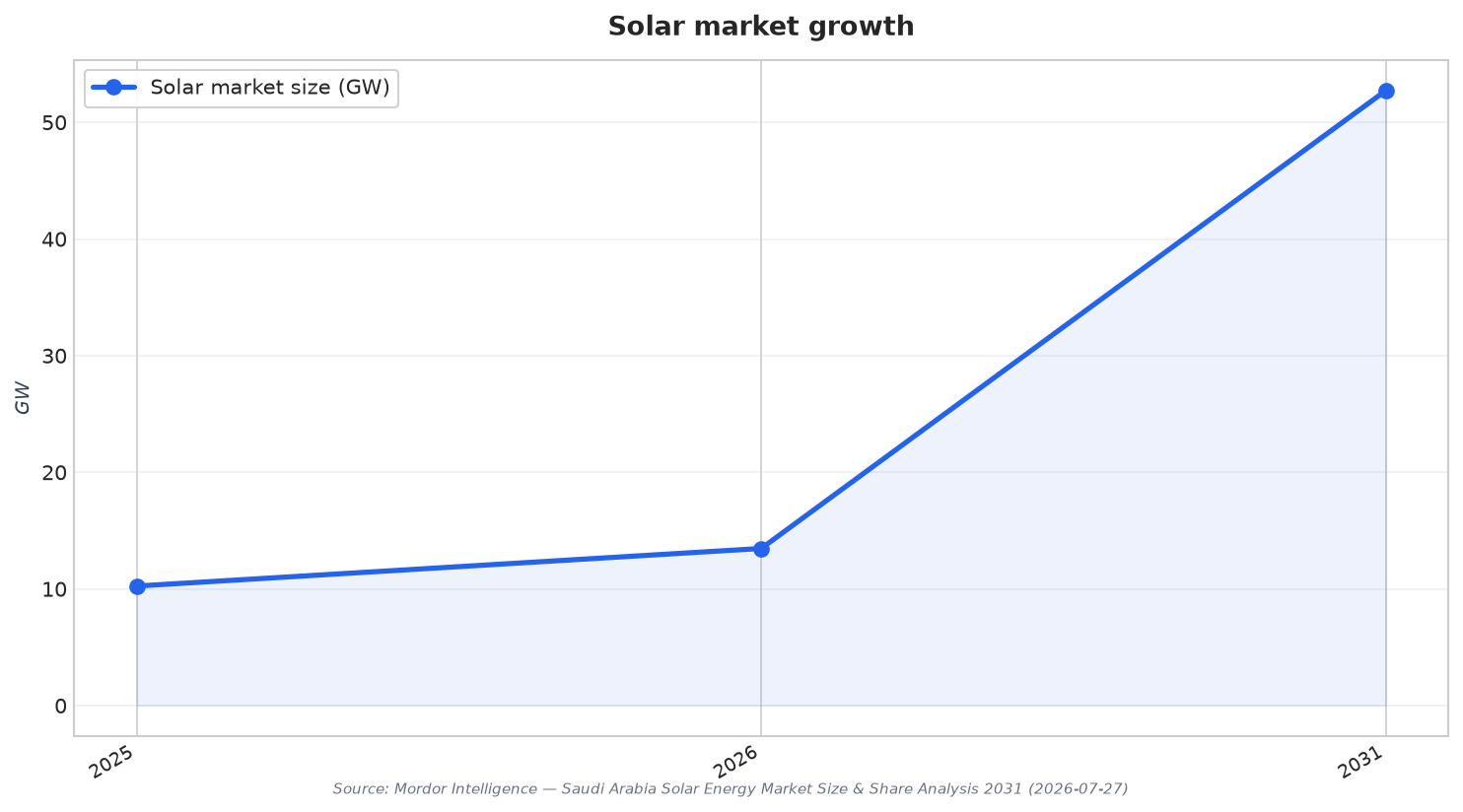
Saudi Arabia’s solar buildout is scaling quickly, and the conversation is shifting from daytime generation to firm delivery after sunset. Mordor Intelligence estimates the Saudi Arabia solar energy market size at 13.47 GW in 2026, up from 10.25 GW in 2025, with projections reaching 52.72 GW by 2031 at a 31.40% CAGR over 2026–2031. Solar PV dominated with 98.55% market share in 2025, while on-grid installations held an 89.85% share. Those figures underline why solar-plus-storage hybrids are increasingly relevant: the grid has to absorb variable solar output at scale, then smooth and shift that energy when demand peaks later.
Procurement signals also point toward firming strategies. Mordor Intelligence notes that utility procurements now embed battery storage and local-content thresholds, and that local-content rules in REPDO auctions increased from 15% to 35% between Round 1 and Round 6. It also reports that over 3.3 GW was awarded in the latest rounds at an average tariff of 1.97¢/kWh, while recent winning bids dipped to 1.67 c/kWh. This tender structure matters because it reduces development risk through predictable timelines and contract structures, and it pushes developers to engineer projects that can meet grid expectations with fewer curtailment penalties and better dispatch characteristics.
What Hybrid Architectures Mean for After-Sunset Firming
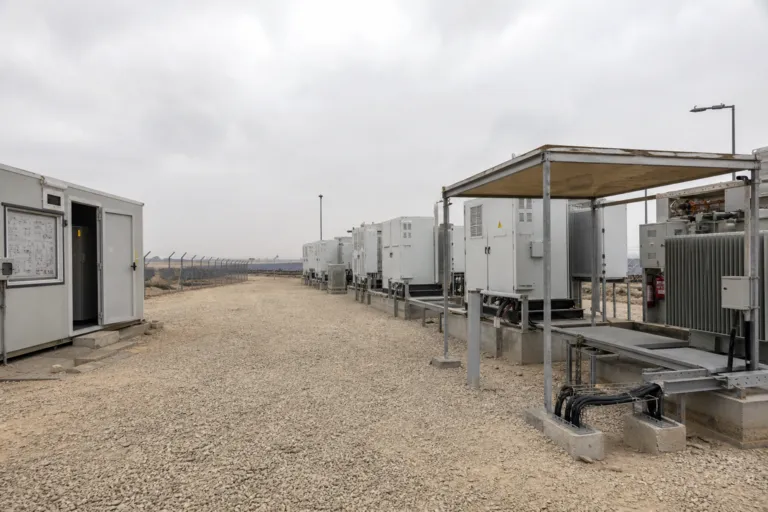
System design choices affect both efficiency and cost, especially at utility scale. IndexBox’s Middle East hybrid solar-wind energy storage analysis says DC-coupled hybrid systems reduce power conversion losses and can lower per-kWh storage costs by 8–12% compared to AC-coupled architectures, noting adoption particularly in Saudi Arabia’s large-scale renewable zones. The same report describes hybrid plants that combine generation and storage with predictive energy management software (EMS) to deliver firm, schedulable output and grid stability services. In parallel, Mordor’s renewable energy market analysis states that transmission-linked hybrid layouts enhance grid stability, smooth variable output, and reduce curtailment penalties in the Saudi Arabian renewable energy market.
Storage momentum is becoming more visible in market sizing and tenders. IMARC Group estimates the Saudi Arabia solar energy storage market reached USD 160.43 million in 2024 and expects it to reach USD 728.01 million by 2033 at a 17.10% CAGR during 2025–2033. It also reports that, in November 2024, Saudi Arabia launched an 8 GWh battery storage tender initiated by the Saudi Power Procurement Company (SPPC), comprising four BESS projects with a combined capacity of 2,000 MW (8,000 MWh). On the supply side, IMARC adds that in October 2024 China’s Hithium partnered with Saudi firm MANAT to launch Hithium MANAT, aiming to establish a 5 GWh battery storage manufacturing plant in Saudi Arabia.
Execution capacity and integration know-how can still constrain rollout, especially for complex hybrids. IndexBox’s Saudi hybrid solar-wind-diesel market study highlights bottlenecks in hybrid controller and EMS supply, stating that lead times for advanced HEMS range from 14–28 weeks globally. It also estimates that Saudi Arabia has about 6–10 EPC firms with demonstrable experience integrating hybrid solar-wind-diesel-battery systems. Even so, the direction is clear: with solar rising, storage tenders expanding, and designs like DC-coupled configurations gaining preference, the solar plus storage hybrid Saudi Arabia theme is increasingly about bankable delivery—firm power profiles, fewer curtailment risks, and a growing local-content and manufacturing ecosystem.
How fast is Saudi Arabia’s solar market projected to grow?
What did the SPPC battery storage tender include?
Why are DC-coupled hybrids gaining attention in the region?
What are key delivery bottlenecks for hybrid projects in Saudi Arabia?
What does a solar-plus-storage hybrid approach in Saudi Arabia aim to solve after sunset?
Talk to us for your needs in:
-
Energy Efficiency Strategy & Feasibility
-
Renewable Energy Strategy & Investment Advisory
-
Digital Energy & Smart Grid Strategy
-
Market Entry Strategy
-
Sustainability & Impact Strategy
-
Energy Project Governance & PMO Advisory
-
Energy Market Research
-
Energy Stakeholder & Customer Research
-
Energy Market Intelligence
-
Energy Feasibility & Investment Assessment
-
Energy Sector Benchmarking & Performance Strategy