For investors, war-risk insurance for Saudi energy projects sits inside a wider conversation about how cross-border capital is protected when conflict risk rises. Political risk insurance (PRI) is typically used by foreign investors and their creditors to protect assets and operations in countries exposed to political instability, and the OECD notes it can reduce uncertainty, lower the cost of capital, and help keep financing available. In the Gulf, that investor focus has intensified because modern exposures extend beyond physical damage to include supply chain disruption, sanctions exposure, port closures, airspace restrictions, and cyber interference, as described in Legal 500’s Gulf-focused analysis. The pricing question becomes practical: what is insurable, on what terms, and for how long.
Shipping lanes and energy logistics shape the risk premium because they transmit shocks into inflation, supply chains, and insurance capacity at the same time. The Actuaries Institute highlights that about 15% to 20% of the global supply of oil and liquefied natural gas passes through the Strait of Hormuz, and calls it a chokepoint that can sharply drive up energy prices and trigger inflationary pressures worldwide. In that same analysis, a prolonged conflict is expected to dampen global economic growth by 1 to 2 absolute percentage points and increase global inflation by 2 to 3 absolute percentage points. For insurers and reinsurers, that feeds into underwriting performance, accumulation concerns, and pricing for specialty classes, including political violence and terrorism, where the article also notes a withdrawal of war risk coverage contributing to higher oil, gas, and freight costs.
How Investors and Insurers Reprice Gulf Energy Risk
Investor pricing follows insurer repricing, and the Howden Re Strait of Hormuz report describes a market turning more restrictive for Gulf energy. It states that energy insurers covering Gulf offshore platforms and refineries are repricing at materially higher rates, that offshore platforms within or adjacent to the Strait zone are now effectively uninsurable at standard market terms, and that war risk extensions for Gulf energy infrastructure are being withdrawn or renegotiated at multiples of prior pricing. The same report notes political violence and terrorism coverage for Middle East energy assets being quoted at up to 10% ROL, and also describes “extreme price volatility” including a 12x repricing, contract uncertainty tied to a 72-hour cancellation clause, and aggregation risk driving underwriting withdrawal. For investors, these terms translate directly into higher contingencies, tighter lender requirements, and more focus on what events trigger coverage across interconnected lines.
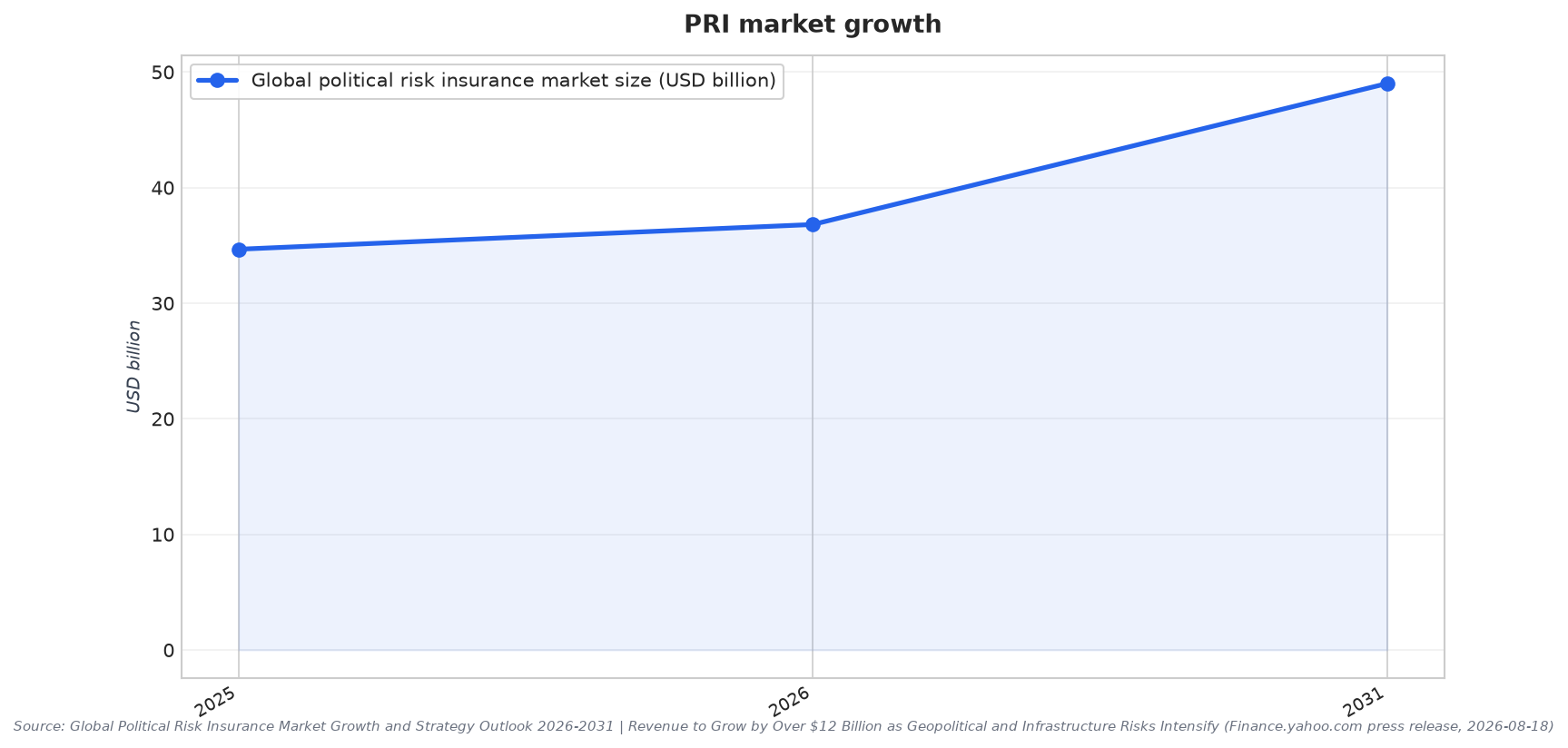
Those constraints land in a global market that is still growing, but not uniformly available where risk feels most urgent. A Finance Yahoo paid press release projects the global political risk insurance market rising from USD 34.67 billion in 2025 to USD 36.81 billion in 2026, reaching USD 49.01 billion by 2031, with a forecast CAGR of 5.89% from 2026 to 2031. It also reports credit and political risk losses linked to geopolitical events exceeding USD 250 million for a third consecutive year. In parallel, The Business Research Company estimates the political risk insurance market at $7.07 billion in 2025 and expects $10.77 billion in 2030 at an 8.8% CAGR, while noting North America as the largest region in 2025 and Asia-Pacific as the fastest growing. The same press release warns capacity remains restricted in several high-risk jurisdictions, and Gulf-specific commentary from Legal 500 stresses that accumulation across marine, aviation, property, energy, and specialty lines is now central to underwriting and dispute risk.
In practice, investors price geopolitical risk by mapping insurance structure to project vulnerabilities and financing points. The OECD describes coverage being offered by specialty private insurers as well as development finance institutions and export credit agencies, and points to public guarantees and compensation mechanisms that supported war-risk coverage so ships began sailing again and millions of tonnes of grain reached global markets. The Finance Yahoo press release adds that large infrastructure and energy projects drive demand because they depend on sovereign commitments, long-term contracts, stable tariff frameworks, and reliable currency-transfer conditions, and notes that the Multilateral Investment Guarantee Agency surpassed USD 100 billion in cumulative guarantee issuance in April 2026, while the World Bank Group Guarantee Platform is targeting USD 20 billion in annual issuance by 2030. For Saudi-linked energy investment decisions, the key is not only buying a policy, but negotiating cancellation clauses, event definitions, and limits that can withstand correlated loss scenarios across the Gulf.
How do investors price war-risk insurance for Saudi energy projects when Gulf tensions rise?
What Strait of Hormuz exposure matters most for insurance pricing?
What pricing benchmarks are being quoted for political violence and terrorism cover on Middle East energy assets?
How large is the global political risk insurance market according to the cited projections?
Why do accumulation and correlated losses matter for Gulf energy insurance?
Talk to us for your needs in:
-
Energy Efficiency Strategy & Feasibility
-
Renewable Energy Strategy & Investment Advisory
-
Digital Energy & Smart Grid Strategy
-
Market Entry Strategy
-
Sustainability & Impact Strategy
-
Energy Project Governance & PMO Advisory
-
Energy Market Research
-
Energy Stakeholder & Customer Research
-
Energy Market Intelligence
-
Energy Feasibility & Investment Assessment
-
Energy Sector Benchmarking & Performance Strategy