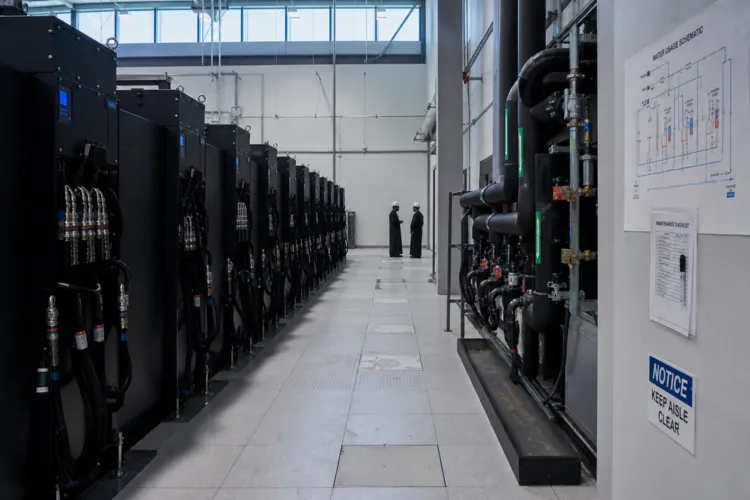
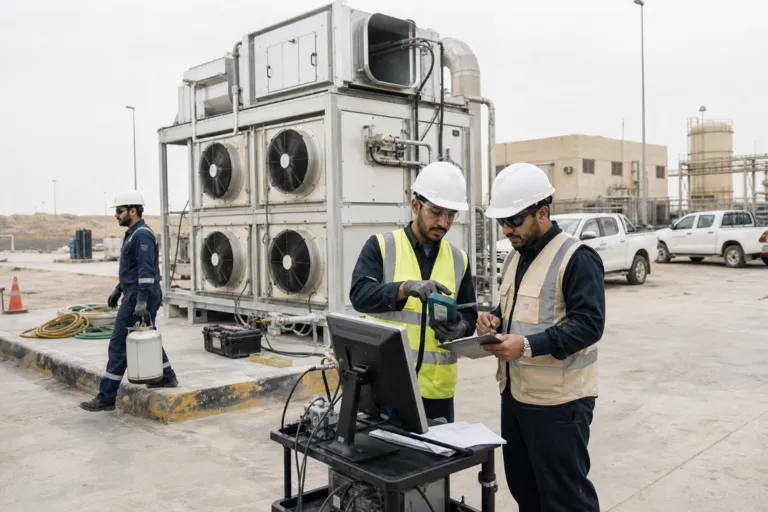
Direct air capture (DAC) is moving from a niche idea to a real climate tool in Saudi Arabia. DAC uses chemical or physical processes to extract carbon dioxide (CO2) directly from ambient air. If the captured CO2 is then put into safe long-term storage, it becomes direct air carbon capture and sequestration (DACCS), which can achieve carbon dioxide removal.
This matters because DAC is different from carbon capture and storage (CCS). CCS captures CO2 from point sources, such as a cement factory or a bioenergy plant. DAC aims at the air itself, using steps like contacting air with chemical media, then using energy such as heat to release a concentrated CO2 stream for dehydration and compression, while the media is regenerated for reuse.
Saudi Arabia has already started testing DAC in real conditions. In July 2025, the Kingdom inaugurated its first DAC demonstration unit in Riyadh through the Ministry of Energy, KAPSARC, and Climeworks. The unit is designed to capture carbon dioxide directly from the atmosphere and is being tested under Riyadh’s hot and arid conditions. The long-term national goal linked to scaling DAC and CCUS is to capture up to 44 million tonnes of CO2 annually by 2035.
Why Demand Is Rising Now, Not Later
Saudi Arabia is also building demand signals through carbon markets. The Riyadh Voluntary Carbon Market launched in November 2024. On day one, 23 companies traded over 2.5 million tonnes of credits at 37.5 SAR per tonne. One large example is a 30 million-tonne deal linked to NEOM. This market activity supports the case for more high-quality carbon removal, including DAC-based credits.
The technology and investment story is moving fast too. A 2025 outlook cited the Direct Air Capture market growing from $0.11 billion in 2025 to $0.69 billion by 2029, a 56.7% CAGR. Yet cost is still a major barrier. One source notes that in 2025 DAC costs exceeded $1000 per tonne of CO2, and DAC has not been integrated into emissions trading because the cost per ton is many times the carbon price.
Beyond Riyadh, the next step may be industrial scale in Jubail. In February 2026, the Royal Commission for Jubail and Yanbu signed an MoU with Climeworks to study the feasibility of a large-scale DAC carbon removal facility in Jubail Industrial City. The same update notes that Aramco, in partnership with Linde and SLB, is building the Jubail CCS hub, planned to capture and store up to 9 million metric tonnes of CO2 per year starting in 2027 in the first phase. Together, these projects show how DAC could become a new frontier beyond traditional CCUS, with carbon removal treated as a future service, not only a cost.
What is direct air capture saudi arabia testing today?
How is DAC different from CCS?
What is the Saudi target linked to scaling DAC and CCUS?
What happened at the Riyadh Voluntary Carbon Market launch?
Is a larger DAC project being explored outside Riyadh?
Talk to us for your needs in:
-
Energy Efficiency Strategy & Feasibility
-
Renewable Energy Strategy & Investment Advisory
-
Digital Energy & Smart Grid Strategy
-
Market Entry Strategy
-
Sustainability & Impact Strategy
-
Energy Project Governance & PMO Advisory
-
Energy Market Research
-
Energy Stakeholder & Customer Research
-
Energy Market Intelligence
-
Energy Feasibility & Investment Assessment
-
Energy Sector Benchmarking & Performance Strategy