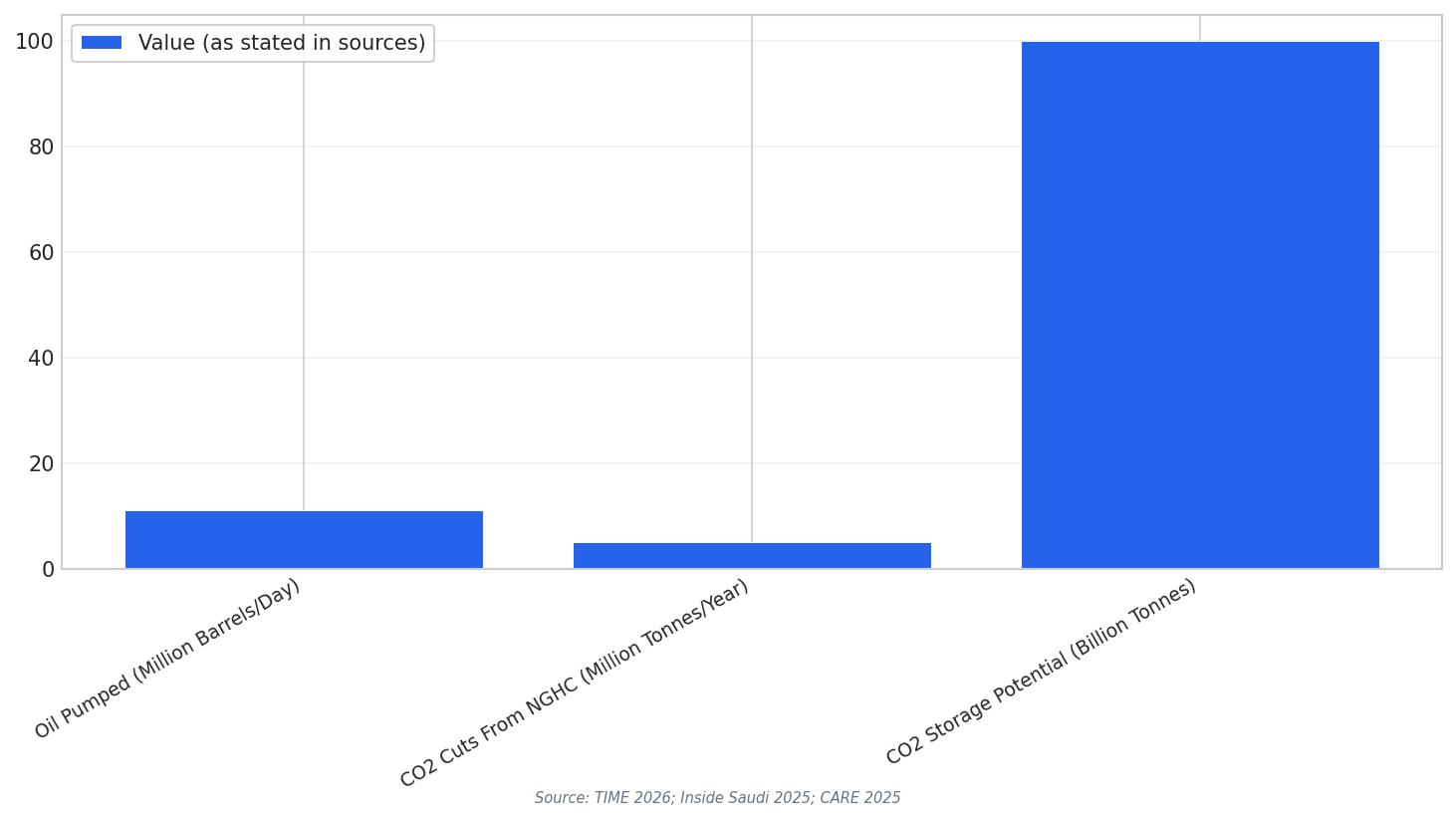
Saudi Arabia is best known for oil. It pumps nearly 11 million barrels of oil a day and sells more than 7 million on international markets. It also says it wants net-zero carbon emissions within its borders by 2060. In that gap between oil strength and climate pressure, a quieter bet is taking shape: e-fuels and synthetic fuels.
Green hydrogen gets the headlines. One large project is expected onstream in 2025 with 4 GW of renewable capacity. Another report says the same project will run on about 4 GW of renewable generation, using 5.5 million solar panels and more than 250 wind turbines, supported by battery storage. This matters for e-fuels too, because renewable electricity is a key input for making low-carbon fuels.
Here is a simple comparison of major Saudi energy and climate figures that shape the business case for fuels beyond crude: oil output, emissions impact claims for a green hydrogen hub, and a CO2 storage potential estimate.
Why E-Fuels Fit the Saudi Playbook
Research focused on the Middle East and North Africa says synthetic fuels could substantially reduce crude oil consumption and CO2 emissions by 2050. But it also sets clear conditions: stringent policy support and technological advancements. It points to the need for robust regulatory frameworks to help cost-competitive alternatives such as ethanol and hydrogen.
Saudi plans already speak this language. One strategy summary says carbon utilisation can turn absorbed CO2 into usable outputs like synthetic fuels, construction materials, and chemical feedstocks, with a target to make more than $2 billion by 2030. The same source says Saudi Arabia’s sedimentary basins may retain more than 100 billion tonnes of CO2. That kind of storage and utilisation narrative supports the idea of producing fuels from captured carbon, not only exporting molecules like hydrogen.
Capturing CO2 is not simple. A Saudi-focused assessment says direct air capture offers high potential for extracting CO2 directly from the atmosphere and is considered sustainable, especially when powered by renewable energy rather than fossil fuels. It also warns the technology remains highly cost-intensive. The same paper notes Saudi grid emission factors typically range between 0.6 and 0.7 kg CO2/kWh, which is another reason clean power supply choices matter when designing synthetic fuel pathways.
Saudi Arabia’s wider context makes this “quiet bet” feel urgent. For Saudis, two-thirds of whom are younger than 35, climate change is not abstract. Summer heat regularly tops 120°F. At the same time, oil remains central to the economy, with Aramco profits cited at about $110 billion in one recent year. E-fuels and synthetic fuels Saudi Arabia projects can be read as an attempt to keep energy leadership while changing what “fuel” means.
What are e-fuels and synthetic fuels Saudi Arabia is exploring?
Why would Saudi Arabia invest in synthetic fuels if it is building green hydrogen projects?
What role does CO2 capture play in making synthetic fuels?
What climate targets and impacts are mentioned in the sources?
Talk to us for your needs in:
-
Energy Efficiency Strategy & Feasibility
-
Renewable Energy Strategy & Investment Advisory
-
Digital Energy & Smart Grid Strategy
-
Market Entry Strategy
-
Sustainability & Impact Strategy
-
Energy Project Governance & PMO Advisory
-
Energy Market Research
-
Energy Stakeholder & Customer Research
-
Energy Market Intelligence
-
Energy Feasibility & Investment Assessment
-
Energy Sector Benchmarking & Performance Strategy