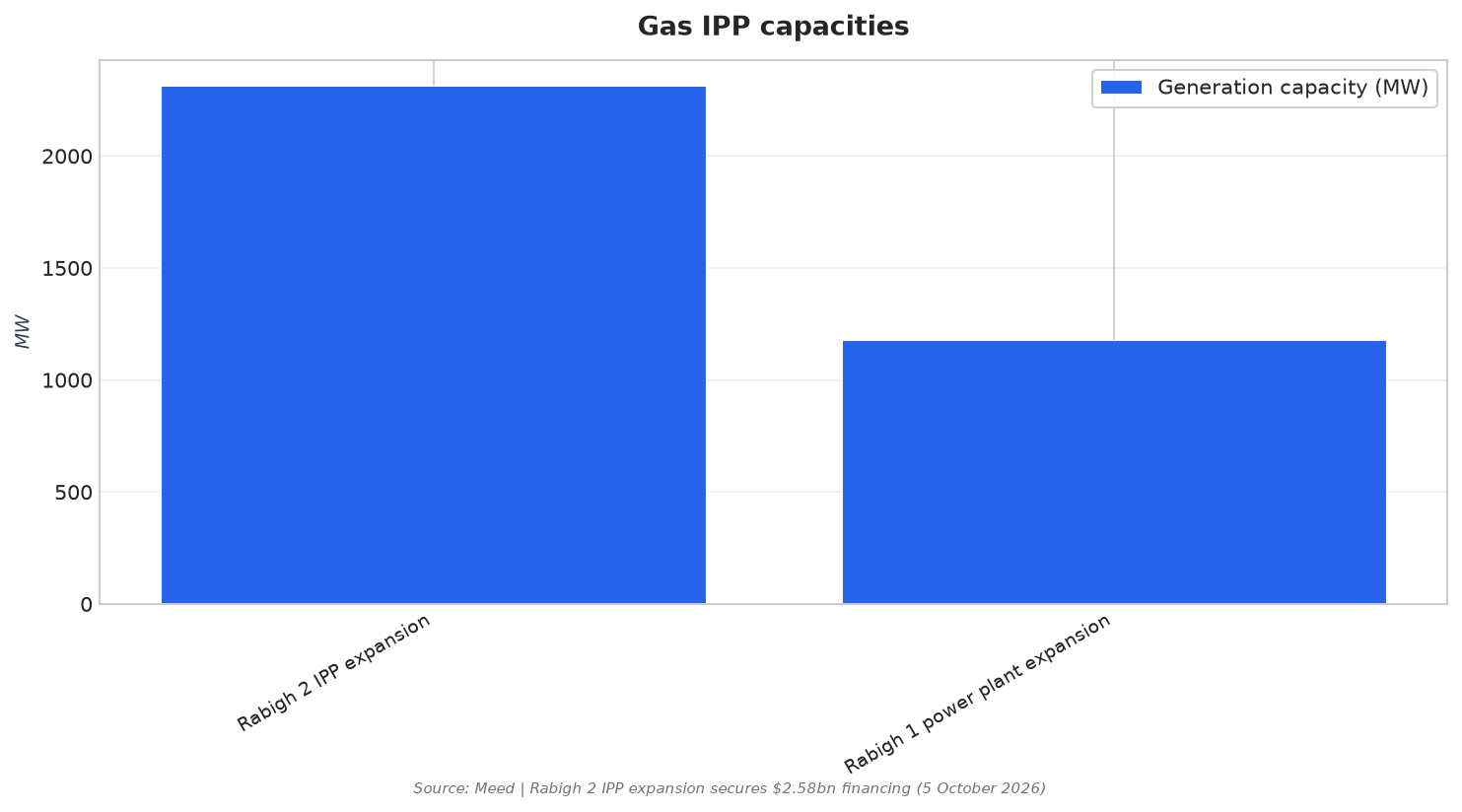
Saudi Arabia’s Rabigh 2 combined-cycle gas-turbine (CCGT) independent power project expansion has reached financial close, backed by SR9.69bn ($2.58bn) in long-term financing, according to disclosures referenced by MEED. The expansion is tied to a 2,313.5MW generation capacity and will be developed in the Mecca region. The project is being developed by Al-Morjan Two Electricity Company, with Acwa and Saudi Energy each holding a 40% stake. It is structured as a build, own and operate project and is designed to be carbon-capture ready, which points to design choices that can accommodate future carbon capture units.
What makes this financing notable is its scale and duration. The tenor is about 34 years, and funding came from a consortium of local, regional, and international lenders. Named lenders include Abu Dhabi Commercial Bank, Alinma Bank, Boubyan Bank, Commercial Bank of Dubai, HSBC Bank Middle East, Industrial and Commercial Bank of China, Riyad Bank, Saudi Awwal Bank, Saudi National Bank, Standard Chartered Bank (Taiwan), and Sumitomo Mitsui Trust Bank (London Branch), among others. Reuters reporting via TradingView added that financing was secured on 1 October for 9.69 billion Saudi Riyal ($2.59 billion), with limited guarantees covering reserve liquidity and the reserve account required under the financing.
What the PPA and Contract Structure Signals
Commercial structure matters as much as megawatts for gas-fired IPPs. MEED reported that Acwa and Saudi Energy signed a 31-year power purchase agreement (PPA) with Saudi Arabia’s principal buyer, Saudi Power Procurement Company (SPPC), for the project. At the time of the PPA disclosure, the contract value was stated at SR11.5bn ($3.07bn) in separate stock exchange filings. The scope also includes financing and expanding a 380kV electrical substation, a grid-facing element that often defines how quickly new capacity can be integrated. Power Technology also noted that the expansion supports the national grid through these 380kV substation upgrades and that the project is planned to supply power to the Saudi Electricity Company (SEC) using natural gas as its primary fuel.
Construction status and delivery partners provide another lens on execution risk. MEED Projects said construction works have commenced, and an Elsewedy Electric–Sinohydro joint venture has been working as the main contractor. Engineering News-Record (ENR) reported an engineering, procurement and construction (EPC) contract valued at $2.2bn for a 2.3-GW natural gas-fired expansion, and cited contractor reporting of more than 39% overall project progress. ENR also noted that the existing Rabigh 2 generating station has a capacity of 2,060MW, was built under a separate contract, and that ACWA Power project records indicate it entered commercial operation in 2018.
Zooming out, the Rabigh 2 IPP expansion sits alongside other Saudi gas-fired IPP activity referenced in the same reporting stream. MEED described a separate energy conversion agreement announced in January for the Rabigh 1 power plant expansion, valued at SR5.33bn ($1.42bn), with a planned 1,179MW gas-fired capacity and expected completion by the end of 2026. MEED also reported that Acwa started initial commercial operations at the Taiba 1 and Qassim 1 CCGT plants, with a combined generation capacity of about 3.8GW, and that these were two of four projects procured under the first round of SPPC’s gas-fired IPP programme. Against that backdrop, the Rabigh 2 financing and long-tenor structure highlights how Saudi Arabia is packaging large CCGT additions with long-duration PPAs and grid substation scope.
What is the financing size and capacity for the Rabigh 2 IPP expansion?
How long is the power purchase agreement for the Rabigh 2 expansion?
Who owns the project company developing the Rabigh 2 expansion?
What additional grid infrastructure is included in the Rabigh 2 expansion scope?
What does “carbon-capture ready” mean in the project description?
Talk to us for your needs in:
-
Energy Efficiency Strategy & Feasibility
-
Renewable Energy Strategy & Investment Advisory
-
Digital Energy & Smart Grid Strategy
-
Market Entry Strategy
-
Sustainability & Impact Strategy
-
Energy Project Governance & PMO Advisory
-
Energy Market Research
-
Energy Stakeholder & Customer Research
-
Energy Market Intelligence
-
Energy Feasibility & Investment Assessment
-
Energy Sector Benchmarking & Performance Strategy