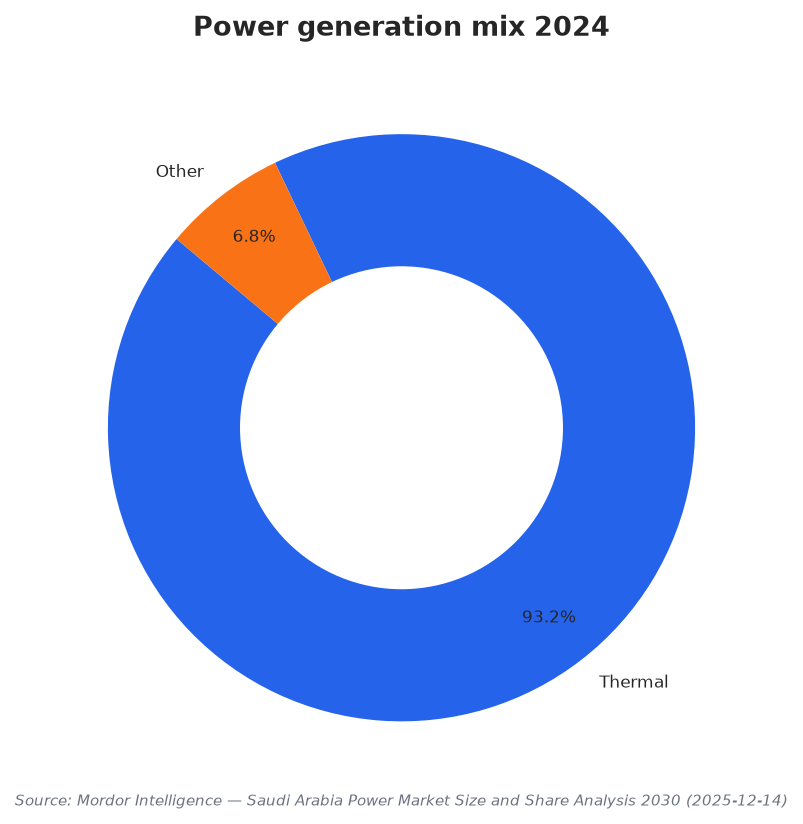
Industrial electrification in Saudi Arabia is becoming more practical as the Kingdom expands renewables and reforms electricity pricing. Mordor Intelligence reports thermal generation still led with 93.2% of power market share in 2024, but renewables are forecast to expand at a 39.6% CAGR through 2030. For factories, the logic is straightforward: as clean electricity grows and tariffs better reflect costs, electrifying process heat can become a core decarbonization and competitiveness lever. That shift also aligns with the Liquid Fuel Displacement Programme, which aims to free oil for export by switching power generation toward gas and clean energy.
Grid-connected renewables climbed to 6.5 GW in 2024 and are scheduled to double to 12.7 GW in 2025, according to Mordor Intelligence. The National Renewable Energy Program has awarded 21 projects totaling 19 GW, and seven plants equal to 4.1 GW were operating by late 2024. Low project tariffs are also shaping the business case for electrification. Mordor Intelligence notes Sakaka Solar closed at 2.32 cents/kWh and Dumat Al Jandal Wind at 2.13 cents/kWh. On the procurement side, the U.S. International Trade Administration highlights ACWA Power’s financial close in August 2023 for Al Shuaibah 1 and Al Shuaibah 2 solar PV projects, with aggregate capacity over 2.6 GW.
Replacing Process Heat: Heat Pumps, Solar PPAs, and Heat Recovery
Replacing fossil-fired heat starts with choosing electrified thermal technologies that fit real plant constraints. Mobility Foresights projects the Saudi Arabia industrial heat pump systems market to grow from USD 4.8 billion in 2025 to USD 11.9 billion by 2032, at a CAGR of 13.9%. The same source links growth drivers to industrial electrification, demand for low-carbon thermal solutions, and long-term energy cost savings. It also notes that integrating heat pumps with industrial energy systems enables reuse of low-grade waste heat for pre-heating, drying, and other thermal processes. For sites that can add on-site clean power, it states heat pumps are increasingly integrated with renewable electricity such as solar PV and wind.
Pricing and permitting changes are pushing industry to act rather than wait. Mordor Intelligence reports the 2018 rate restructuring moved industrial tariffs to 18 halala/kWh and linked quarterly adjustments to Brent and Henry Hub benchmarks. It adds that large factories in Jubail and Yanbu have signed behind-the-meter solar power-purchase agreements over 100 MW each, achieving delivered costs below two cents/kWh. On the enabling infrastructure, Mordor Intelligence cites a USD 20 billion modernization plan anchored in HVDC links and smart meters to integrate the growing renewable fleet, and notes streamlined licensing can clear projects in six months for plants below 500 MW, a quarter of the previous timeline.
Not every process heat load must be electrified immediately; some can be reduced first through recovery and monitoring. A Saudi Energy Consulting market analysis says Mobility Foresights projects the Saudi Arabia heat recovery system market to grow from USD 14.6 billion in 2025 to USD 25.3 billion by 2031, at a 9.7% CAGR, driven by rising energy prices, demand for efficiency, and decarbonization efforts. The same analysis states Saudi Arabia accounted for 3.7% of the global waste heat recovery system market by revenue in 2023 and warns that lack of education and outreach can inhibit adoption. In practice, it recommends measuring and monitoring heat flows so projects compete fairly for capital, supported by IoT-enabled monitoring tools for performance and predictive maintenance.
What is driving industrial electrification in Saudi Arabia for process heat?
How fast are renewables scaling on Saudi Arabia’s grid?
What role can industrial heat pumps play in replacing fossil process heat?
What do the sources say about behind-the-meter solar for industrial sites?
How big is the opportunity for waste heat recovery in Saudi industry?
Talk to us for your needs in:
-
Energy Efficiency Strategy & Feasibility
-
Renewable Energy Strategy & Investment Advisory
-
Digital Energy & Smart Grid Strategy
-
Market Entry Strategy
-
Sustainability & Impact Strategy
-
Energy Project Governance & PMO Advisory
-
Energy Market Research
-
Energy Stakeholder & Customer Research
-
Energy Market Intelligence
-
Energy Feasibility & Investment Assessment
-
Energy Sector Benchmarking & Performance Strategy