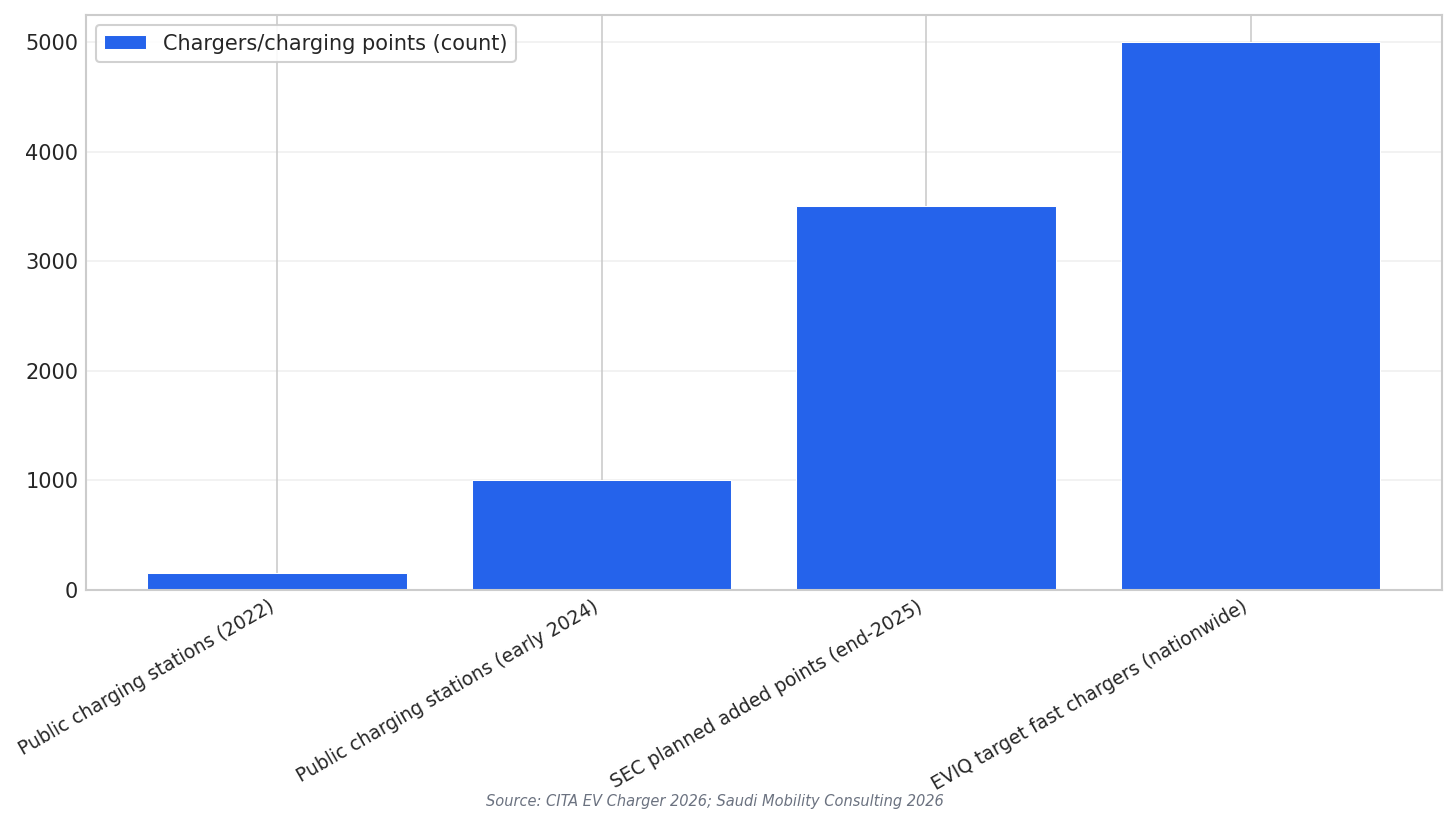
Saudi Arabia is moving from early EV trials to large-scale rollout. Electric vehicle registrations rose by 425% between 2021 and 2023, growing from 375 EVs in 2021 to over 12,000 by the end of 2023. This growth makes ev charging infrastructure saudi arabia a practical issue, not a future one. Public charging station counts also show fast change, but the numbers differ by source. One source says public charging stations grew from 150 in 2022 to over 1,000 by early 2024. Another says Saudi Arabia had only 101 public chargers in 2024. Either way, the direction is clear: demand is rising faster than confidence can.
The 2026 story is about building enough fast charging in the right places. EVIQ, a joint venture between the Public Investment Fund (PIF) and the Saudi Electricity Company (SEC), plans to install over 5,000 fast chargers across cities and highways. EVIQ’s inter-city plan also sets a national scale goal: by 2030, 5,000 chargers and 1,000 hubs nationwide, linking Riyadh, Dammam, Mecca, and Madinah. At the city level, the plan supports the national target of 30% EV adoption by 2030 and matches Riyadh’s goal to make 30% of its vehicles electric by 2030.
Three separate targets help define the current build gap and direction: public charging stations rose from 150 in 2022 to over 1,000 by early 2024, SEC plans an additional 3,500 charging points across 1,000 locations by end-2025, and EVIQ targets over 5,000 fast chargers nationwide.
Who Is Building the Network, and Where 2026 Focuses
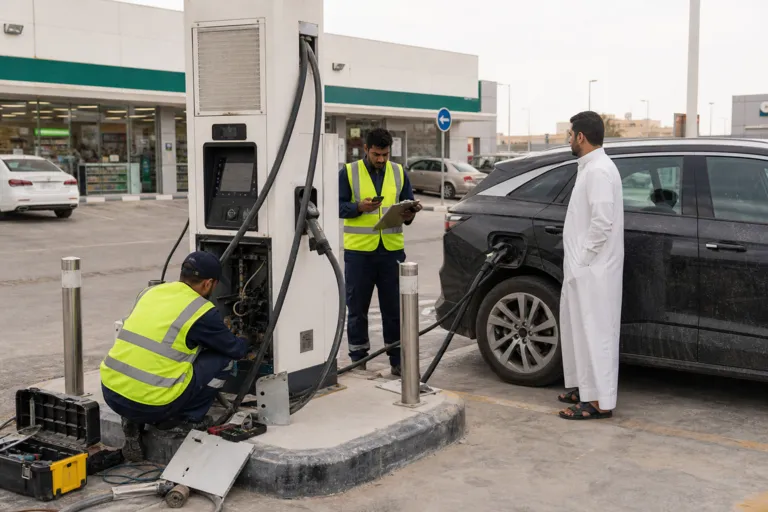
EVIQ is not acting alone. It signed an MoU with Remat Al-Riyadh Development to deploy a city-wide charging network, with placement in high-traffic zones, residential hubs, and public parking. This is meant to reduce range anxiety and make chargers easy to find. The 2026 strategy also prioritizes “desert highways” like the H-40 Riyadh–Jeddah corridor. Ultra-fast chargers rated between 150 and 350 kW are planned at key highway stops such as Afif and Al Quwayiyah. By the end of 2025, EVIQ plans to complete 60 charging stations across major cities and highways such as Riyadh–Qassim and Jeddah–Madinah.
Other operators are also visible. Lucid reported it has surpassed 100 EV chargers across Saudi Arabia, alongside studios in Riyadh, Jeddah, and Al Khobar. On the manufacturing side, Foxconn Interconnect Technology (FIT), through its joint venture Smart Mobility, is expected to start production in 2026 at its first EV charger manufacturing facility in Saudi Arabia. This local production matters because it can shorten supply lines when networks scale.
The biggest investment gap is not only money. It is speed, coverage, and trust. Saudi Arabia’s Ministry of Investment data points to a $20 billion government investment package targeted at EV infrastructure development through 2030. Another source describes a government commitment of over USD 50 billion toward EV manufacturing and infrastructure through 2030, with PIF leading landmark investments. But drivers still judge the network by what they can see on roads. In 2022, 60% of consumers cited range anxiety as a major concern, and today that figure is down to 25%, linked to visible infrastructure progress. Closing the gap in 2026 means more chargers in daily parking areas, plus reliable midpoints on long routes.
What is the main 2030 target for ev charging infrastructure saudi arabia?
Who are the key charging network operators mentioned for Saudi Arabia?
What is planned for inter-city charging in 2026?
How fast is EV adoption rising in Saudi Arabia?
What evidence suggests range anxiety is falling?
Talk to us for your needs in:
-
Energy Efficiency Strategy & Feasibility
-
Renewable Energy Strategy & Investment Advisory
-
Digital Energy & Smart Grid Strategy
-
Market Entry Strategy
-
Sustainability & Impact Strategy
-
Energy Project Governance & PMO Advisory
-
Energy Market Research
-
Energy Stakeholder & Customer Research
-
Energy Market Intelligence
-
Energy Feasibility & Investment Assessment
-
Energy Sector Benchmarking & Performance Strategy