For operators who need higher uptime, drone inspection solar wind farms saudi arabia is not just about better photos. It is about finding faults early and acting fast. One example is a wind blade crack that spread from 3 mm to 30 mm over four months. Another example is a solar string delivering 18% less power due to a failed bypass diode that no human eye caught. AI-powered drone inspection can turn these findings into maintenance actions before revenue disappears.
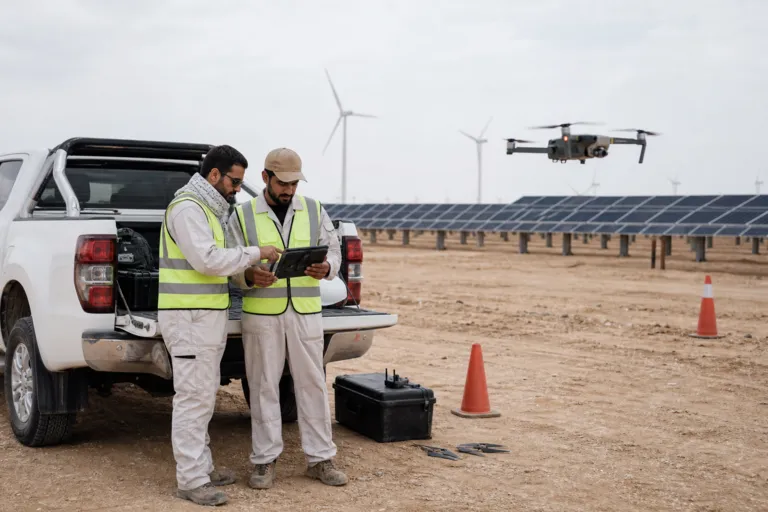
ROI comes from speed, coverage, and fewer risky tasks. OXmaint reports a 75% reduction in inspection time versus manual methods, with 99% AI defect detection accuracy on thermal scans. For wind, a full drone inspection can take under 20 minutes per turbine, compared with 4 to 8 hours using rope access teams. For solar, inspecting a 20 MW site can take 2 to 4 hours by drone versus 2,500 hours on foot.
The cost gap can be large too. OXmaint lists traditional rope-access wind turbine inspection at $3,000 to $5,000 per turbine, versus $800 to $1,500 with drone + AI. For a 50 MW solar farm, manual inspection is listed at $400,000 to $600,000, versus $150,000 to $300,000 with drones. These comparisons show why teams often expect payback inside the first inspection cycle.
High-Value Use Cases for Solar and Wind Sites
On wind assets, AI visual analytics can detect leading edge erosion at the millimeter level, lightning protection system damage, trailing edge splits, and delamination. It can also flag nacelle casing cracks and tower bolt anomalies. These are defects that can be hard to confirm from the ground. Drone workflows also reduce exposure to climbing and rope access, because the operator stays on the ground.
On solar farms, thermal AI can detect hotspots from bypass diode failure, string outages from blown fuses or open circuits, PID patterns, delamination and micro-cracks, and soiling and shading maps. OXmaint also reports defect detection coverage of 10% to 25% of a PV system with manual methods versus 95%+ with thermal AI. This supports targeted cleaning and targeted repairs, instead of broad, expensive field work.
For deeper module-level proof, autonomous drone electroluminescence (EL) mapping is another option. Sinovoltaics and Quantified Energy Labs describe AI-enabled drones that perform high-resolution nighttime EL imaging. The system can inspect up to 15,000 modules per 8-hour night shift, reaching one module per second throughput. More than one million modules have already been analyzed worldwide. Use cases include pre- and post-installation testing, preventive maintenance, warranty and insurance claims after events like hail or sandstorms, and end-of-warranty checks.
What is the main ROI driver for drone inspection solar wind farms saudi arabia?
How much can wind turbine inspection costs drop with drones and AI?
What solar defects can thermal AI find that are easy to miss?
How fast can drone EL mapping inspect solar modules?
Talk to us for your needs in:
-
Energy Efficiency Strategy & Feasibility
-
Renewable Energy Strategy & Investment Advisory
-
Digital Energy & Smart Grid Strategy
-
Market Entry Strategy
-
Sustainability & Impact Strategy
-
Energy Project Governance & PMO Advisory
-
Energy Market Research
-
Energy Stakeholder & Customer Research
-
Energy Market Intelligence
-
Energy Feasibility & Investment Assessment
-
Energy Sector Benchmarking & Performance Strategy