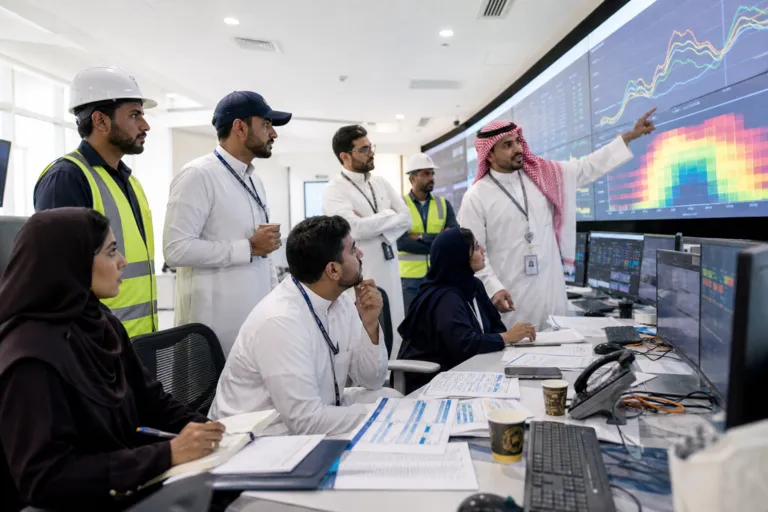
Utilities use AI to turn large data streams into forecasts they can act on. Power Magazine describes utilities that have already invested in sensors, smart meters, grid software, and dashboards, but now need AI-driven analytics that recommend next steps or trigger next-best actions. In forecasting, that means using historical operational data and real-time sensor streams to predict customer demand peaks, system stress, and load imbalances. Utility Dive frames the shift clearly: algorithms can balance supply and demand minute by minute, while also helping utilities restore service faster after storms.
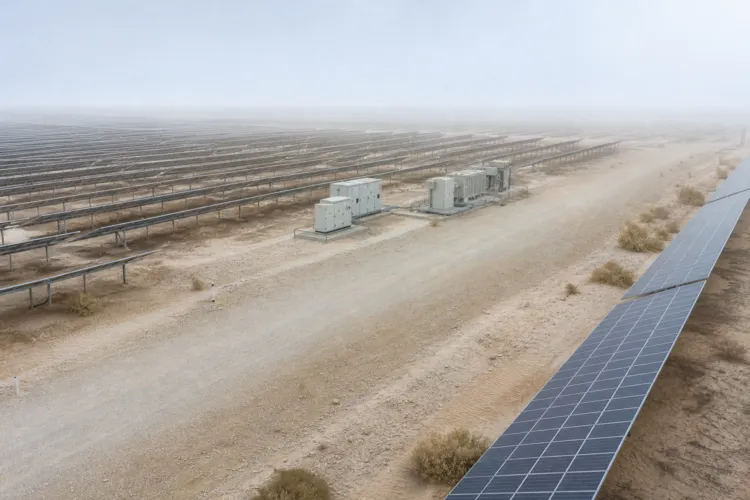
In Saudi Arabia, forecasting matters more as solar expands and variability rises. pv magazine reports Saudi Arabia added around 7–8 GW of solar in 2025. The same analysis forecasts annual solar additions between 12 GW and 14 GW for 2028 to 2035, taking cumulative solar capacity past 50 GW in 2029 and to 67.2 GW by the end of the decade, with 100 GW surpassed in 2033 and 129.7 GW by 2035. The analyst also highlights that absorbing much more solar will require major grid and flexibility investments, including better forecasting and grid codes for inverter-based resources.
How Forecasting Works: Data In, Decisions Out
AI forecasting is not only about predicting a single number for tomorrow’s load. Power Magazine emphasizes analyzing historical operational data plus real-time sensor streams to forecast demand peaks and equipment failure, then intervening proactively. That same approach supports renewable integration by anticipating rapid changes that can create system stress. Another Power Magazine article notes that advanced algorithms can forecast consumption and generation in real time, guiding when to store, use, or sell energy to support grid reliability and deeper renewable integration. The common thread is speed: moving from static dashboards to prescriptive, AI-driven actions.
Reliability pressures add urgency to forecasting quality. Utility Dive reports that 80% of major power outages between 2000 and 2023 stemmed from weather-related events. When storms or heat-driven stress align with high load, utilities need forecasts that are both timely and operational. AI platforms can help predict periods of high demand and run systems more efficiently, according to Power Magazine. In parallel, better forecasting supports planning decisions, such as where to reinforce the grid or how to schedule crews and maintenance to reduce the risk of failure propagation.
Trust also shapes which forecasts are used in daily operations. Power Magazine argues for explainable AI (XAI) so grid operators can understand why a model recommends shifting power loads, and so energy teams can validate and refine recommendations. The same source reports explainable weather forecasting could increase wind energy’s economic value by 20%, and that explainability improves performance by nearly 10% in studies. Saudi Arabia’s wider energy sector is also scaling AI around data strength. Oilandgas360 reports Saudi Aramco recorded $1.8 billion of AI-driven Technology Realized Value in 2024, identified 442 AI use cases, and had more than 200 solutions deployed with over 100 in development as of end-2025, alongside an emphasis on data quality.
Forecasting is also connected to procurement and readiness, not just real-time dispatch. Power Magazine notes AI can forecast demand based on outage history, asset age, weather cycles, and project timelines, and then trigger restocking or supplier sourcing. That matters when solar growth requires new transmission to resource areas and PV-plus-storage procurement to cover evening peaks and limit curtailment, as pv magazine notes. Put together, ai energy forecasting saudi arabia becomes a practical operating capability: predicting load, estimating renewable output, and translating those forecasts into grid actions, investment priorities, and operational resilience.
What is ai energy forecasting saudi arabia used for?
Why is better forecasting tied to Saudi solar growth?
What outage statistic shows why forecasting and resilience matter?
How does explainable AI change energy forecasting decisions?
What does Saudi Aramco’s AI activity indicate about data-driven operations?
Talk to us for your needs in:
-
Energy Efficiency Strategy & Feasibility
-
Renewable Energy Strategy & Investment Advisory
-
Digital Energy & Smart Grid Strategy
-
Market Entry Strategy
-
Sustainability & Impact Strategy
-
Energy Project Governance & PMO Advisory
-
Energy Market Research
-
Energy Stakeholder & Customer Research
-
Energy Market Intelligence
-
Energy Feasibility & Investment Assessment
-
Energy Sector Benchmarking & Performance Strategy