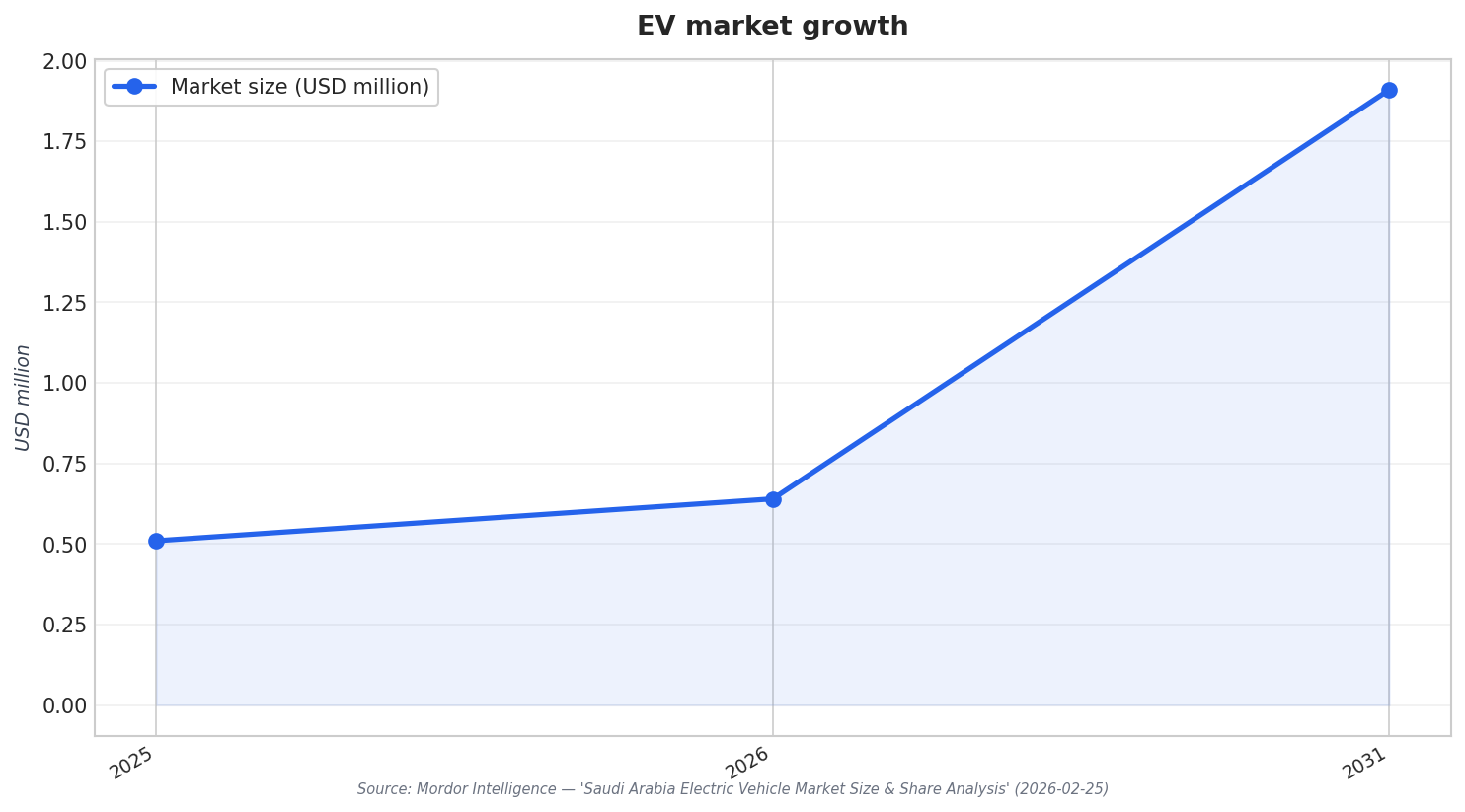
Vehicle-to-grid programs rely on one simple shift: an electric vehicle becomes a controllable energy resource, not only a load. For vehicle to grid Saudi Arabia use cases, the building blocks are appearing in parallel. EV adoption is rising, charging infrastructure is scaling, and bidirectional charger suppliers are positioning products and pilots around grid services. One signal of momentum is registration growth cited from the Saudi Ministry of Investment: EV registrations increased by 425% between 2021 and 2023, moving from 375 EVs in 2021 to over 12,000 by the end of 2023. At the same time, broader market forecasts from Mordor Intelligence expect the Saudi Arabia electric vehicle market size to grow from USD 0.51 million in 2025 to USD 0.64 million in 2026, and reach USD 1.91 million by 2031, with a 24.51% CAGR over 2026–2031.
V2G readiness also depends on where EVs are concentrated and how they are used. Mordor Intelligence reports that passenger cars held 76.81% of the Saudi EV market share in 2025, while commercial vehicles are forecast to expand at a 24.53% CAGR through 2031. That mix matters because fleets can be aggregated more predictably than individual drivers. Regionally, Riyadh commanded 38.73% of 2025 sales, and Jeddah is projected to post the highest 24.57% CAGR through 2031. IndexBox adds a reality check on scale: Saudi Arabia’s total new vehicle market is approximately 650,000–700,000 units annually, and Battery EVs represent less than 2% in 2026. That gap frames why early V2G value may come from targeted pilots rather than nationwide dispatch at first.
Bidirectional Charging: The V2G Hardware and Rules Taking Shape
Bidirectional chargers are the practical enabler of V2G, because they allow energy to flow from the vehicle back to the grid when needed. IndexBox projects the Saudi Arabia bi-directional EV charger market to grow from an estimated USD 45–60 million in 2026 to about USD 620–850 million by 2035, linking growth to grid modernization and fleet electrification under Vision 2030. The same source expects DC bidirectional chargers (V2G-capable) to capture over 55% of market value by 2030, while AC bidirectional units dominate residential installations by unit volume. On policy and interoperability, IndexBox notes that adoption of ISO 15118-20 is accelerating, and that Saudi Arabia’s Electricity & Cogeneration Regulatory Authority (ECRA) is mandating compliance for new grid-connected bidirectional chargers from 2027.
Charging build-out is the other half of the equation, because V2G requires enough connection points in the right locations. Grand View Research estimates the Saudi Arabia EV charging infrastructure market generated USD 10.5 million in revenue in 2025 and is expected to reach USD 35.5 million by 2033, with a 15.5% CAGR from 2026 to 2033, and notes slow chargers held an 81.9% revenue share in 2025. IndexBox also highlights operational friction: grid connection lead times for new charging stations can exceed 12 months. In parallel, IndexBox estimates Saudi Arabia needs 8,000–12,000 additional public charging points by 2030 to support forecast EV volumes, representing a USD 500–800 million investment opportunity. These timelines and investment ranges help explain why V2G aggregation models can start with specific sites that already have power capacity and predictable parking duration.
Execution will hinge on certification, installers, and aggregation programs that can monetize grid services. IndexBox reports that Saudi standards referencing IEEE 1547 and UL 1741-SA can require 12–18 months for new charger models to complete certification, which can slow product variety and market entry. It also estimates the aftermarket installation capacity for bidirectional systems at about 150–200 certified technicians nationwide in 2026, and points to Silicon Carbide power module lead times of 26–36 weeks for high-efficiency modules rated above 10 kW. Despite these constraints, IndexBox says utility-backed energy service providers are launching V2G aggregation pilots in Riyadh, Jeddah, and Dammam, offering free or subsidized bidirectional chargers in exchange for rights to dispatch stored energy during peak demand events. That structure shows how EV owners could participate without managing grid interactions themselves.
What does vehicle-to-grid mean for Saudi Arabia’s EV market?
How fast are EV registrations growing in Saudi Arabia?
What is the forecast for Saudi Arabia’s bidirectional EV charger market?
What policy or standard is linked to bidirectional charging in Saudi Arabia?
What could slow V2G deployment in the near term?
Talk to us for your needs in:
-
Energy Efficiency Strategy & Feasibility
-
Renewable Energy Strategy & Investment Advisory
-
Digital Energy & Smart Grid Strategy
-
Market Entry Strategy
-
Sustainability & Impact Strategy
-
Energy Project Governance & PMO Advisory
-
Energy Market Research
-
Energy Stakeholder & Customer Research
-
Energy Market Intelligence
-
Energy Feasibility & Investment Assessment
-
Energy Sector Benchmarking & Performance Strategy