Corporate PPA Saudi Arabia discussions are accelerating as industrial and commercial electricity needs expand and as renewable procurement becomes more structured. A power purchase agreement (PPA) is a long-term contract between an electricity producer and a buyer, with predetermined terms and pricing for a defined period. In Saudi Arabia, these agreements are tied to financing and operating renewable projects such as solar and wind plants, because they allocate risk and provide revenue certainty for developers while giving buyers more predictable pricing. Dimension Market Research projects the Saudi Arabia PPA market will reach USD 24.5 billion in 2026 and grow at a 36.2% CAGR to USD 395.1 billion in 2035, framing how central long-dated contracts have become to power procurement strategies.
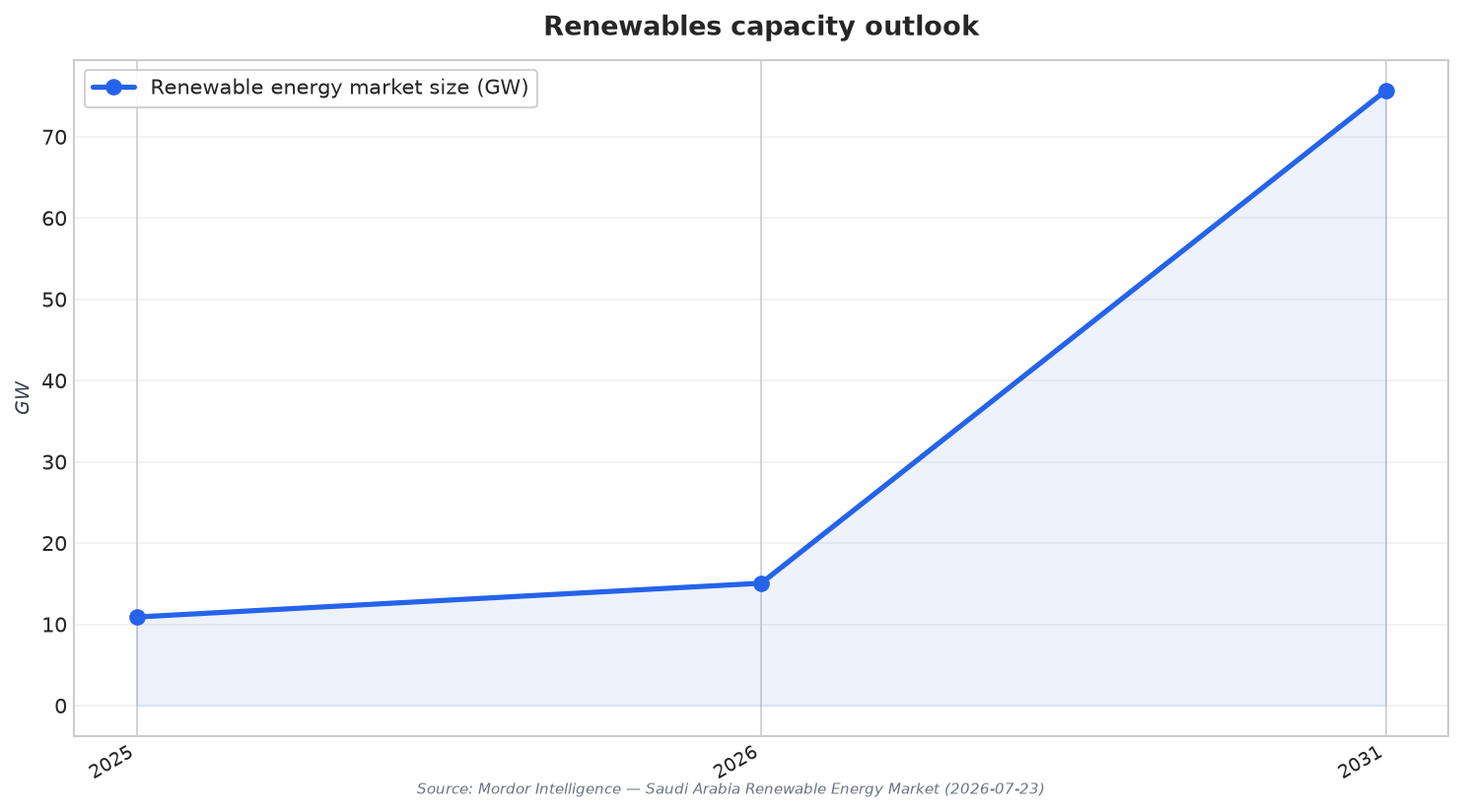
Industrial buyers are not acting in a vacuum. Mordor Intelligence estimates Saudi Arabia’s renewable energy market size at 15.06 GW in 2026, up from 10.90 GW in 2025, with 2031 projections at 75.68 GW (38.12% CAGR over 2026–2031). It also reports solar tariffs averaging USD 0.018/kWh and cites the National Renewable Energy Program’s 130 GW procurement pipeline. At the system level, the Saudi Arabia power market report notes commercial and industrial demand is rising at an 11.5% CAGR, and it links that growth to petrochemicals, data centers, and logistics hubs contracting directly for solar-plus-storage or cogeneration to lower delivered costs. These signals matter for corporate buyers because they indicate both supply momentum and active demand-side contracting behavior.
How NREP and SPPC Shape Renewable PPA Contracting
Saudi procurement under NREP is built around auction-based tenders and long-term contracts run through the Saudi Power Procurement Company (SPPC). In this structure, projects are typically developed as Independent Power Producer (IPP) agreements backed by 25-year PPAs with SPPC as the principal buyer. A Saudi renewables guide states that by early 2026, SPPC had signed PPAs covering more than 47.7 GW of renewable capacity, and that by the end of 2025 Saudi Arabia had tendered approximately 64 GW of cumulative renewable capacity through NREP and predecessor mechanisms, including 20.6 GW tendered during 2025 alone. For industrial buyers, this matters because standardized, bankable contract templates can anchor the broader renewable build-out that eventually supports more corporate procurement options.
When industrial buyers evaluate corporate renewable procurement, they typically weigh contract structure, tenor, and delivery model. Dataintelo describes two common formats: a physical PPA, where electricity is delivered through the grid to the buyer’s facilities, and a virtual PPA, a financial contract-for-difference without physical delivery. In 2025, Dataintelo reports physical PPAs represented approximately 67.4% of total contract value and virtual PPAs accounted for 32.6%, with virtual PPAs growing faster at a 14.6% CAGR through 2034. The same report explains why long tenors are common in project finance: lenders require a minimum of 10 to 15 years of contracted revenues at a fixed or floor price, and developers’ tenor thresholds exceed 12 years in most markets. These benchmarks help Saudi industrial buyers compare internal planning cycles against contract commitments.
Operational realities also affect contracting decisions in Saudi Arabia. Mordor Intelligence highlights dust-driven PV efficiency losses of 15–20% annually and notes grid congestion in high-solar regions as near-term challenges, alongside abundant USD 1.25/MMBtu natural-gas supply that can temper adoption. On the supply side, Mordor Intelligence reports solar energy led with a 93.15% share in 2025, while wind is projected to advance at an 81.7% CAGR through 2031, and it adds that ACWA Power and Masdar jointly controlled 45% of awarded capacity in 2024. For buyers, the practical takeaway is to structure PPA terms around performance, delivery, and risk allocation, while tracking how NREP tenders, industrial load growth, and renewable deployment forecasts reshape the available contracting landscape over time.
What is a corporate PPA in Saudi Arabia in simple terms?
How are renewable PPAs commonly structured under Saudi Arabia’s NREP?
How much renewable capacity has SPPC reportedly signed under PPAs?
What is the difference between a physical PPA and a virtual PPA?
What operational issue can affect solar performance in Saudi Arabia?
Talk to us for your needs in:
-
Energy Efficiency Strategy & Feasibility
-
Renewable Energy Strategy & Investment Advisory
-
Digital Energy & Smart Grid Strategy
-
Market Entry Strategy
-
Sustainability & Impact Strategy
-
Energy Project Governance & PMO Advisory
-
Energy Market Research
-
Energy Stakeholder & Customer Research
-
Energy Market Intelligence
-
Energy Feasibility & Investment Assessment
-
Energy Sector Benchmarking & Performance Strategy