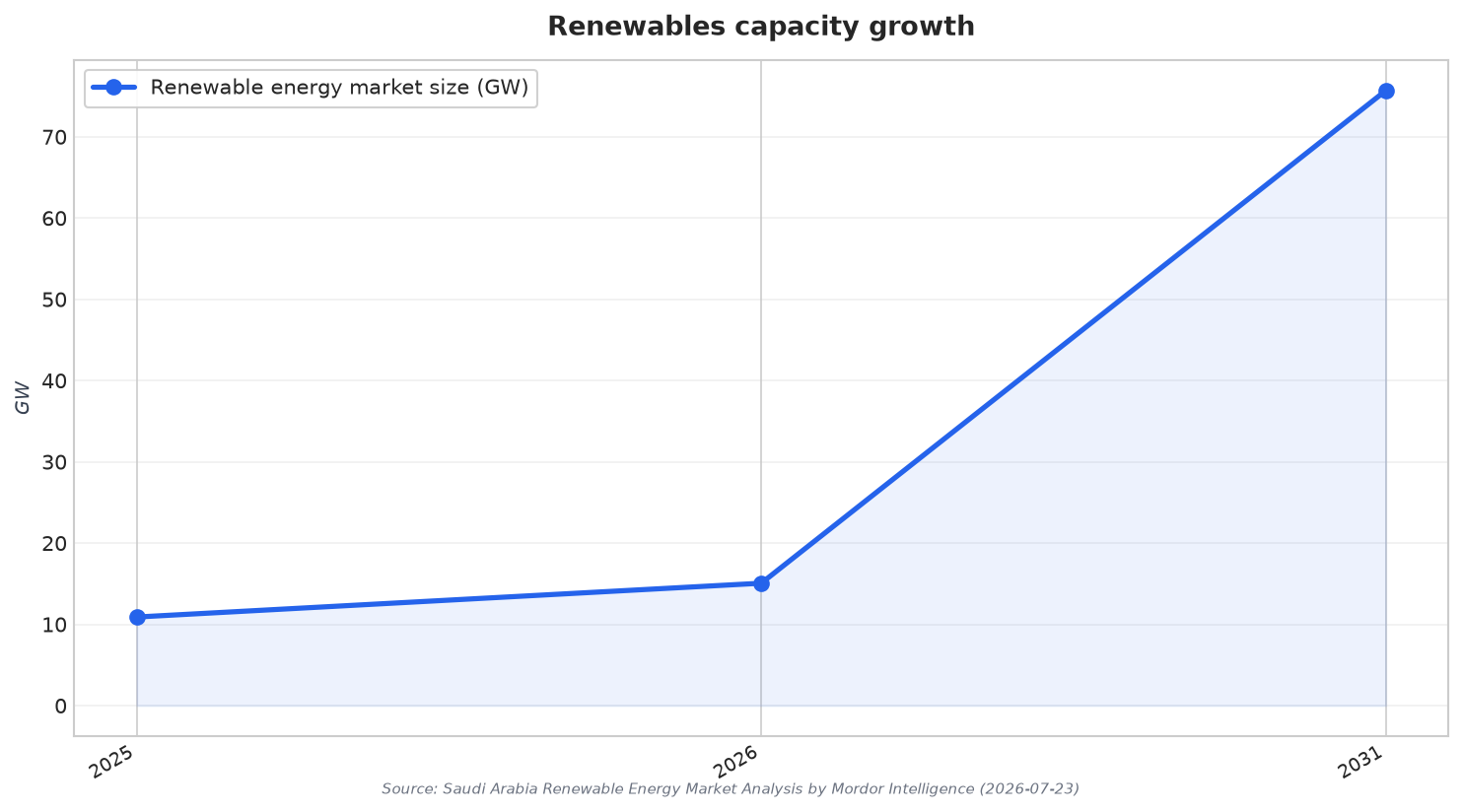
Renewable project finance in Saudi Arabia in 2026 is shaped by a fast-scaling market and a procurement model designed to be repeatable. Mordor Intelligence estimates the Saudi renewable energy market size at 15.06 GW in 2026, up from 10.90 GW in 2025, with a 2031 projection of 75.68 GW and a 38.12% CAGR over 2026–2031. Against that growth curve, lenders prioritize structures that can be replicated across many auctions, not one-off negotiations. In practice, this points financing toward IPP-style deals anchored by long-term contracted cash flows and a clear, centralized offtaker.
The bankability backbone is the NREP tender and the PPA. Under the program, procurement is run through the Saudi Power Procurement Company (SPPC), with projects typically developed as IPPs backed by 25-year PPAs with SPPC. One market analysis describes a four-counterparty architecture that lenders can diligence repeatedly: the Public Investment Fund (PIF) as a strategic sponsor, PIF-owned developer Badeel, ACWA Power as a principal developer and operator, and SPPC as the PPA counterparty. This standardization matters in competitive rounds where reported solar tariffs have averaged USD 0.018/kWh, putting pressure on execution discipline and a tight financing plan.
How Lenders Underwrite 2026 NREP Deal Flow and Risks
In 2026, lenders are underwriting scale, not single assets, because the pipeline is large and continuously tendered. SPPC reporting cited in industry coverage indicates tenders launched for more than 43 GW, with PPAs signed for over 38 GW, including an update specifying 38.7 GW signed out of 43.2 GW launched. The same coverage reports 10.2 GW already connected to the national grid, projected to rise to 12.7 GW by the end of 2025. For Round 7 specifically, one analysis specifies 5.3 GW total (3.1 GW solar PV and 2.2 GW wind) across four solar and two wind projects, while separate Round 7 guidance notes the round has kicked off covering 3.1 GW across four solar projects. Other reporting frames 14 GW of NREP awards targeted for 2026, and lenders generally align diligence calendars to these recurring award cycles.
Risk allocation in financing memos is heavily influenced by operating conditions and grid realities. Mordor Intelligence flags dust-driven PV efficiency losses of 15–20% annually and identifies grid congestion in high-solar regions as a near-term constraint. Those factors push lenders to focus on performance testing, O&M readiness, and evidence that equipment meets international IEC standards referenced in market commentary. Local-content policy also shapes how debt packages are structured, because local-content thresholds are described as exceeding 35%, affecting supply-chain choices, delivery schedules, and warranties. The same market source notes solar held a 93.15% share in 2025, while wind is projected to advance at an 81.7% CAGR through 2031, which can influence portfolio diversification and technology risk appetite.
Finally, lenders model sponsor and policy alignment as part of credit comfort in Saudi renewable build-outs. By company concentration, ACWA Power and Masdar jointly controlled 45% of awarded capacity in 2024, reinforcing why sponsor track record and operating capability remain central to bankability. Policy and spending signals also shape long-term confidence: a U.S. Department of Commerce country guide notes a Saudi government pledge to generate 50% of the country’s electricity from renewable sources by 2030, and states the Ministry of Energy’s spending on power and renewable energy projects is expected to reach USD 293 billion by 2030. These anchors do not remove execution risk, but they explain why lenders keep returning to the same PPA-led template when structuring renewable project finance Saudi Arabia transactions in 2026.
How are NREP renewable PPAs typically structured in Saudi Arabia?
What capacity volumes show the scale lenders are financing through NREP rounds?
How much capacity is associated with NREP Round 7 in 2026 coverage?
What operating risks do lenders pay attention to for Saudi solar assets?
What policy and investment signals support lender confidence into 2030?
Talk to us for your needs in:
-
Energy Efficiency Strategy & Feasibility
-
Renewable Energy Strategy & Investment Advisory
-
Digital Energy & Smart Grid Strategy
-
Market Entry Strategy
-
Sustainability & Impact Strategy
-
Energy Project Governance & PMO Advisory
-
Energy Market Research
-
Energy Stakeholder & Customer Research
-
Energy Market Intelligence
-
Energy Feasibility & Investment Assessment
-
Energy Sector Benchmarking & Performance Strategy