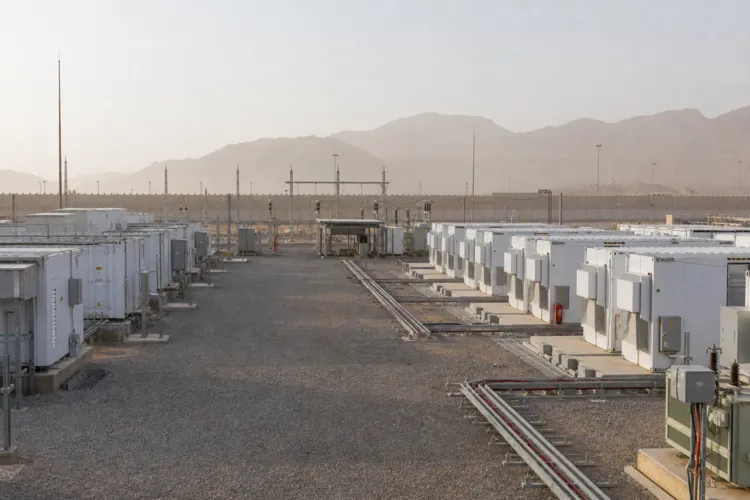
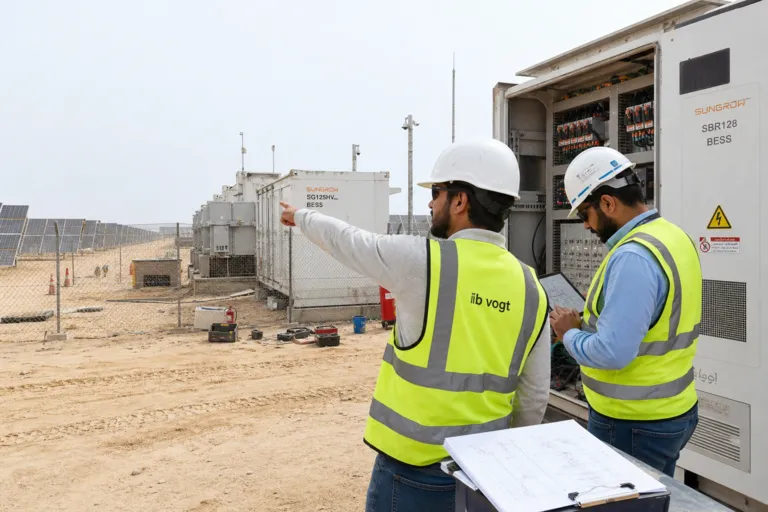
Search interest around the saudi 12 gwh battery storage tender is rising because Saudi Arabia’s renewable buildout is increasingly framed around grid integration and flexibility. In reporting on Saudi solar additions, commentary notes that the main drivers of the solar market in the coming years are likely to shift toward grid integration and flexibility, including faster interconnection and a focus on large-scale solar-plus-storage. That context matters when reading any qualification round for battery energy storage systems (BESS). It suggests storage is being positioned as infrastructure for system reliability, not just an add-on to generation.
However, the sources provided here do not publish the qualification-round bidder list, bidder sites, or a specific award timeline for a 12 GWh BESS process. What they do show is the scale and cadence of Saudi procurement that sets expectations for how storage could be sequenced. For example, Saudi Power Procurement Company signed five solar PPAs totaling 12 GW and two wind PPAs totaling 3 GW, described as the largest renewable energy capacity signed for in a single phase globally to date. Those projects are scheduled to be operational across 2027 and 2028, which creates a clear operational window where flexibility solutions can become more valuable.
What the Procurement Record Says About Timing Signals
Saudi procurement rounds provide useful timing signals even when a tender’s bidder-site detail is not public in these sources. The sixth phase of Saudi Arabia’s national renewable energy program concluded with 3 GW of solar awarded, and the seventh round has already kicked off, covering 3.1 GW across four solar projects. Separately, one report describes Saudi Arabia awarding five renewables projects worth an estimated $2.4 billion (also cited as 9 billion Saudi riyals) with total capacity of 4.5 GW, as part of the sixth phase. That same report includes the 1.5 GW Dawadmi Wind IPP Plant in Riyadh province, with a cited LCOE of 1.33803 U.S. cents per kWh.
For bidders trying to infer an award path for a BESS qualification round, the key takeaway from these sources is directional rather than definitive. The market is described as moving toward large-scale solar-plus-storage. Growth is led by gigawatt-sized utility-scale projects, and three ACWA Power projects totaling 2.79 GW of new operational capacity came online last year. Taken together with the 2027–2028 operational scheduling for major signed PPAs, the available evidence points to storage procurement being aligned with the grid’s need to integrate large volumes of new variable generation over the same period.
Forecasts in the sources also underline why storage tenders attract attention. Annual solar additions are forecast between 12 GW and 14 GW for 2028 to 2035, taking cumulative solar capacity past 50 GW in 2029, to 67.2 GW by the end of the decade, and to 129.7 GW by 2035. Yet the same analysis notes this trajectory falls behind a target of 130 GW of renewable power capacity by 2030, implying the country would need to add over 23 GW of renewables annually to reach it. In that setting, BESS qualification rounds are likely to be watched for how they support faster interconnection and grid flexibility.
What does the saudi 12 gwh battery storage tender cover in these sources?
Do the sources list bidder sites for the Saudi BESS qualification round?
What timing clues do the sources provide that may relate to storage needs?
Which Saudi procurement rounds are mentioned alongside the solar-plus-storage shift?
What renewable-growth pressure is highlighted that could make storage procurement more important?
Talk to us for your needs in:
-
Energy Efficiency Strategy & Feasibility
-
Renewable Energy Strategy & Investment Advisory
-
Digital Energy & Smart Grid Strategy
-
Market Entry Strategy
-
Sustainability & Impact Strategy
-
Energy Project Governance & PMO Advisory
-
Energy Market Research
-
Energy Stakeholder & Customer Research
-
Energy Market Intelligence
-
Energy Feasibility & Investment Assessment
-
Energy Sector Benchmarking & Performance Strategy