Saudi Arabia’s oil export system in 2026 is still defined by scale and routing flexibility. Crude exports typically range between 6 and 8 million barrels per day, while crude production capacity sits at roughly 12 million barrels per day, with sustainable maximum capacity publicly defended at 12.0–12.3 million barrels per day. Adding refined products and natural gas liquids can lift total petroleum exports above 8 million barrels per day in most months. This baseline matters because refinery upsets and shipping constraints do not occur in a vacuum; they force quick decisions on what to export, from where, and through which coast.
On the infrastructure side, Saudi Arabia’s dual-coast architecture is central to managing export pressure. The Arabian Gulf side is anchored by Ras Tanura, described as the largest single crude terminal complex in the world, with throughput capacity above 6 million barrels per day including Sea Island loading. The Red Sea side runs through Yanbu, fed by the 1,200-kilometre East-West Pipeline (Petroline), which can deliver up to 7 million barrels per day from Eastern Province fields to the Red Sea coast. In a year when chokepoints can tighten, this configuration increases the Kingdom’s optionality to reroute flows rather than rely on a single exit.
Ras Tanura and SATORP: Capacity, Shock, and Substitution
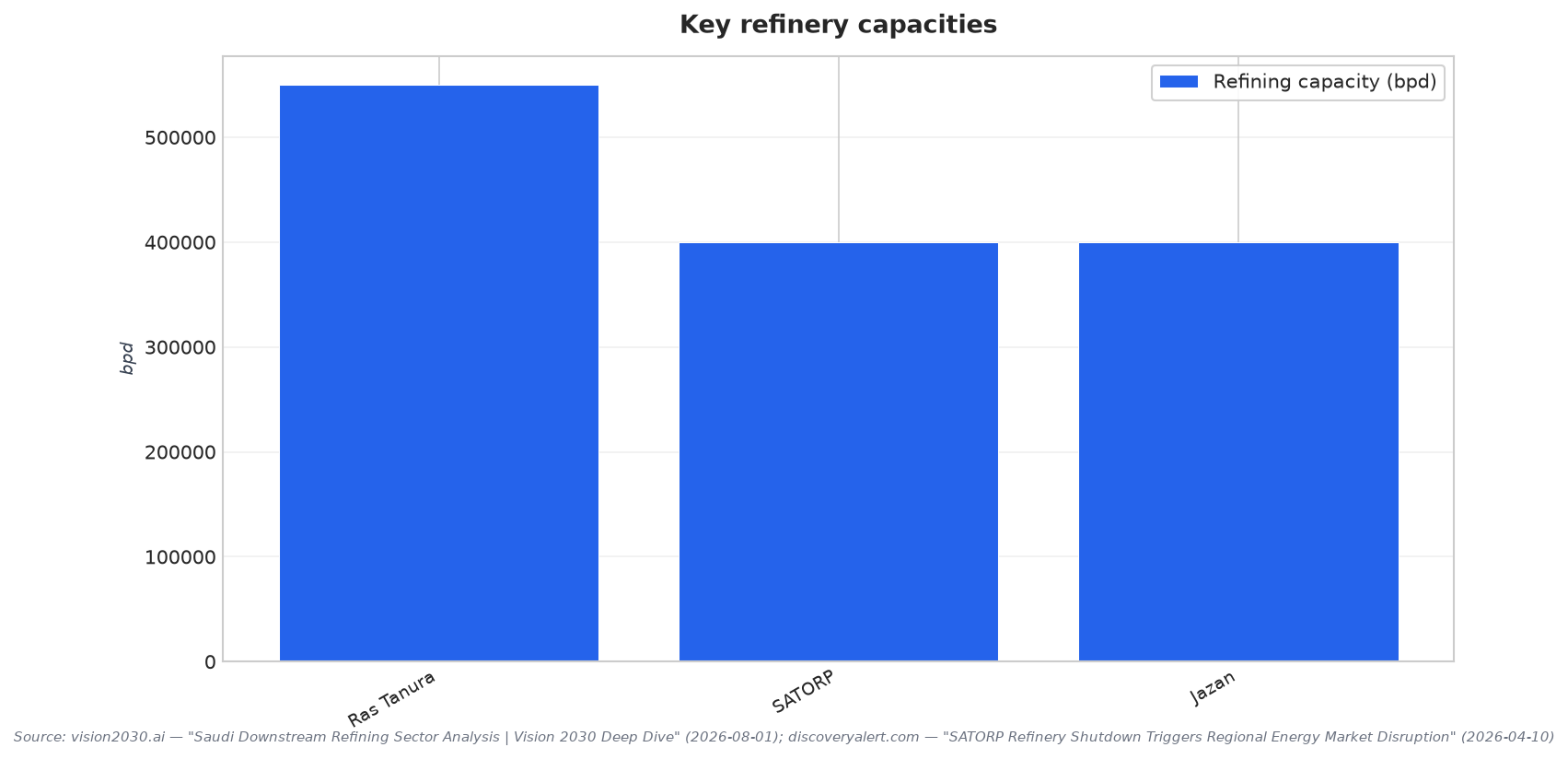
Ras Tanura is not only a major terminal; it is also one of Saudi Aramco’s oldest and largest refineries, with capacity of approximately 550,000 barrels per day. SATORP, located in Jubail Industrial City, operates a 400,000 barrels per day full-conversion refinery that processes Arabian Heavy crude into products including ultra-low-sulphur diesel, jet fuel, and petrochemical feedstock. A temporary SATORP shutdown in 2026 underscored how a single site can create ripple effects across domestic distribution and export programs, requiring refined products to be rerouted to alternative facilities. One analysis framed Ras Tanura’s 550,000 barrels per day as the largest alternative processing option, while also pointing to Jazan’s 400,000 barrels per day as modern backup capability.
Pressure in 2026 is also regional, not just local, and logistics can be as binding as physical damage. Kpler assessed that Middle Eastern refinery runs were around 7.3 million barrels per day versus 9.9 million barrels per day in February 2026, as damage and constrained product evacuation through the Strait of Hormuz reduced throughput. Kpler also estimated the Middle East lost around 4 million barrels per day of refined product supply since the start of the conflict, with roughly 2.5 million barrels per day from curtailed refinery output and about 1.5 million barrels per day from other supply streams, primarily LPG and NGL-derived naphtha. In that context, rerouting product exports becomes a balancing act between inventories, evacuation limits, and which complexes can safely raise runs.
Against this backdrop, saudi refinery exports 2026 become a question of resilience across refineries, terminals, and routes. Vision 2030-focused analysis places total refining capacity at approximately 2.9 million barrels per day across domestic and international joint ventures, while another overview states Saudi refining capacity exceeds 3.3 million barrels per day, anchored by Ras Tanura, Yanbu, Jazan, SATORP, and YASREF. Even with large installed capacity, Kpler’s base case expected transit to remain constrained through the rest of 2026, with a gradual reopening beginning only in late Q4 2026, and a return to pre-war throughput unlikely before Q2 2027. That timeline implies export rerouting decisions may remain a defining feature of 2026 planning rather than a short-lived workaround.
Why did export rerouting become so important for Saudi refinery exports in 2026?
What is Ras Tanura’s refining capacity, and why does it matter in disruptions?
What is SATORP’s capacity and ownership structure mentioned in the sources?
How large was the refined product supply loss in the Middle East during the 2026 conflict period?
When did Kpler expect recovery in regional refining runs to meaningfully improve?
Talk to us for your needs in:
-
Energy Efficiency Strategy & Feasibility
-
Renewable Energy Strategy & Investment Advisory
-
Digital Energy & Smart Grid Strategy
-
Market Entry Strategy
-
Sustainability & Impact Strategy
-
Energy Project Governance & PMO Advisory
-
Energy Market Research
-
Energy Stakeholder & Customer Research
-
Energy Market Intelligence
-
Energy Feasibility & Investment Assessment
-
Energy Sector Benchmarking & Performance Strategy