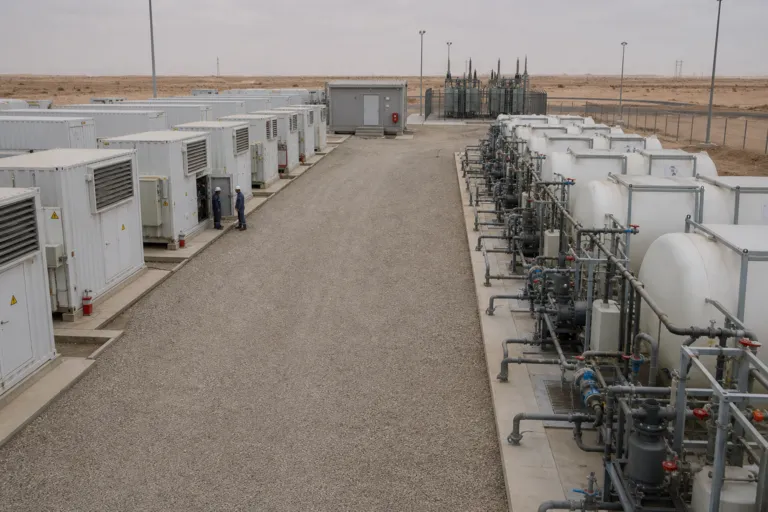
Saudi Arabia’s flow battery energy storage market remains in an early commercial phase as of 2026, but it is being pulled forward by the need to firm solar and wind generation with long-duration storage. IndexBox estimates total installed flow battery capacity at 50–80 MWh as of early 2026, mainly pilots and demonstrations. Within that base, vanadium redox flow batteries (VRFBs) represent over 85% of installed flow battery capacity in the country, supported by positioning around long cycle life of 20+ years and safety advantages in high-temperature desert environments. Demand today clusters around utility-scale grid storage and renewable integration, with emerging use cases for backup and microgrids tied to remote mining and desalination sites.
The shift in specifications is clear. IndexBox reports a move toward 6–8 hour storage durations, because a solar-dominated grid requires longer discharge durations than typical 2–4 hour lithium-ion systems. As a result, flow batteries are increasingly being specified in RFPs for 6-hour and 8-hour projects, and some tenders require 10-hour capacity for off-grid mining operations. In the next-generation batteries outlook for Saudi Arabia, IndexBox frames grid-scale long-duration storage as the largest near-term opportunity, highlighting 8–12 hour vanadium flow systems and stating that 5–10 GWh of tenders are expected by 2028. The same source notes that vanadium redox flow battery projects are gaining traction for 6–12 hour duration storage at utility scale, with two pilot deployments exceeding 100 MWh each announced for 2027.
Costs, Economics, and Why Financing Structures Matter
Project economics and procurement design will shape how fast long-duration storage scales. IndexBox places total installed costs for flow battery systems in Saudi Arabia at $350–$550 per kWh of energy capacity for 4-hour systems, with electrolyte costs representing 30–40% of the total. For a 6-hour VRFB system, IndexBox estimates a levelized cost of storage (LCOS) of $0.12–$0.18 per kWh, and describes it as competitive with lithium-ion for durations above 4 hours. Developers are also exploring electrolyte leasing arrangements, where a third party owns the vanadium electrolyte and leases it over the system life, lowering initial capex by 25–35% in Saudi Arabia. In global context, Mordor Intelligence also describes electrolyte leasing cutting initial capital requirements by 25–30% and notes that electrolytes represented 43.3% of 2025 component sales in the global VRFB market.
Supply chain exposure is another factor that will influence timelines and costs for vanadium flow battery Saudi Arabia projects. IndexBox states the market is structurally import-dependent, with no domestic vanadium mining or electrolyte production as of 2026, and that stack components, membranes, and power conversion systems are sourced from international suppliers in China, Japan, Germany, and the United States. A Middle East-focused IndexBox report adds that regional vanadium resources in Saudi Arabia and Oman are at early exploration stages, so near-term dependence on Chinese, Russian, and South African vanadium feedstock persists through at least 2028. It also notes that duty exemptions or reductions for qualifying renewable energy and energy storage imports can effectively reduce import costs by 2–5 percentage points, while vanadium electrolyte imports can face chemical and hazardous transport requirements that add 5–10% to logistics costs for cross-border movement within the region.
Policy and procurement momentum could turn today’s pilots into bankable volume. IndexBox links growth to Vision 2030 renewable energy targets and identifies government procurement mandates under the National Renewable Energy Program (NREP) and the Saudi Green Initiative as creating a pipeline of 200–400 MWh of flow battery projects by 2028, with the first gigawatt-scale tender expected by 2030. Looking longer-term, IndexBox projects that the total addressable market for long-duration storage in Saudi Arabia is expected to exceed 5–8 GWh by 2035. Buyers also matter: the Middle East IndexBox report places end-use demand largely with electric utilities and grid operators (45–55%), renewable developers (25–35%), and heavy industry and data centers (10–15%), while noting that Saudi Arabia is among the countries where national strategies include explicit storage deployment targets and dedicated procurement programs for long-duration technologies.
How much flow battery capacity is installed in Saudi Arabia so far?
What share of Saudi Arabia’s installed flow battery capacity is VRFB?
What durations are being specified for long-duration storage in Saudi Arabia?
What are the key cost figures cited for flow batteries in Saudi Arabia?
What is the supply-chain constraint for vanadium flow battery projects in Saudi Arabia?
Talk to us for your needs in:
-
Energy Efficiency Strategy & Feasibility
-
Renewable Energy Strategy & Investment Advisory
-
Digital Energy & Smart Grid Strategy
-
Market Entry Strategy
-
Sustainability & Impact Strategy
-
Energy Project Governance & PMO Advisory
-
Energy Market Research
-
Energy Stakeholder & Customer Research
-
Energy Market Intelligence
-
Energy Feasibility & Investment Assessment
-
Energy Sector Benchmarking & Performance Strategy