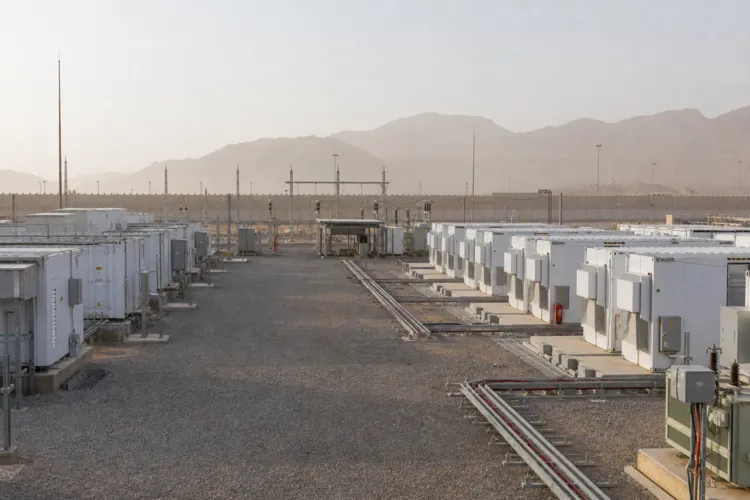
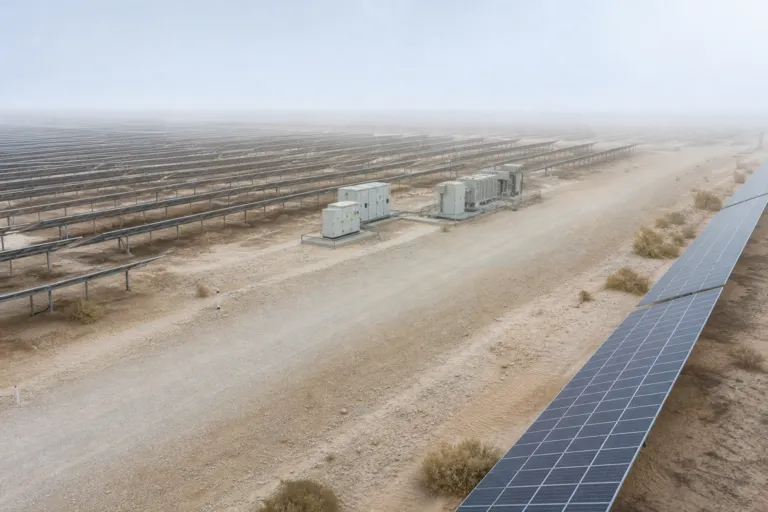
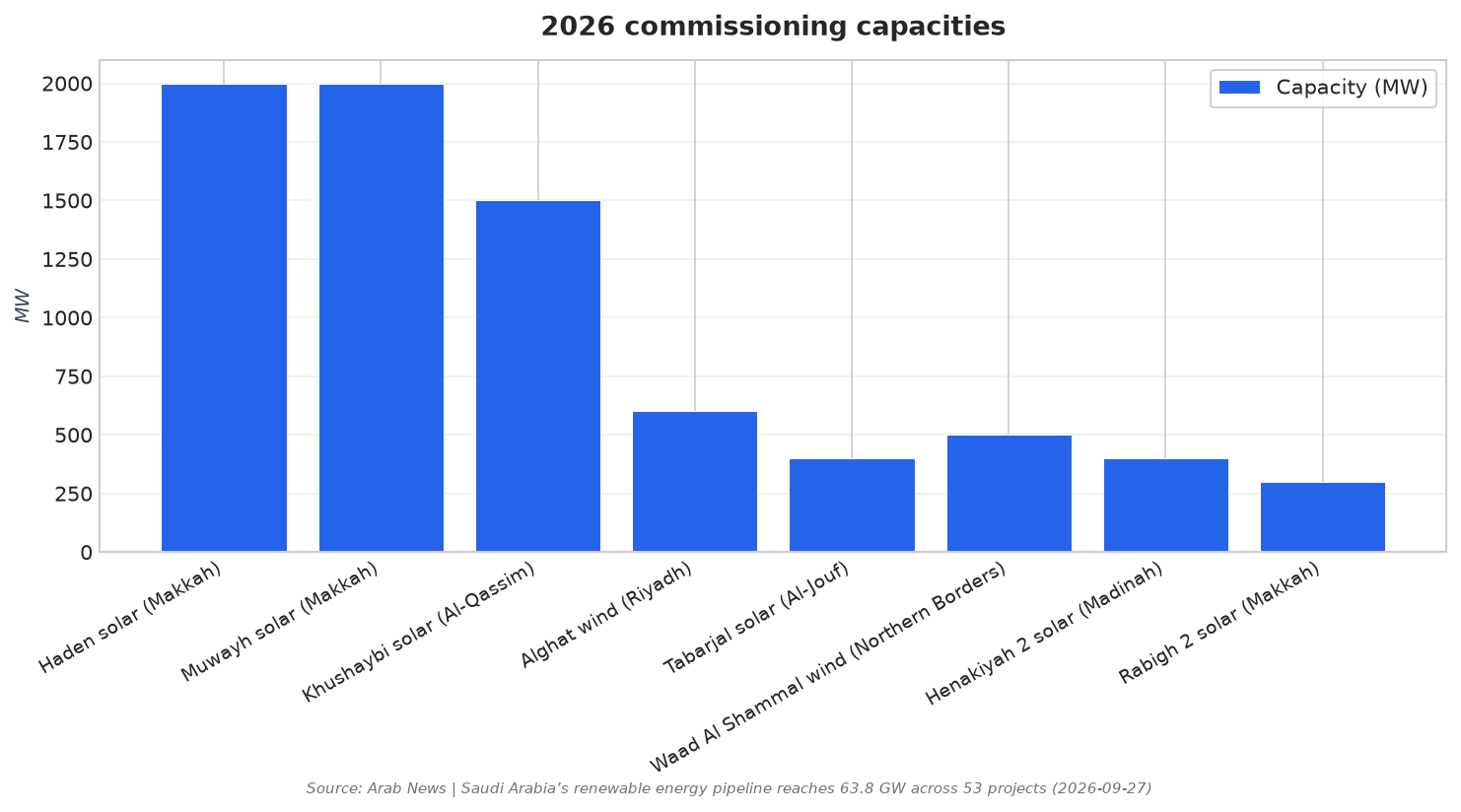
Al-Qassim’s role in Saudi Arabia’s next renewable buildout is highlighted by the Khushaybi solar project, which the Saudi Arabia Renewables Tracker lists at 1.5 GW. The same tracker places Khushaybi among eight projects with an expected commissioning year of 2026, together totaling 7.7 GW. Across the Kingdom, the tracked renewable energy pipeline stands at 63.8 GW spread across 53 projects. Those figures frame why a single, utility-scale PV plant in Al-Qassim matters: it is part of a defined commissioning set, and it contributes to a pipeline that is expanding across multiple regions.
The 2026 wave is not only about one site, but Khushaybi is one of the largest solar entries within that year’s list. The tracker also cites major 2026 solar projects including Haden at 2 GW in Makkah and Muwayh at 2 GW in Makkah, alongside Tabarjal solar at 400 MW in Al-Jouf. Wind additions listed for 2026 include Alghat wind at 600 MW in Riyadh and Waad Al Shammal wind at 500 MW in the Northern Borders. Two other 2026 solar projects remain under development: Henakiyah 2 at 400 MW in Madinah and Rabigh 2 at 300 MW in Makkah. Within that lineup, Al-Qassim’s 1.5 GW Khushaybi project stands out as a central solar component of the commissioning schedule.
Why Al-Qassim’s Khushaybi Project Fits the National Pipeline
The national pipeline data shows why large solar plants are a dominant theme. Solar accounts for 81% of tracked capacity, while wind represents 19%. By project status, about 30% of tracked capacity is installed, 37% is under development, and 32% is tendered. The tracker also points to broad geographic spread, naming regions that include Riyadh, Makkah, Madinah, Al-Qassim, the Eastern Province, and Al-Jouf. In this context, locating a 1.5 GW solar project in Al-Qassim supports the idea that new buildout is not confined to one area, but distributed across multiple provinces while maintaining a strong solar tilt in the overall portfolio.
Cost and financing narratives also appear in the source material, but they need to be interpreted carefully as context rather than project-specific claims. Across tracked developments, levelized costs of energy range from 1.04 cents per kWh at Shuaibah 1 to 2.98 cents per kWh at Layla, and several large solar plants under development are listed at about 1.09 cents to 1.36 cents per kWh. Separately, one market commentary reports that in September 2024 ACWA Power secured USD 2.58 Billion in financing for three large-scale solar projects in Haden, Muwayh, and Al-Khushaybi totaling 5,500 MW capacity. Taken together, those points suggest that Saudi Arabia’s utility-scale solar buildout is being tracked not only by capacity and schedule, but also through competitive cost ranges and notable capital mobilization.
The Khushaybi solar project Saudi Arabia watchers follow is also tied to a bigger national trajectory. The Renewables Tracker states that Saudi Arabia’s cumulative operating renewable-energy capacity has increased more than 63-fold since 2020, reaching 19.3 GW in 2026. The same reporting also states the Kingdom aims to produce 100–130 GW of renewable energy capacity by 2030 and achieve net-zero emissions by 2060. In that setting, Al-Qassim’s 1.5 GW Khushaybi plant can be read as both a provincial milestone and a practical part of a defined commissioning wave that supports a much larger pipeline.
Where is the Khushaybi solar project located, and what capacity is it listed at?
How does Khushaybi fit into Saudi Arabia’s 2026 commissioning wave?
What share of Saudi Arabia’s tracked renewables pipeline is solar versus wind?
What does the tracker say about the status mix of projects in the pipeline?
What do the sources report about financing linked to Al-Khushaybi, Haden, and Muwayh?
Talk to us for your needs in:
-
Energy Efficiency Strategy & Feasibility
-
Renewable Energy Strategy & Investment Advisory
-
Digital Energy & Smart Grid Strategy
-
Market Entry Strategy
-
Sustainability & Impact Strategy
-
Energy Project Governance & PMO Advisory
-
Energy Market Research
-
Energy Stakeholder & Customer Research
-
Energy Market Intelligence
-
Energy Feasibility & Investment Assessment
-
Energy Sector Benchmarking & Performance Strategy