Talk about badeel renewable energy Saudi Arabia and one detail stands out first. Badeel is wholly owned by the Public Investment Fund (PIF), and it is signing long-term power purchase agreements (PPAs) as part of the Kingdom’s National Renewable Energy Program (NREP). In July 2025, a consortium of ACWA Power, Badeel, and Saudi Aramco Power Company (SAPCO) signed PPAs with the Saudi Power Procurement Company (SPPC) for seven projects valued at USD 8.3 billion. The portfolio totals 15,000 MW, including 12,000 MW of solar PV and 3,000 MW of wind, with financial closure anticipated by Q3 2025 and operations expected between late 2027 and early 2028.
Those PPAs are not just project announcements. They are a signal of how ownership and procurement are evolving in Saudi power. PIF is positioning itself as a lead developer of 70% of the Kingdom’s renewable energy target capacity by 2030, according to U.S. government market intelligence, and Sustainability Magazine also describes PIF as leading the development of 70% of the Kingdom’s renewable energy infrastructure. The same Sustainability Magazine source links that push to a national target of reaching 50% renewables in the national energy mix by 2030. In practice, Badeel’s role inside PIF means procurement, financing, and asset development can be aligned with state-directed goals rather than fragmented across many small developers.
Why PIF’s Badeel Matters for Control of New Capacity
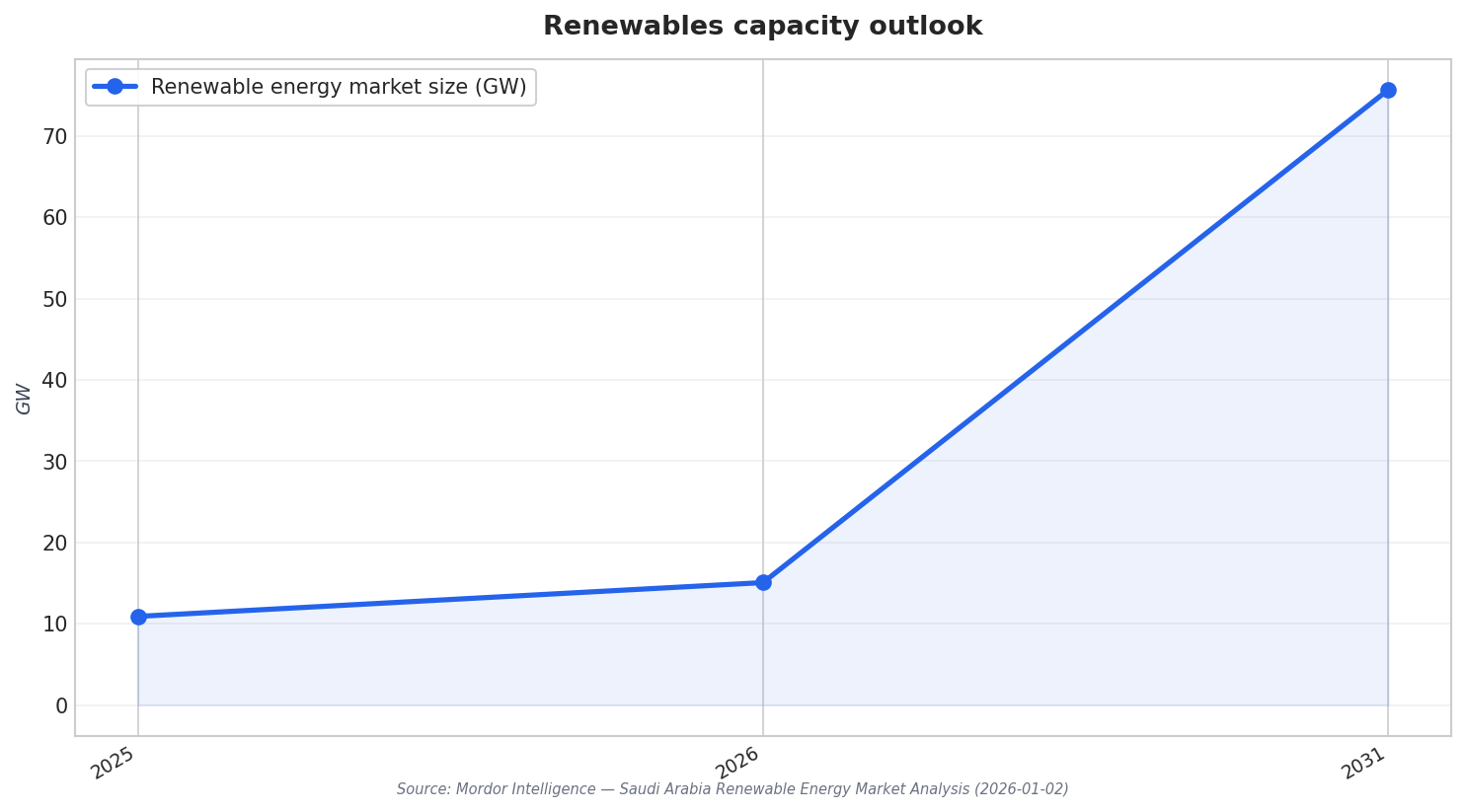
The broader market backdrop explains why these ownership structures matter now. Mordor Intelligence estimates Saudi Arabia’s renewable energy market size at 10.90 GW in 2025, rising to 15.06 GW in 2026, with 2031 projections of 75.68 GW and a 38.12% CAGR over 2026–2031. Solar dominates the mix with a 93.15% share in 2025, while wind is projected to advance at an 81.7% CAGR through 2031. The same report points to NREP’s 130 GW procurement pipeline and says local-content thresholds exceed 35%, linking renewables expansion to industrial localization. It also flags operational realities, including dust-driven PV efficiency losses of 15–20% annually and grid congestion in high-solar regions.
Electric mobility adds another layer of urgency to who owns and builds power assets. One market report cites a 425% increase in EV registrations between 2021 and 2023, moving from 375 EVs on the road in 2021 to over 12,000 by the end of 2023. The same source says public charging stations grew from 150 in 2022 to over 1,000 by early 2024, and that the Saudi Electricity Company plans 3,500 additional charging points across 1,000 locations by end of 2025 with an investment of SAR 500 million (USD 133 million). Mordor Intelligence also notes a 10-year government purchase commitment for up to 100,000 Lucid units, reinforcing the idea that demand growth is being steered alongside supply planning.
Finally, PIF’s approach spans both electrons and industry. A separate analysis of Ceer Motors says PIF-backed Ceer awarded a SAR 5 billion construction contract for the Ceer Electric Vehicle Manufacturing Complex in King Abdullah Economic City on a site of more than 1 million square meters with 530,000 square meters under roof, and it cites a public target for vehicle production in Q4 2026. It also reports a SAR 8.2 billion Hyundai Transys electric-drive-system contract and 16 supply-chain agreements worth more than SAR 3.7 billion. Put together, these moves show how PIF-owned platforms like Badeel can sit at the center of a new power-ownership model: contracted renewables capacity under NREP, paired with fast-rising EV demand and localization-linked industrial programs that make reliable, scalable clean power strategically valuable.
What role does Badeel play in Saudi Arabia’s renewable energy buildout?
How large are the seven PPA-backed projects involving Badeel, and what technologies do they use?
When are the Badeel consortium’s renewable projects expected to reach key milestones?
How does EV growth connect to the power-ownership shift around Badeel and PIF?
What does the market data say about renewable energy growth in Saudi Arabia?
Talk to us for your needs in:
-
Energy Efficiency Strategy & Feasibility
-
Renewable Energy Strategy & Investment Advisory
-
Digital Energy & Smart Grid Strategy
-
Market Entry Strategy
-
Sustainability & Impact Strategy
-
Energy Project Governance & PMO Advisory
-
Energy Market Research
-
Energy Stakeholder & Customer Research
-
Energy Market Intelligence
-
Energy Feasibility & Investment Assessment
-
Energy Sector Benchmarking & Performance Strategy