Saudi Arabia’s modern wind build-out has a clear anchor project: Dumat Al Jandal. REGlobal describes it as the Kingdom’s first utility-scale wind farm and notes it remains the only operational wind project, with 400 MW of installed capacity. Mordor Intelligence also flags that wind growth in the pipeline centers on Dumat Al Jandal and upcoming projects in Yanbu and Al Ghat, where hub-height wind speeds average seven meters per second. Together, these references frame a pipeline that is still young on the ground, but widening in geography and ambition as the country moves toward 2030 goals.
Vision 2030 targets provide the roadmap and the ceiling for how far this pipeline is intended to go. REGlobal states that under Saudi Vision 2030 the Kingdom has set a target of 50% renewables by 2030, with a specific target of 16 GW of wind energy capacity. In parallel, Mordor Intelligence describes the NREP as a large procurement engine, and its Saudi renewables report cites a 130 GW procurement pipeline. Within the broader regional context, Mordor Intelligence also identifies Saudi Arabia as the fastest-growing wind market in the Middle East and Africa and expects it to grow at a 25.7% CAGR through 2031, signaling the speed at which projects are expected to move from plans to steel in the ground.
Auctions, Bankability, and the Near-Term Project Queue
Pricing and procurement milestones are shaping which projects reach financial close first. Mordor Intelligence reports that Saudi Arabia’s Round 6 awarded 1.5 GW of wind at USD 0.0133 per kWh, and that Round 7 has pre-qualified 5.3 GW of bids slated for award. In the power-market view, Mordor Intelligence highlights that Dumat Al Jandal Wind closed at 2.13 cents/kWh, framing it among the world’s lowest tariffs. It also notes a permitting environment where streamlined licensing can clear sub-500 MW projects in six months, while more than 60 IPP projects worth over USD 80 billion have moved into feasibility or construction across renewables and other generation types. These factors collectively reduce time-to-close and support a deeper queue of wind awards.
Specific projects beyond the first plant show how the onshore wind energy Saudi Arabia story is moving into repeatable, utility-scale clusters. REGlobal cites a tracker indicating Saudi Arabia has 12 wind projects that are either installed, under development, or tendered. It also reports that 2025 deals under the NREP include 3 GW of wind at two projects in the Riyadh region: Starah (2 GW) and Shaqrah (1 GW), supplied by Goldwind turbines. These agreements, led by a consortium including ACWA, Badeel (PIF’s Water and Electricity Holding Company), and Saudi Aramco Power Company (SAPCO), reached financial close and are expected to come online between 2027 and 2028. Mordor Intelligence further positions corporate PPAs as an emerging parallel growth engine in the wider Middle East and Africa wind market, alongside sovereign auctions and grid expansion programs.
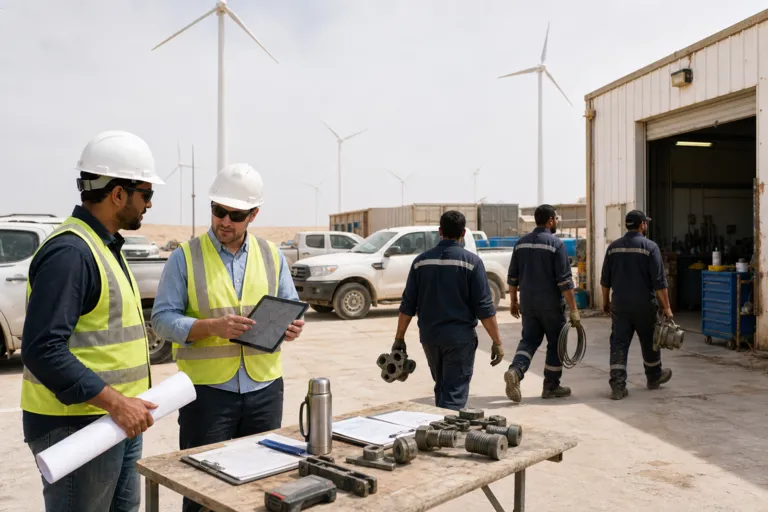
The supply chain is being pulled forward by both scale and localization requirements. IndexBox estimates the Saudi Arabia onshore wind turbine bearing market at USD 45–55 million in 2026, projecting it to USD 120–150 million by 2035. It links this growth to a Vision 2030 renewable target of 58 GW, with wind expected to account for 16 GW of installed capacity, and notes local content regulations that aim for 30–40% local value addition in wind farm components by 2030. IndexBox also states import dependence remains high, with 85–95% of high-precision wind turbine bearings sourced from China, Germany, Japan, and Sweden. It adds that gearbox and main shaft bearings represent 60–70% of annual bearing value demand, reflecting large multi-megawatt turbines, and puts average pricing for a complete bearing set at USD 180,000–250,000 per turbine for new installations. These details show how industrial capability, services, and component sourcing become part of the pipeline map through 2030.
What is Saudi Arabia’s operational baseline for wind today?
What wind capacity target is set under Vision 2030?
How much capacity did Saudi Arabia’s NREP Round 6 award, and at what price?
Which named wind projects are expected to come online between 2027 and 2028?
What does the supply chain outlook say about onshore wind energy in Saudi Arabia?
Talk to us for your needs in:
-
Energy Efficiency Strategy & Feasibility
-
Renewable Energy Strategy & Investment Advisory
-
Digital Energy & Smart Grid Strategy
-
Market Entry Strategy
-
Sustainability & Impact Strategy
-
Energy Project Governance & PMO Advisory
-
Energy Market Research
-
Energy Stakeholder & Customer Research
-
Energy Market Intelligence
-
Energy Feasibility & Investment Assessment
-
Energy Sector Benchmarking & Performance Strategy