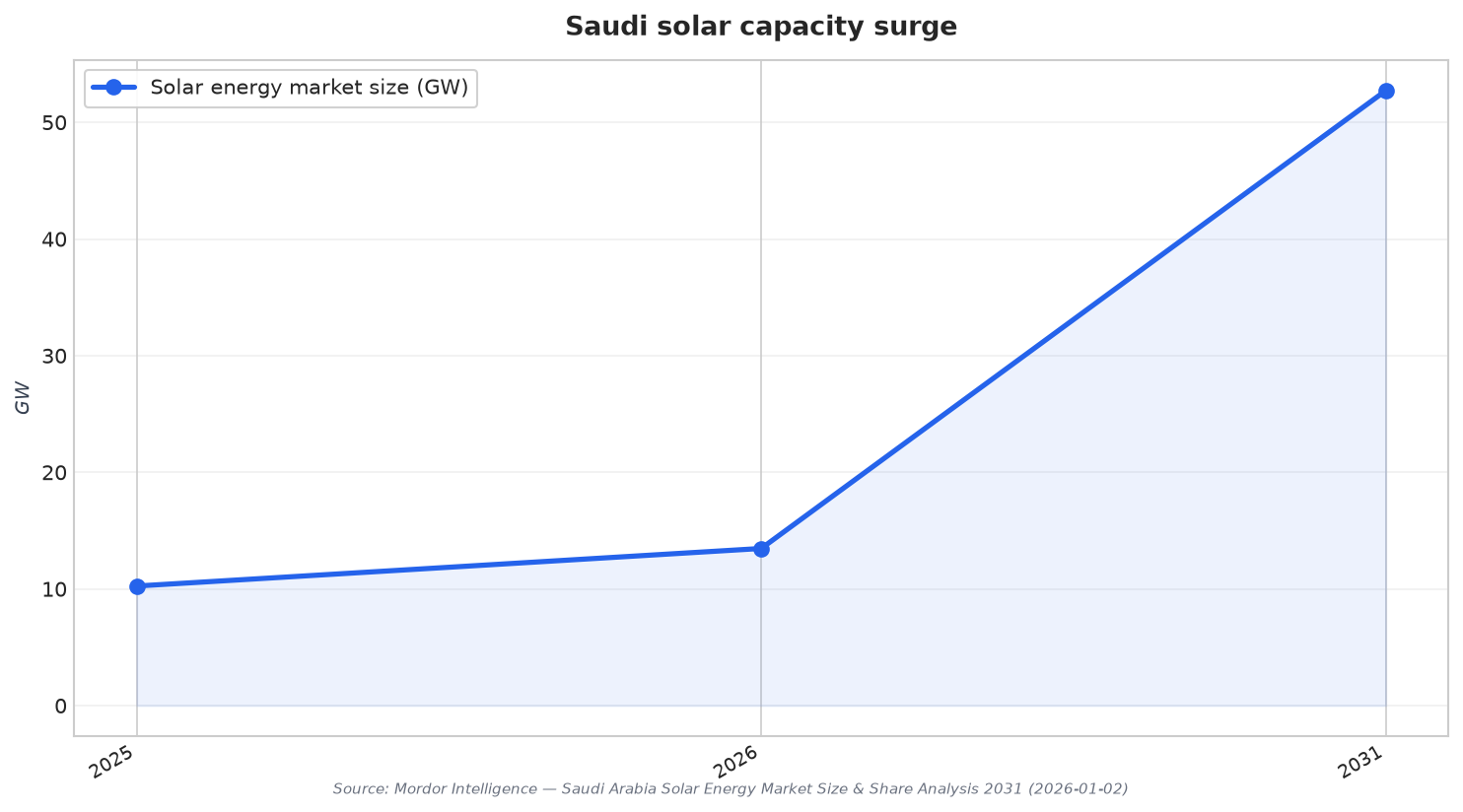
Agrivoltaics in Saudi Arabia is gaining attention because the Kingdom is scaling solar while modernizing agriculture under Vision 2030. Mordor Intelligence estimates the Saudi agriculture market at USD 15.20 billion in 2026, with a forecast of USD 20.30 billion by 2031 at a 5.96% CAGR. The same report notes that agrivoltaic pilots can create dual revenue streams that improve farm cash flow and water-use efficiency. On the power side, Mordor Intelligence estimates Saudi Arabia’s solar energy market at 13.47 GW in 2026, rising from 10.25 GW in 2025, with a 2031 projection of 52.72 GW and a 31.40% CAGR over 2026–2031. Together, these trajectories frame why co-locating energy and food production is being discussed as a practical deployment pathway.
The policy and investment context matters because agrivoltaics sits at the intersection of farm capex and energy economics. In agriculture, Vision 2030 subsidies are described as covering up to 60% of capital costs in the Mordor agriculture report, while the Agricultural Development Fund can provide up to 75% financing for greenhouse projects and modern irrigation systems, plus tax holidays extending up to 10 years for qualifying agritech investments. That same report also states the Kingdom imports approximately 90–95% of its edible oil requirements, underlining the food-security motivation behind productivity improvements. On renewables, Mordor’s solar market analysis cites a 2030 government target of 58.7 GW of renewables and notes local-content rules in REPDO rounds increased from 15% to 35% between Round 1 and Round 6. Those signals can support agrivoltaic business cases where farms want predictable pathways for on-site generation and potential grid interaction.
How Agrivoltaic Designs Fit Desert Farms and Greenhouses
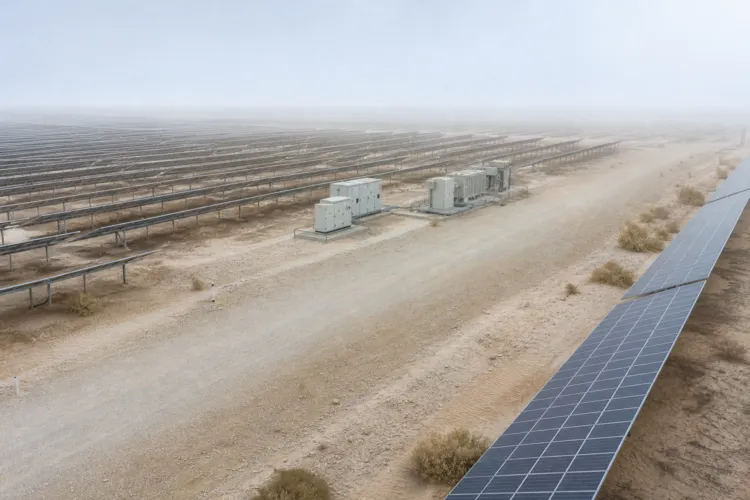
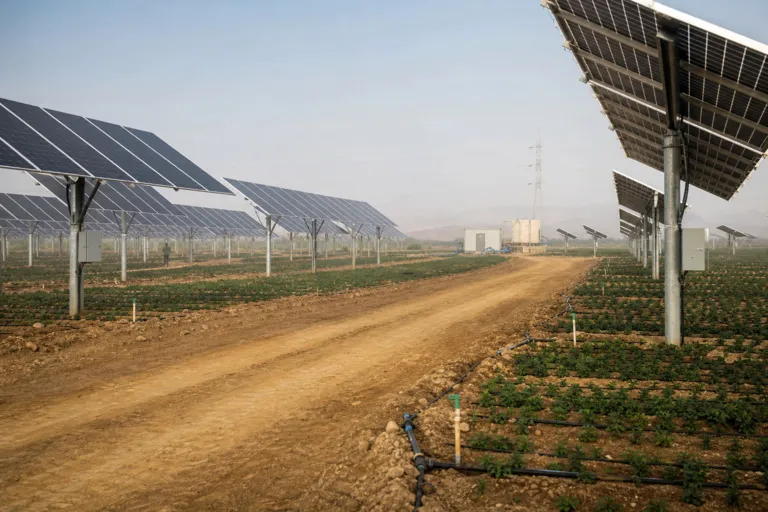
Saudi-focused practitioners describe several agrivoltaic configurations, each with distinct engineering tradeoffs. HAALA Energy explains that arrays can be spaced with gaps between rows for crop access, elevated on stilts so farming continues underneath, or integrated into greenhouse structures where panels regulate light and temperature. For elevated systems, HAALA highlights clearance for tractors and harvesters and structural engineering that accounts for wind load, soil conditions, and a 25 to 30 year lifespan. The same source ties agrivoltaics to operational needs in the Kingdom, noting that hotter months bring longer days and higher irradiance, generating more power when farms often need it most, especially for water pumping. It also points to livestock and poultry sites with high cooling loads that may be far from the grid, making on-site solar and storage an attractive alternative to diesel generation in those settings.
Market structure in solar provides additional context for where agrivoltaics could plug in. In 2025, solar PV accounted for 98.55% of Saudi Arabia’s solar energy market share, and on-grid installations held an 89.85% share, according to Mordor Intelligence. Utility-scale projects represented 65.05% of the market in 2025, while commercial and industrial installations are forecast to expand at a 38.9% CAGR to 2031. That blend suggests agrivoltaics can be framed not only as a utility-land use concept, but also as a distributed energy and farm-infrastructure strategy. Mordor’s renewables report also notes that emerging agrivoltaic arrays in irrigation districts diversify applications beyond utility-scale desert sites, and it specifically points to central agricultural regions such as Qassim exploring agrivoltaics to co-optimize water usage, crop yield, and electricity generation.
The direction of travel is toward pilots that prove performance in Saudi conditions, then scaled replication. A 2025 framework paper calls agrivoltaics “a framework for the co-location of solar energy and agriculture” and recommends prioritizing pilot projects and giga-scale integration, including launches in key agricultural regions such as Al-Qassim to demonstrate practical efficiency and scalability. Industry commentary from Lucintel emphasizes that technological advancements, including bifacial and high-efficiency solar panels, can improve energy capture and durability while providing shade that may help microclimate regulation, reduce water evaporation, and maintain or improve crop yields. Meanwhile, HAALA reports it was founded at KAUST in 2017 and says it was commissioned by the Ministry of Energy during COVID to conduct a year-long study, with AEON Strategy, analyzing the energy requirements of 20 agricultural sites across the Kingdom. Taken together, these signals show how agrivoltaics can be engineered around sand, heat, and water scarcity while aligning with Saudi Arabia’s fast-moving solar pipeline.
What does agrivoltaics mean in Saudi Arabia’s context?
Which regions are mentioned for agrivoltaic pilots in the Kingdom?
How big is Saudi Arabia’s solar market in the figures cited?
How can agrivoltaics support farm economics and operations?
What are key engineering considerations for agrivoltaics on Saudi farms?
Talk to us for your needs in:
-
Energy Efficiency Strategy & Feasibility
-
Renewable Energy Strategy & Investment Advisory
-
Digital Energy & Smart Grid Strategy
-
Market Entry Strategy
-
Sustainability & Impact Strategy
-
Energy Project Governance & PMO Advisory
-
Energy Market Research
-
Energy Stakeholder & Customer Research
-
Energy Market Intelligence
-
Energy Feasibility & Investment Assessment
-
Energy Sector Benchmarking & Performance Strategy