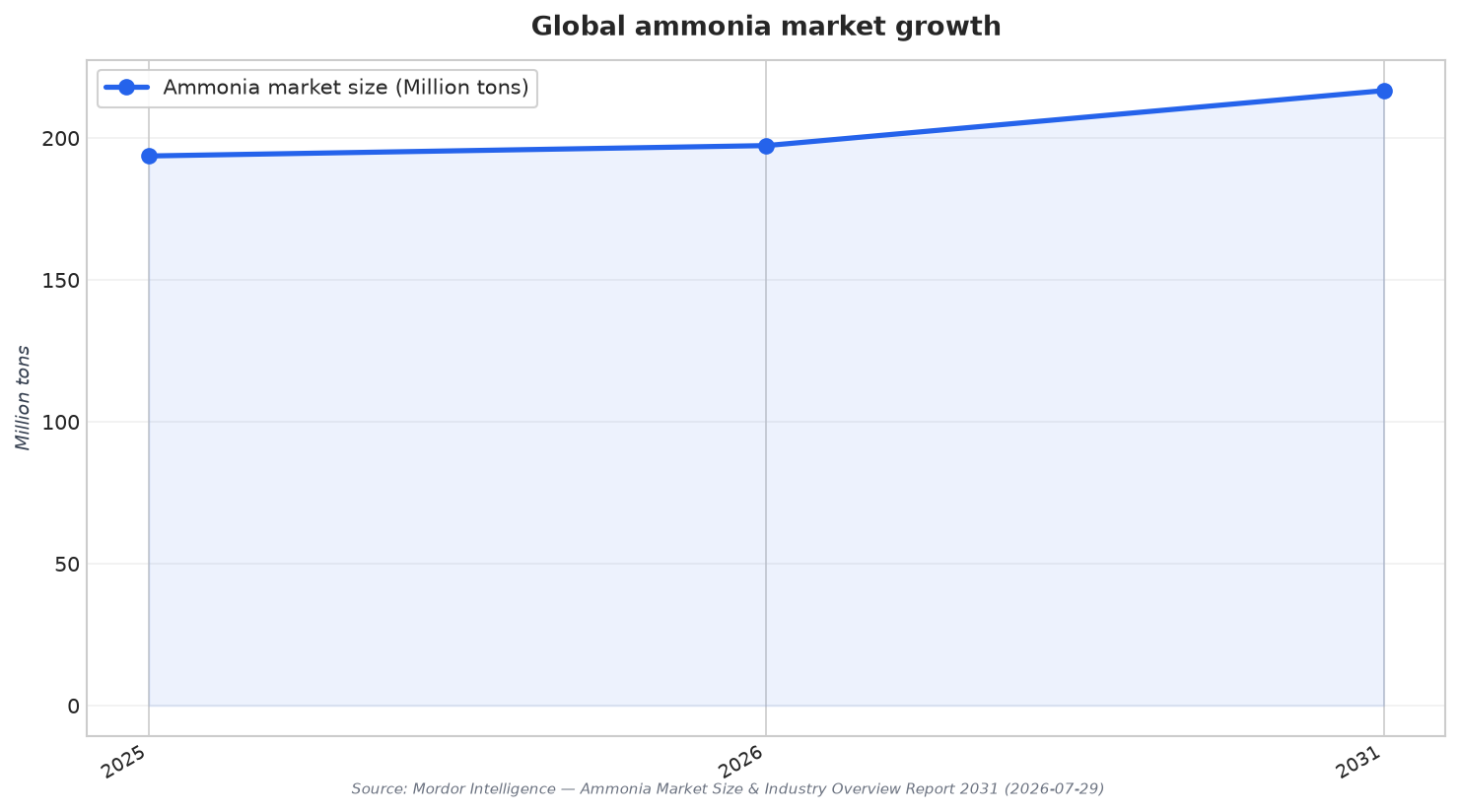
Utilities are increasingly testing ammonia as a decarbonization tool, and global market signals point to power generation as the fastest-growing end-use. Mordor Intelligence estimates the ammonia market at 193.69 million tons in 2025, rising to 197.35 million tons in 2026 and reaching 216.72 million tons by 2031, with a 1.89% CAGR over 2026–2031. The same source notes that power generation shows the highest forecast CAGR among end-user industries at 5.87% through 2031, even while agriculture remains the largest share at 78.76% in 2025. This is the demand backdrop for an ammonia co-firing power plant in Saudi Arabia as a practical bridge that can start small, learn fast, and scale as low-carbon supply expands.
Early co-firing activity linked to Saudi supply is already documented, but it is important to keep the geography straight. A Saudi Energy Consulting analysis cites a DataM Intelligence release stating that Japan, in partnership with Saudi Aramco and SABIC, imported 40 tons of blue ammonia for co-firing in power plants. This is not a Saudi in-country power-plant deployment figure; it is an early, real-world power use-case for Saudi-produced blue ammonia in Japan. The same analysis also notes that in August 2023, Saudi Aramco expanded its partnership with SABIC to enhance blue ammonia export capabilities and send large shipments to Japan, reinforcing the idea that offtake and logistics partnerships can be as decisive as production capacity for building credible low-carbon fuel pathways.
Why Co-Firing Fits a “Bridge” Approach in Saudi Arabia
Multiple sources describe blue ammonia as a transitional lever that can work alongside green ammonia, which aligns with a staged power-sector strategy. UNFCCC supplementary information explicitly frames blue ammonia as a bridging technology that can leverage existing SMR plant infrastructure and the mature Haber-Bosch process, and says it can play a major role alongside green ammonia in decarbonizing the sector this decade. Meanwhile, the RSC paper explains that ammonia can be used directly as a zero-carbon fuel in thermal power plants, and that early demonstrations have co-fired small fractions of ammonia in coal-fired boilers and gas turbines, demonstrating stable combustion. It also notes that Japan and Korea have included ammonia in national hydrogen strategies and conducted blending trials in power generation, providing a practical reference point for how learning-by-doing can proceed.
Saudi-specific cost and supply ambitions further support a bridge narrative, without assuming any single plant configuration. The RSC study references Saudi Arabia’s domestic production costs at $0.38 per kgNH3 (as shown in its figure), and adds that long-distance maritime transport can add 2–21% additional emissions versus a U.S. domestic production emissions reference of 0.66 kgCO2e per kgNH3, depending on the pathway. Separately, Market Data Forecast cites a pilot-scale anchor for green supply: the NEOM green ammonia plant targeting 1.2 million tons per year by 2026 (as per Air Products and NEOM). Taken together, these points suggest a pragmatic path where co-firing demand can start with available blue ammonia while green volumes ramp, with careful attention to logistics so carbon benefits are not diluted in the value chain.
For planners considering ammonia co-firing power plant Saudi Arabia options, the market’s structural shift matters as much as pure growth. Mordor Intelligence reports that liquid ammonia led with 91.28% of volume in 2025, which aligns with the reality that traded volumes often move as liquid using established terminals and tankers. Data Insights Consultancy also argues that the Middle East and Africa is a vibrant emerging market, projecting a 5.5% to 8.7% CAGR for conventional ammonia and a 41.52% CAGR for green alternatives, while highlighting a 2026 focus on Saudi Arabia (NEOM), the UAE, and Egypt. Those trends indicate a credible runway for pilot-to-scale moves in co-firing, provided projects are paired with durable offtake and supply-chain choices that protect both cost and emissions outcomes.
What evidence links Saudi-produced ammonia to power-plant co-firing today?
Why is ammonia co-firing discussed as a bridge rather than an end-state solution?
What Saudi cost and supply figures are relevant to evaluating co-firing pathways?
How does the global market outlook support ammonia use in power generation?
Talk to us for your needs in:
-
Energy Efficiency Strategy & Feasibility
-
Renewable Energy Strategy & Investment Advisory
-
Digital Energy & Smart Grid Strategy
-
Market Entry Strategy
-
Sustainability & Impact Strategy
-
Energy Project Governance & PMO Advisory
-
Energy Market Research
-
Energy Stakeholder & Customer Research
-
Energy Market Intelligence
-
Energy Feasibility & Investment Assessment
-
Energy Sector Benchmarking & Performance Strategy