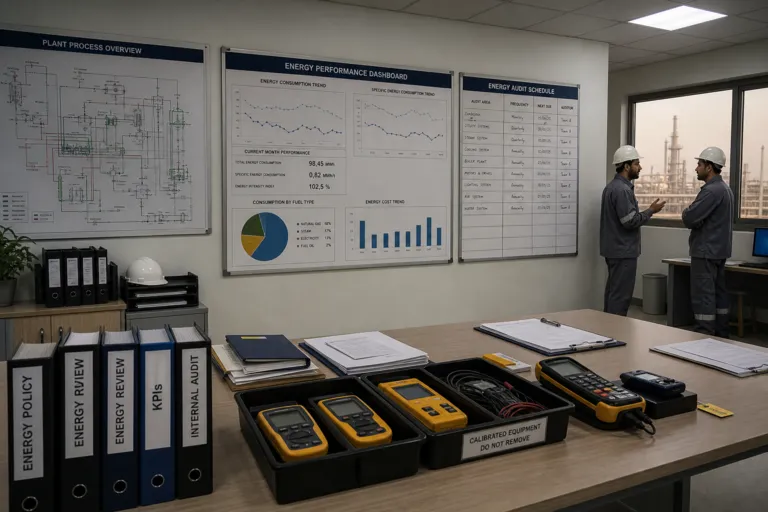
In Saudi Arabia, energy efficiency is a rising priority for businesses and institutions as operational demands grow across sectors such as manufacturing, construction, oil and gas, logistics, healthcare, and commercial facilities. Multiple Saudi-focused sources describe a common pressure: organizations are expected to improve operational efficiency, minimize energy usage, and show environmental responsibility to customers, shareholders, and regulators. ISO 50001 fits this need by providing an international framework for an Energy Management System (EnMS) that helps organizations enhance energy efficiency, decrease energy consumption, optimize energy use, and lower costs through better energy planning and monitoring.
At a practical level, ISO 50001 is designed around organized processes rather than one-off projects. Saudi guidance sources emphasize core elements such as creating an energy policy aligned to organizational objectives, identifying significant energy uses, setting quantifiable energy goals and targets, and monitoring and analyzing energy performance over time. They also highlight operational controls for efficiency and continuous improvement as essential features. This is why many organizations treat ISO 50001 as a management tool as much as a technical one: it links energy data to decision-making, and it builds routines that make energy performance visible and governable.
What ISO 50001 Looks Like in a Saudi Implementation
A Saudi-based example in the literature is an ISO 50001-compliant EnMS implemented at the Saudi Standards, Metrology, and Quality Organization (SASO) across three sites in Riyadh, Jeddah, and Dammam. The review describes methods that included energy audits, implementation procedures, and performance dashboards supported by data analysis and statistical regression. It also notes real-time data visualization using Power BI dashboards and reports measurable improvements across KPIs, including energy consumption per kilogram of production decreasing steadily, alongside better control of energy costs despite market volatility. The same study frames benefits in both business terms (cost savings) and environmental terms (reductions in CO2 emissions), while also discussing challenges to implementation.
For organizations planning ISO 50001 energy management in Saudi Arabia, several sources converge on a clear sequence. Start with senior management commitment so the energy policy is not isolated from business priorities and, where relevant, Saudi Vision 2030 sustainability goals such as reducing carbon footprint. Then conduct a comprehensive energy review to identify current energy uses and pinpoint opportunities for improved performance. Define energy benchmarks and measurable Energy Performance Indicators (EnPIs) or KPIs, and use data to track progress and guide action plans. Maintain governance through internal audits at least annually and regular management reviews, and then complete an external certification audit by an independent third party when the EnMS is ready.
ISO 50001 is positioned in Saudi sources as relevant for organizations of many types, including manufacturing and heavy industries (such as textiles, cement, and steel) and large commercial buildings (such as shopping malls and corporate offices). Beyond internal efficiency, the cited benefits include improved compliance with environmental regulations, stronger credibility with customers and stakeholders, and better operational performance that can help attract investors. International context also reinforces the business case: one reviewed analysis notes global ISO 50001 adoption in the data center sector remains below 15% despite significant cost and compliance advantages, illustrating that the opportunity is often less about awareness and more about execution and removing barriers.
What is ISO 50001 and what does it help Saudi organizations do?
What did the SASO case study in Saudi Arabia report after ISO 50001 implementation?
Which steps are commonly recommended to implement ISO 50001 in Saudi institutions?
Which organizations in Saudi Arabia are good candidates for an ISO 50001 Energy Management System?
How does ISO 50001 energy management in Saudi Arabia support credibility and compliance?
Talk to us for your needs in:
-
Energy Efficiency Strategy & Feasibility
-
Renewable Energy Strategy & Investment Advisory
-
Digital Energy & Smart Grid Strategy
-
Market Entry Strategy
-
Sustainability & Impact Strategy
-
Energy Project Governance & PMO Advisory
-
Energy Market Research
-
Energy Stakeholder & Customer Research
-
Energy Market Intelligence
-
Energy Feasibility & Investment Assessment
-
Energy Sector Benchmarking & Performance Strategy