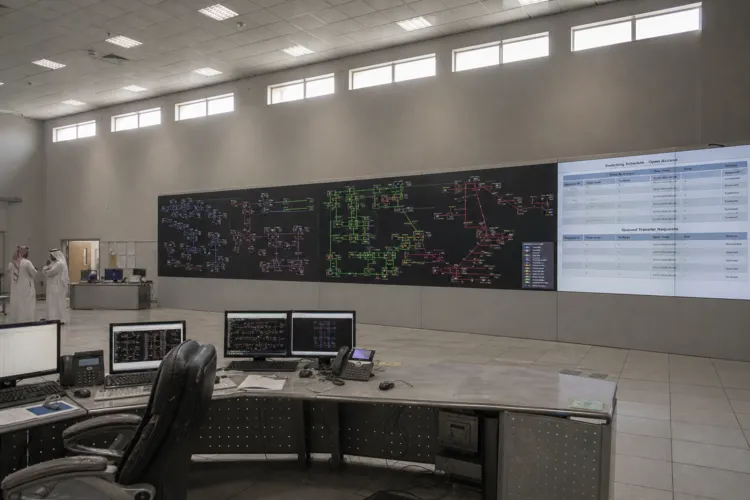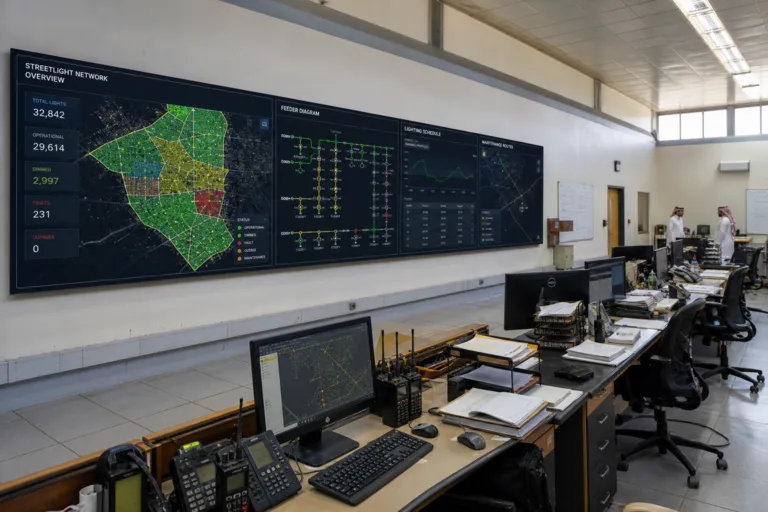
Municipal road lighting is a leading driver of smart lighting spend in Saudi Arabia, supported by nationwide street retrofit programs and procurement models that increasingly bundle supply, installation, and performance outcomes. MarkWide Research describes Saudi smart lighting as networked luminaires with embedded sensors, wireless communication modules, and centralized management platforms that enable remote dimming, occupancy response, and energy analytics. The same source notes that systems typically operate on 220–230V AC supply, with power factors exceeding 0.9, and often communicate via mesh protocols such as Zigbee or Bluetooth Low Energy. On the product side, LED street lights sit within a broader market that Custom Market Insights values at $8,975.6 million in 2024, with growth projected to $21,337.7 million by 2033 at a CAGR of 10.1%.
For cities, the retrofit case is framed around energy savings, faster maintenance response, and better visibility control. A Futurism summary of IMARC research states that government initiatives aim to replace all streetlights nationwide with LED technology, targeting a 70% to 75% reduction in energy consumption. The same source gives city-specific examples: Riyadh municipality alone upgrades over 100,000 streetlights, reducing energy use by 50%, while Makkah’s retrofit saves 70% energy and eliminates 41,000 tonnes of carbon emissions annually. These figures matter because they connect fixture replacement to measurable outcomes that municipal budgets can track. In parallel, IMARC also reports that Saudi Arabia’s LED lights market was valued at SAR 1,672.4 million in 2025, underscoring the commercial scale behind ongoing conversion programs.
Smart Controls Turn Retrofits Into Managed Infrastructure
Saudi Arabia’s retrofit wave is also shifting from “LED-only” projects to managed lighting systems. Futurism describes adaptive brightness control where AI algorithms adjust LED intensity based on ambient light, occupancy, and time patterns, cutting energy consumption by 40% across urban street lighting installations while maintaining optimal visibility. It also cites IoT-driven motion detection and cloud-based management platforms that can help municipalities save 45% on electricity bills across commercial districts. Industry Today adds a rollout datapoint: in May 2025, inteliLIGHT expanded in Riyadh by adding 50,000 remotely managed LED points and pushed Saudi Arabia’s AI-controlled streetlights above 150,000 units nationwide. Together, these examples show why municipal tenders increasingly prioritize controls, data, and remote operations as part of the asset, not as an optional add-on.
Retrofit specifications and supplier qualification are shaped by Saudi regulations as much as by technology. MarkWide notes that SASO technical regulations mandate minimum luminous efficacy and electromagnetic compatibility for imported lighting products, and that the Saudi Energy Efficiency Center enforces consumption labeling that filters low-performance imports from distribution channels. In parallel, MarkWide’s LED-focused report references SASO 2870 minimum energy performance standards and product registration requirements, while also pointing to the Saudi Building Code and municipal green building guidelines in Riyadh and Jeddah that embed LED specifications into new construction permitting. For connected street lighting, MarkWide also flags that evolving cybersecurity standards for connected infrastructure can reshape vendor qualification requirements and project commissioning timelines.
Competition for municipal projects is increasingly tied to financing models and turnkey delivery, not only luminaire performance. MarkWide states that project finance tied to energy performance contracting is fragmenting the competitive landscape for smart lighting deployment in Saudi Arabia, while municipal street retrofit mandates under Vision 2030 compress procurement timelines and encourage vendor consolidation around turnkey energy performance contracting models. It also highlights how vendors differentiate: Philips Saudi Lighting Company leverages an established local manufacturing footprint, Osram/Ledvance focuses on specialized IoT-enabled control systems, and Al Fanar Company Ltd competes through backward integration into electrical infrastructure for bundled bids. For organizations planning led street lighting Saudi Arabia retrofits, these dynamics reinforce a practical takeaway: evaluate fixtures, controls, compliance, and delivery model as one integrated scope.
What results have Saudi municipalities reported from LED streetlight retrofits?
How do smart controls improve street lighting retrofit performance in Saudi Arabia?
What standards and compliance factors affect LED and smart street lighting in Saudi Arabia?
How widespread is AI-controlled street lighting in Saudi Arabia?
What should buyers prioritize for LED street lighting in Saudi Arabia projects?
Talk to us for your needs in:
-
Energy Efficiency Strategy & Feasibility
-
Renewable Energy Strategy & Investment Advisory
-
Digital Energy & Smart Grid Strategy
-
Market Entry Strategy
-
Sustainability & Impact Strategy
-
Energy Project Governance & PMO Advisory
-
Energy Market Research
-
Energy Stakeholder & Customer Research
-
Energy Market Intelligence
-
Energy Feasibility & Investment Assessment
-
Energy Sector Benchmarking & Performance Strategy